Introduction: From Email Overload to Clear, Predictable Workflows
I learned the hard way that email isn’t a workflow—it’s an invisible queue. Approvals stalled in inboxes, priorities were set by whoever shouted loudest, and we “worked harder” without finishing faster. The turning point was making the work itself visible. Once we mapped requests and approvals on a simple Kanban board, teams finished faster without longer hours, and leaders finally saw where work actually waited.
Kanban makes work visible and predictable so teams finish faster without longer hours. Turn emails, requests, and approvals into items; email‑to‑item and approval automations remove stalls. Limit WIP (work in progress) to cut context switching; cycle time drops and SLAs (service-level agreements) stabilize. Make ownership and capacity obvious; manage by throughput and lead time so bottlenecks surface early.
Lyaxis can map this fast—explore the playbook in our newsletter; templates are there if useful. Takeaway: fewer fires, steadier delivery, more leadership time.
How Kanban Visualizes Requests and Approvals to Cut Chaos
Email hides work. Kanban turns every request and approval into a visible item, so flow—not noise—sets priorities.
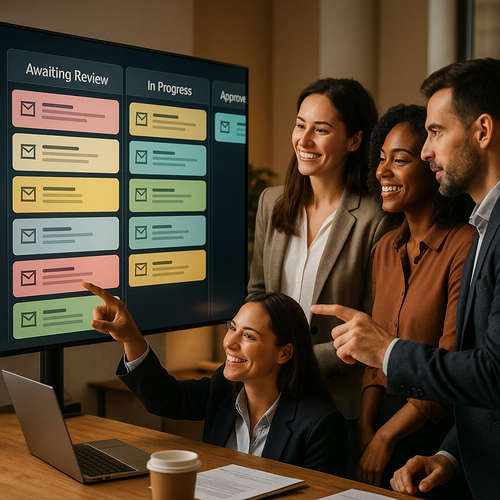
Before: a design approval sits in an inbox. After: email-to-item creates a card, routes to “Awaiting Review,” starts an SLA (service-level agreement) timer, and nudges the approver.
Mapping states and WIP (work in progress) limits reveal hidden queues and cut context switching; blockers surface early. Handoffs become explicit, approvals automated, and throughput steadies—often with double-digit cycle-time gains, no extra meetings.
Want this in your org? Lyaxis shares field-tested playbooks in a newsletter; explore a monday.com board template when it fits. Less chaos, faster finishes, same hours.
Unlocking Flow Efficiency: Reducing Cycle Time and Context Switching
- Make queues visible: convert emails, requests, and approvals into trackable items with owners; email-to-item and columns replace hidden threads.
- Protect focus: set WIP (work in progress) limits per lane, batch similar tasks, and flag blockers; fewer switches cut rework and fatigue.
- Standardize intake and approvals: templates, SLAs (service-level agreements), and approval automations move decisions out of inboxes.
- Measure and tune: watch cycle time, aging WIP (work in progress), and flow efficiency to remove bottlenecks.
Flow efficiency beats effort. Cycle time shrinks when work waits less, not when people work more. Want a pilot? Lyaxis maps this on monday.com—insight-first via CEO Brief; templates follow. Faster throughput without longer hours.
Practical Insights: Using monday.com to Automate Email-to-Work Items
Email is the biggest ungoverned queue. Turn it into a Kanban board in monday.com so work is visible, owned, and measurable.
- Email-to-item intake: captures the thread, parses fields, and routes by team or priority—no triage ping‑pong.
- WIP limits and SLA timers: surface overload early; auto‑reassign or pause intake to protect flow.
- Approval automation: nudges, escalates after set windows, and logs decisions—no silent bottlenecks.
- Templates: standardize requests, cutting back‑and‑forth and cycle time.
Lyaxis’ next flow note unpacks the pattern—insight first—with an optional monday.com starter board when it fits. Result: fewer emails, faster throughput, reliable SLAs (service-level agreements). If you want to try this setup, start a board on monday.com here: monday.com.
Building Sustainable Throughput: Leadership Relief without Longer Hours
Sustainable throughput comes from matching demand to capacity, not heroics. Kanban makes hidden queues—emails, ad‑hoc requests, approvals—visible so leaders regain predictability.
- Use email-to-item: turn every email into a trackable item; you’ll see where work actually waits.
- Set WIP limits: cut context switching; quality rises, cycle times shrink.
- Automate approvals: run them on a simple board (e.g., monday.com) to remove inbox bottlenecks.
- Tune with flow metrics: track arrival rate, WIP (work in progress), and cycle time to adjust policies, not push hours.
Lyaxis can design this cadence; our newsletter brief shows the patterns and links a monday.com template. Result: faster flow, calmer leadership time.