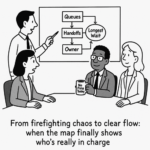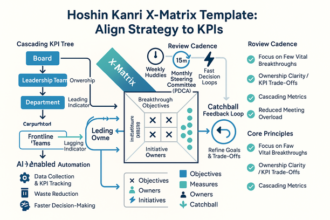
After years of leading cross‑functional teams through growth spurts and crunch times, I learned this the hard way: most “status updates” hide the real work. The turning point wasn’t a new tool or a bigger meeting—it was putting our process on the wall. Once we mapped how value actually moved, priorities snapped into focus, handoffs became decisions, and the fires started to fade. This article shares the patterns that made that shift repeatable.
Introduction: Rethinking Process Mapping as a Leadership Catalyst
Process maps aren’t paperwork; they’re a leadership catalyst. Visualizing how work moves turns noise into clear priorities and speeds confident decisions.
- Use maps as live meeting agendas — replace status theater with decisions anchored in flow and data.
- Expose handoffs and bottlenecks — name owners, SLAs (Service Level Agreements), and feedback loops so rework shrinks.
- Connect steps to OKRs (Objectives and Key Results) and customer outcomes — fund the few fixes that move the needle.
- Right‑size the method — sketch, swimlane, value stream—and set a lightweight cadence as a single source of truth.
- Teams self‑correct — leaders escape firefighting.
Want pragmatic patterns? Lyaxis’ newsletter distills field‑tested cadences—and relief.
Breaking Silos and Sparking Improvement Conversations with Process Maps
Process maps aren’t paperwork; they’re leadership instruments. They expose dependencies and turn opinions into evidence. Use them to replace siloed updates with shared, fact‑based dialogues.
- Use maps as agendas — in reviews, walk the map—not the org chart—so handoffs, waits, and rework surface fast.
- Make ownership explicit — every step has an owner, a metric, and a feedback loop tied to OKRs.
- Prioritize leverage — fix the longest waits and riskiest handoffs; ship low‑risk experiments weekly.
- Keep it light — a 30‑minute mapping pulse replaces status theater and frees leadership time.
Want patterns? Lyaxis shares pragmatic mapping heuristics in a brief newsletter—ideas you can use anywhere. Result: fewer fires, faster cross‑team flow, compounding execution.
Embedding Systems Thinking to Surface Bottlenecks and Ownership Clarity
Systems thinking turns maps into a leadership instrument, not paperwork. Follow value end‑to‑end so bottlenecks, handoffs, and fuzzy ownership can’t hide.
- Trace demand to delivery — see where work waits; measure flow efficiency, not busyness.
- Name a single owner per step and its KPI (Key Performance Indicator) — shared accountability is no accountability.
- Turn the map into your meeting agenda — discuss facts—queues, defects, rework—not opinions.
- Tie constraints to OKRs — fix root causes before scaling them.
Curious? Lyaxis shares field‑tested patterns in a brief, value‑first newsletter—gain clarity without new tools. The payoff: fewer firefights, faster lead time, and teams that self‑correct.
Designing Lightweight, Strategic Process Mapping That Drives Execution
Process maps aren’t paperwork; they’re leadership instruments that turn strategy into execution. Done right, they replace firefighting with focus.
- Anchor to outcomes — start with OKRs, map only critical handoffs, assign an owner and metric to each.
- Make it the agenda — in weekly reviews, surface bottlenecks and commit to one change and one experiment.
- Show value flow — visualize queues, SLAs, and WIP (Work in Progress); align tradeoffs across teams before they spark fires.
- Right‑size tooling — whiteboard → screenshot → lightweight tool; one source of truth, versioned by cadence.
Lyaxis shares field‑tested patterns in a value‑first newsletter—gain practical briefs, expect fewer escalations and faster cycles.
Conclusion: Unlocking Growth Through Transparent Processes and Shared Language
Transparent maps and a shared language turn firefighting into focus. They align decisions, expose friction, and make improvement a habit.
- Use maps as meeting agendas — talk flow, handoffs, and metrics against OKRs; choose the next experiment.
- Make ownership explicit — who does what, where work waits, what “done” means—rework drops.
- Adopt a lightweight cadence — 30‑minute reviews keep maps alive without bureaucracy.
- Prioritize constraints — fix one bottleneck tied to strategy; teams self‑correct, leadership gains time.
For practical patterns that stick, Lyaxis Briefings unpack the how—an insight stream, not a signup. Takeaway: clarity compounds into throughput, predictability, and growth.