Bridging the Gap from Process Maps to Reliable Automation
From years of leading transformation programs, I’ve learned that process maps are fantastic for aligning teams—but they rarely survive first contact with real systems. Hand‑offs, edge cases, and change requests pile up, and the “map” drifts from reality. What consistently closes that gap isn’t more diagramming; it’s turning intent into governed execution with safety rails, observability, and clear ownership. This article shows how to make that shift in practice.
Introduction: Bridging the Gap from Process Maps to Reliable Automation
Process maps clarify intent; they rarely survive messy systems. The gap is governance, not diagrams—turn intent into tested, traceable automation.
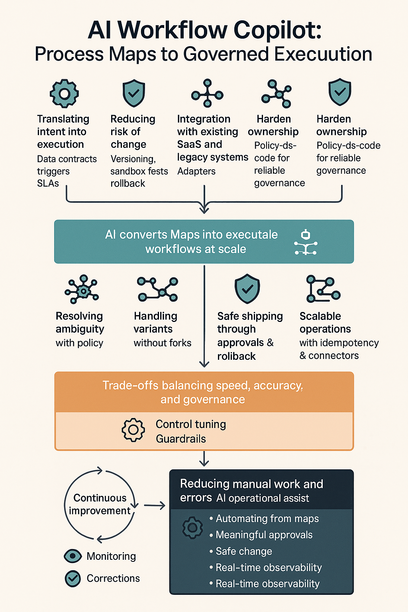
- Translate intent into execution — Translate steps into data contracts, triggers, and Service Level Agreements (SLAs) so workflows run the same way every time.
- Reduce change risk — Add versioning, sandbox tests, and rollback to cut change risk.
- Make outcomes auditable — Instrument every path for audit trails and cause‑of‑failure visibility.
- Integrate without rewrites — Integrate with existing Software as a Service (SaaS) and legacy systems via adapters, not rewrites.
- Harden ownership — Standardize ownership with policy‑as‑code to prevent brittle hacks.
See how Lyaxis operationalizes these patterns—our executive newsletter distills what to automate next and why it pays, with audit‑ready reliability.
How AI Converts Process Maps into Executable Workflows at Scale
Artificial Intelligence (AI) turns process maps into governed, executable workflows. The reward is days‑to‑deploy, fewer errors, and clear ownership.
- Resolve ambiguity with policy — It reads maps, resolves ambiguities with policy defaults, and binds steps to systems via schemas.
- Handle variants without forking — Variants and exceptions become shared modules, not forks; simulation and tests cover edge cases before go‑live.
- Ship change safely — Change is safe: versioning, approvals, rollback, observability, and audit trails are built in.
- Operate reliably at scale — At scale, idempotent tasks (safe to retry without side effects), retries, and open specs avoid lock‑in while connectors unify SaaS and legacy data.
Curious? Lyaxis’ monthly briefing distills patterns and benchmarks to de‑risk your roadmap—before any tool choice. Result: faster launches and fewer incidents.
Navigating Trade-offs: Speed, Accuracy, and Governance in Automation
Automation wins when speed, accuracy, and governance advance together. The lever is control tuning, not headcount.
- Tune risk by workflow — Set risk thresholds per workflow: auto‑approve low‑risk at high confidence; route edge cases; watch exception rate vs. cycle time.
- Control change with guardrails — Ship change safely via policy‑as‑code, versioning, canaries, and instant rollback.
- Continuously improve — Close the loop: capture corrections, retrain, and monitor drift and SLAs.
- Standardize the plumbing — Standardize triggers and data contracts; enforce idempotency and audit trails.
Lyaxis AI Copilot converts maps into governed automations with tunable controls—our field notes show where leaders gain speed without losing trust. The payoff: faster execution, fewer exceptions, and confidence at scale.
Reducing Manual Work and Errors with an AI Operational Assistant
Manual steps and brittle automations drain capacity and invite errors. An AI operational assistant turns your process maps into governed, executable workflows that remove rework and surface exceptions early.
- Automate from the map — It auto‑derives rules, triggers, and data checks from Business Process Model and Notation (BPMN), shrinking Information Technology (IT) queues and handoffs.
- Keep approvals meaningful — Approvals appear only on true exceptions, cutting cycle time while preserving control.
- Change safely, every time — Versioning, test sandboxes, and rollback keep changes safe and auditable.
- See the impact in real time — Real‑time observability quantifies error rates and SLA impact across tools.
For the playbook, skim the Lyaxis Operator Notes newsletter—practical briefs on turning maps into automation without lock‑in. Outcome: fewer errors, faster throughput, leaders back on strategy.
Building Trust and Control: Piloting an AI Workflow Copilot for Sustainable Growth
Pilot an AI workflow copilot to close the design‑to‑execution gap without losing control. Start small, prove value, expand deliberately.
- Translate and guardrail — Translate process maps into executable rules with human‑in‑the‑loop guardrails; exceptions route to accountable owners.
- Make performance observable — Track cycle time, error rate, SLA adherence, versioning, tests, and rollback.
- Integrate with what you have — Integrate with existing tools via open connectors to avoid lock‑in and retire brittle scripts.
- Scale by domain — Scale by domain, not department; policies travel, context stays local, compliance holds.
Want the patterns behind successful pilots? Lyaxis’ CEO (Chief Executive Officer) newsletter distills benchmarks and guardrail designs—insight first, purchase later. The payoff: faster execution, fewer errors, governed growth.