Building an Operations Control Tower for Confident Executive Oversight
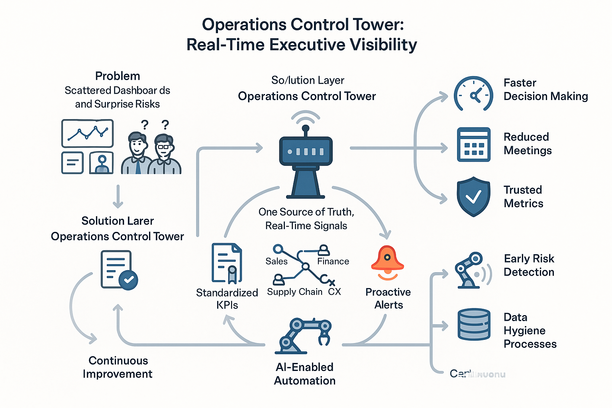
After years helping executive teams wrestle with scattered dashboards and surprise risks, I’ve learned that oversight improves most when leaders shift from hunting for answers to having a single, reliable vantage point. The most effective pattern I’ve seen is an Operations Control Tower—one place where definitions are consistent, signals are fresh, and actions are obvious. This article shares how a control tower transforms decision speed, cross‑functional trust, and operating cadence without adding meetings or micromanagement.
Introduction: Why an Operations Control Tower Transforms Executive Oversight
In high-growth ops (operations), scattered dashboards slow judgment. An operations control tower gives real-time line-of-sight, compressing time-to-clarity and surfacing risk early.
- Before: sales shows green while finance sees amber. After: one source of truth for pipeline, margin, and cash, aligned to shared definitions.
- A 9 a.m. churn spike triggers action by noon, not in next quarter’s review.
- Solve the constraint: standardize KPI (key performance indicator) definitions and data contracts; governance restores trust.
- A simple cadence—weekly tower review—replaces ad-hoc fire drills and extra meetings.
Want the patterns? Lyaxis maps proven control‑tower designs in a short newsletter brief. Outcome: fewer meetings, faster calls, earlier risk detection.
Breaking Silos: Achieving Unified, Real-Time KPI Visibility Across Departments
When finance’s runway, sales pipeline, supply risk, and CX (customer experience) backlog share one live view, you debate actions—not numbers. A Control Tower makes latency visible, owners explicit, and definitions consistent.
- One heartbeat per KPI with freshness stamps ends report roulette.
- Leading indicators cross-link: pipeline quality + inventory turns + SLA (service level agreement) risk forecast revenue and churn.
- Single accountable owner per metric; changes logged; meetings shrink.
- Materiality-based alerts cut noise and trigger pre-agreed plays.
- Start small: the solvable constraint is defining latency and ownership.
Lyaxis maps heartbeat, ownership, and shared definitions—gain the patterns via our newsletter. Faster calls, fewer meetings, durable trust.
Sharper Decisions, Fewer Meetings: Leveraging Leading Indicators and Data Hygiene
Decisions accelerate when dashboards move from lagging snapshots to predictive signals backed by clean pipelines. Meetings shrink; updates are obvious.
- Pick a few leading indicators per motion (lead velocity, pipeline health, ticket aging) tied to outcome deltas and thresholds.
- Standardize KPI owners, sources, freshness SLOs (service level objectives), and validation; broken tests pause charts, not judgment.
- Reduce noise: group alerts by materiality and trend, not spikes.
- Mini-scenario: skip MQL (marketing-qualified lead) debates—lead-coverage ratio prompts a staffing pivot days earlier.
For patterns, Lyaxis’ newsletter shares indicator picks and hygiene guardrails; when useful, a Control Tower template and vetted partners follow. Result: faster choices, fewer meetings, trust.
Governance and Alignment: Standardizing Metrics to Build Trust and Accountability
Control towers fail when metrics drift across teams. Lightweight governance makes KPIs (key performance indicators) contracts, not opinions.
- One definition per KPI, with an owner and version history, ends debates and shortens meetings.
- Contracted lineage—sources, transforms, SLAs (service level agreements)—means alerts trigger only when agreements break, not when dashboards wobble.
- Role-based access clarifies who sees what; execs get rollups, operators get drill‑downs; controls, not gates.
- Leading indicators live in the contract with thresholds and review cadence, so risk surfaces early.
Lyaxis maps these minimal contracts; our newsletter distills the patterns before tooling choices. Net: faster, trusted decisions and shorter, calmer reviews.
Scaling Oversight Without Micromanagement: Establishing Reliable Cadences and Proactive Alerts
Oversight at scale comes from reliable cadences and signal-driven alerts, not more meetings. A Control Tower turns noise into early warnings and focused rituals.
- Anchor a weekly review to a single KPI glossary; debates end, decisions accelerate.
- Set thresholds on leading indicators—capacity, cycle time, pipeline health—to trigger pre-reads, not fire drills.
- Route alerts with owner, context, and next best action; leaders see exceptions only.
- Visualize handoffs (lead-to-cash, ticket-to-resolution) so SLA (service level agreement) risk appears before customers feel it.
For a practical blueprint, Lyaxis offers a short newsletter distilling patterns—and can stand up the Control Tower. Takeaway: calmer oversight, faster decisions, intact autonomy.