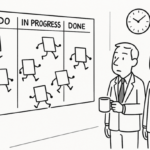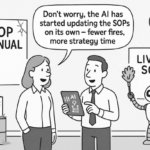
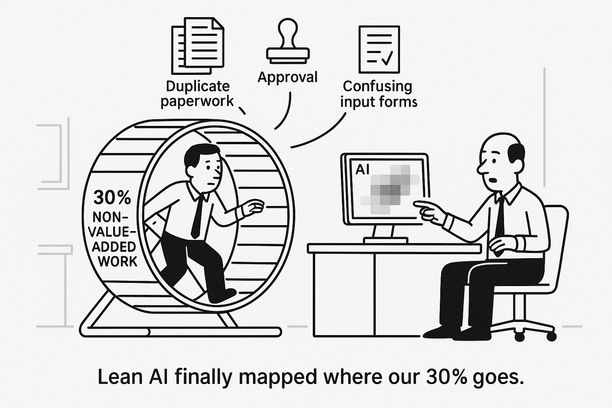
I’ve sat with growth-stage teams who felt their days were packed yet progress lagged. In retrospective after retrospective, the pattern repeated: work stalled in approvals, the same status was entered in three tools, and defects traced back to unclear inputs. When we paired Lean practices with AI (artificial intelligence) signals, those opaque workflows turned into a measurable map of waste—and momentum came back without adding headcount.
Introduction: Unlocking Hidden Waste with Lean-Aligned AI Insights
Lean + AI turns opaque workflows into measurable waste maps. Most growth-stage firms carry ~30% non‑value work hidden in delays, rework, and approvals.
- Instrument value streams
Timestamp reality, not opinions; expose wait time, handoff friction, and rework hotspots by product. - Quantify duplicates
Find double entry across tools and approvals that add risk without control; retire steps with evidence. - Lift first‑time‑right
Link defects to unclear inputs; improve specs and feedback loops to cut loops and cycle time. - Simplify with guardrails
Use policy‑as‑code (policies encoded in software for automatic enforcement) to keep compliance intact while flow speeds up.
Explore the Lyaxis newsletter for patterns and low‑risk pilots that compound margin.
Spotlight on Waste: How AI Illuminates Duplicate Work and Approval Bottlenecks
AI turns messy activity logs into a heatmap of waste, flagging duplicates, approval creep, and slow queues before they stall delivery. Done well, it removes 20–30% non‑value work with minimal disruption.
- Duplicate fingerprints
Expose copy‑paste tasks and rework; effort and cost become visible. - Approval depth
Pinpoint steps that add delay without catching defects. - Queue health
Highlight wait/work ratios and aging items starved by handoffs. - First‑time‑right signals
Trace defects to unclear inputs, removing steps safely.
Borrow the Lyaxis newsletter signal lists to pilot quietly and surface high‑ROI (return on investment) wins. Result: shorter cycles, lower risk, and leadership time back.
Transforming Rework and Cycle Times: The AI Edge in Process Intelligence
AI process intelligence turns opaque work into margin. It isolates rework drivers and predicts cycle times before you change anything.
- Surface non‑value‑added tasks
Identify ~30% hidden waste—duplicate entry, redundant handoffs, and approval creep—without new headcount. - Simulate Lean‑aligned tweaks
Model policy changes and staffing shifts to see first‑time‑right and risk impacts before you commit. - Quantify which approvals to drop or automate
Make decisions with auditable traces. - Replace status chasing
Use live baselines and ROI your board can trust.
Where is your 30% hiding? The Lyaxis newsletter shares field‑tested heuristics you can use today—tools come later. Outcome: faster flow, fewer surprises, stronger margins.
Fast-Tracking Impact: Prioritizing High-ROI AI Interventions to Scale Without Headcount
Scale by removing waste, not adding headcount. The fastest wins come where friction is high and variation low.
- Triage by ROI × risk × effort
Target duplicate entry, approval creep, and rework loops—often 30%+ non‑value work. - Instrument Lean baselines
Track cycle time, first‑time‑right, and handoff latency; let assistants cut status chasing and streamline approvals with guardrails. - Pilot with 2–3 teams
Fix integrations to stop redundancy, then scale when cost per outcome drops and auditability holds. - Adopt calmly with proof
Use newsletter scorecards and before/after patterns to spot your top three interventions this quarter.
Outcome: shorter cycles, higher margins.
Building Lasting Momentum: Creating a Lean AI Practice for Continuous Operational Excellence
Momentum sticks when wins become a Lean AI practice. Process intelligence exposes duplicate work, approval creep, and rework—often 25–35% of effort—so you cut waste without adding headcount.
- Shared standards
Make data comparable and audits simple; “done” becomes unambiguous. - Lightweight governance
Speed decisions with risk‑tiered controls, auto‑evidence, and clear owners. - Outcome loops
Track first‑time‑right and cycle time; trims follow facts, not opinions. - Upskill operators
Teach teams to read logs and fix prompts; leaders regain focus.
For practical templates and metrics, the Lyaxis newsletter shares what works—no pitch. Result: faster flow, fewer handoffs, higher margins.