Transforming Ops Communication with monday.com
I’ve led ops (operations) teams that tried to run on email. The pattern was always the same: requests buried in threads, people guessing at ownership, and leaders jumping in late to put out fires. Moving our conversations onto monday.com turned that chaos into a shared, trackable workflow—without adding headcount.
Email scatters ops work; monday.com makes it a shared, trackable workflow. Expect fewer fires, faster answers, clear ownership.
- Single source of truth: Replace threads with items holding context, files, and updates on the task.
- Accountability by default: Every request gets an owner, due date, and SLA (service level agreement); automations route by priority.
- Faster response: Triage queues and reminders prevent slips; Slack/Email sync logs conversations to the item.
- Measurable ops: Dashboards surface throughput and bottlenecks; the audit trail speeds handoffs and compliance.
The payoff: quicker resolutions and leadership time back.
From Email Chaos to Clarity: Centralizing Task-Based Conversations
Email hides ownership and context, spawning delays and duplicate threads. Centralizing conversations in monday.com turns every request into a trackable task.
- Standardized intake auto-routes to the right board, assigns an owner and due date, and sets priority.
- Discuss, attach files, and record decisions on the item so nothing lives in CC (carbon copy)s.
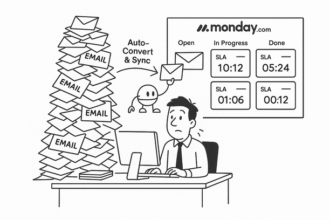
- SLA (service level agreement) automations time-stamp first response/resolution and escalate before breaches.
- Email/Slack convert to items; duplicates merge; status updates notify stakeholders.
Net: faster responses, clean handoffs, real metrics.
Ensuring Ownership and Speed: Automated Routing and SLA Tracking
Email threads hide ownership and slow decisions. Automated routing and SLA tracking in monday.com give every request an owner, clock, and path to done.
Structured intake auto-tags by team, priority, and customer impact, assigning an owner and due date. SLA timers drive response and resolution, pausing on customer waits and escalating in Slack before breach. Dashboards surface what’s due, why it matters, and where leaders can unblock. Threaded updates replace emails and create a searchable audit trail.
Result: fewer fires, faster cycles, proof of performance.
Streamlining Intake and Handoffs for Reliable Request Management
Email isn’t a system; it’s a leak. Standardized intake on monday.com turns scattered asks into trackable work.
- Forms + rules capture the Who/What/When and auto-route by priority and SLA (service level agreement). Fewer back-and-forths, faster first response.
- Each request gets owner, due date, and status. Stakeholders see progress without pings.
- Handoffs use required fields and checklists. Nothing advances without the essentials.
- Email/Slack sync to items. Every decision is searchable with an audit trail for compliance and onboarding.
Building Scalable Ops Workflows that Free Leadership Time
Email threads bury ownership and slow decisions; modular, monday.com-based ops turn every request into a task with owner, due date, and SLA.
Centralized intake auto-routes by priority and queue, ending inbox triage. Task-based communication keeps context on the item; Slack/email sync creates a searchable audit trail. Reusable automations standardize approvals and escalations; dashboards surface SLA risk and throughput. Leadership roll-ups expose blockers and capacity, replacing status meetings with targeted coaching.
Impact: faster cycle times, fewer meetings, and reclaimed executive hours—without adding headcount.
Want templates, field-tested boards, and rollout patterns? Browse the Lyaxis newsletter for practical monday.com playbooks and teardown insights: https://lyaxis.com/category/newsletter/