I used to wear a packed calendar like a badge of honor—every 30 minutes booked, every channel buzzing. It felt like momentum, but my results weren’t compounding. The breakthrough came when I started visualizing where my time actually went. Seeing red clusters of reactive work and the specific decisions waiting on me turned busyness into clear, fixable flow. What follows are the practical visuals, metrics, and habits that helped me trade hustle for leverage—and create more impact with fewer burnt-out weeks.
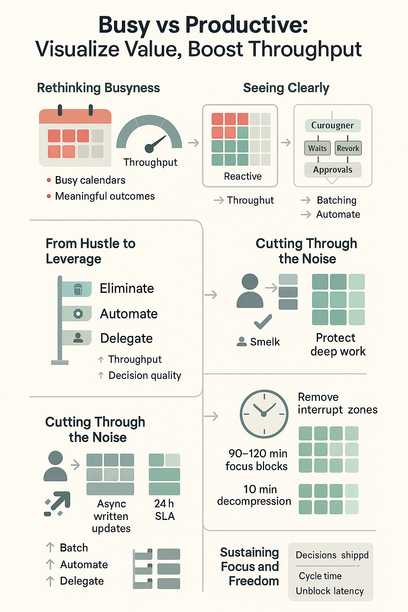
Rethinking Busyness: Why Activity Doesn’t Equal Impact
Busy calendars impress; activity is vanity—impact is throughput, decisions, and learning speed. Throughput is the rate of meaningful outcomes completed per week, not hours logged. Decisions move strategy, and learning speed compounds advantage.
Busyness isn’t output. Map your week to see where attention leaks and value compounds. Track weekly throughput and decision latency (how long decisions wait for you), not hours; context switching taxes focus and quietly drains momentum.
Busyness masks fragility; leverage compounds. Visualize work to surface asymmetric bets—and cut the grind. Are you compounding or just consuming hours?
Seeing Clearly: Visualizing Where Leadership Time Truly Goes
When you can see where time turns into value, it becomes easier to prune noise and feed throughput. A few simple visuals make the invisible obvious:
- Calendar heatmaps: compare time vs revenue or risk removed; prune low-yield meetings. Read your calendar heatmap: if red clusters lack an owner, a decision, or a deliverable, it’s busywork. Turn your calendar into a heatmap: red for reactive, green for creation. A chief operating officer (COO) saw Mondays glow red with status calls; one green block moved revenue.
- Value stream maps: reveal waits, rework, and approvals that starve throughput; fix the bottleneck. Map the value stream from customer signal to cash and compress steps that don’t cut cycle time (total time from request to delivery).
- Interruption maps: tally context switches; then batch, automate, or delegate high-variance tasks that fragment attention.
From Hustle to Leverage: Prioritizing High-Impact Tasks with Visual Tools
Use a leverage ladder to move yourself and your team up the curve. Rank work by reach × repeatability × durability; then deliberately shift time into higher-leverage layers.
- Eliminate: stop low-yield activities that don’t move cycle time or outcomes.
- Automate: script, template, or systematize recurring steps so they happen without you.
- Delegate: push ownership—and decision rights—to the right level with clear success criteria.
- Guard deep work: reserve intact blocks for pivotal bets and trajectory-changing decisions.
Climb a leverage ladder: protect decisions that change trajectory; automate or delegate the rest. Tie time blocks to outcomes—pipeline, retention, hiring quality—not replies. Track weekly throughput and decision latency so your metrics reward impact, not motion.
Cutting Through the Noise: Reducing Meeting Bloat and Context Switching
Busy isn’t productive; throughput comes from intact attention. Most bloat is mis-sized decisions and unbatched contexts. Context switching can cut throughput by 20–40%—treat it like a hidden tax.
- Right-size meetings: convert status to asynchronous (async) updates with a 24‑hour service-level agreement (SLA); reserve time for decisions and cap at 25/50 minutes.
- Default to written debate: crisp briefs beat meandering calls. One COO cut 14% of calendar hours by halving recurring meetings and moving status async.
- Batch context with a heatmap: stack sales, group hiring, and protect deep-work blocks to minimize task switching.
- Map value to flow: sketch idea → customer → revenue and cut steps that don’t move it; use a leverage ladder to delegate or automate the rest.
Sustaining Focus and Freedom: Protecting Deep Work and Balancing Recovery
Busyness mimics progress; deep work plus recovery creates it. Protect both and output rises without longer hours.
- Sprint, then reset: work in 90–120‑minute focus blocks, then take a 10‑minute decompression. One chief executive officer (CEO) batched approvals twice weekly and reclaimed strategy time.
- See value, not meetings: calendar heatmaps expose interrupts; remove or redesign the red to defend your green creation blocks.
- Map leverage simply: note where you decide, design, or do—then delegate or automate the rest so your time skews to “decide.”
- Track real outcomes: count decisions shipped, cycle time, and unblock latency (how long work waits on you)—not message count.
Less motion, clearer flow—fewer burnt-out weeks. If you want calm, visual ways to reclaim leadership time—heatmap templates, leverage ladders, and lightweight automations—the Lyaxis newsletter curates field-tested visuals and prompts you can apply immediately.