I first stumbled into Kanban out of necessity. My team’s “invisible” office work kept derailing deadlines and onboarding took weeks of handholding. Once we put our work on a board, set a few light policies, and measured flow, two things happened fast: the firefighting cooled and new hires shipped value in days. This post distills what worked—practical, low-burden moves any knowledge team can adopt.
Introduction: Why Kanban Empowers Lean Office Workflows
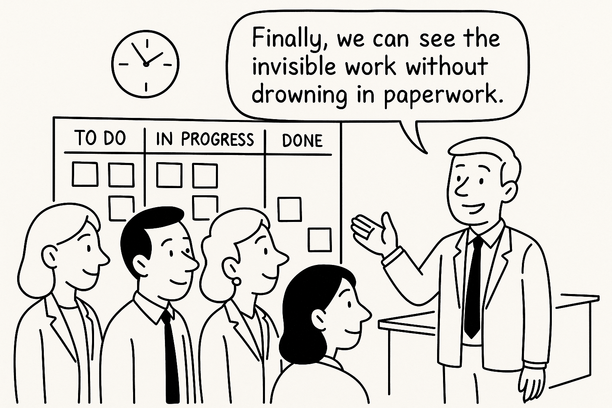
Kanban makes invisible office work visible and manageable. It creates predictability without bureaucracy, so teams deliver faster and onboard with less handholding.
- Visualize work: A simple board exposes ownership, blockers, and handoffs—no more surprise pileups.
- Limit WIP (Work in Progress): Fewer concurrent tasks shortens lead time and raises quality.
- Standardize lightly: Clear policies become living “how we work,” not dusty SOPs (Standard Operating Procedures).
- Measure flow: WIP, lead time, and throughput reveal true bottlenecks.
- Enable autonomy: Teams pull work; leaders exit firefights.
For a low-burden start, the Lyaxis brief surfaces quick insights; Impruver University helps habits stick. Net result: steadier throughput, fewer escalations.
Building Repeatable Processes Without Bureaucracy: Kanban in Knowledge Teams
Kanban gives knowledge teams just-enough structure to make work repeatable without red tape.
- Policies, not police: Define Ready/Done and pull criteria so work stops bouncing and approvals shrink.
- Checklists in the card: Templates capture tribal know-how as quality gates, not binders.
- Cadence beats status: Daily flow check and weekly replenishment replace status meetings; risks surface early.
- See flow, fix flow: WIP caps and lead-time trends expose bottlenecks and lift predictability.
Curious? Lyaxis’ newsletter unpacks boards you can adapt—insight, not pitch. For staying power, coaching like Impruver University helps habits stick. Takeaway: predictable delivery, faster onboarding, less firefighting—without bureaucracy.
Visualizing Flow and Bottlenecks: Making Work and WIP Limits Visible
Invisible work breeds silent queues; making flow and WIP (Work in Progress) visible steadies throughput and speeds onboarding.
- Boards that mirror value: Map work types and classes of service so priorities and ownership are obvious.
- Explicit WIP limits: Cap in-progress per column; fewer starts, faster finishes; leaders see true bottlenecks.
- Aging and flow signals: Flag items past expected cycle time and track WIP, lead time, throughput, and cumulative flow to trigger rebalancing early.
Curious what to watch? Lyaxis shares a brief on the few signals that matter—plus a nudge toward Impruver University to make habits stick. Net: steadier delivery, lighter oversight.
Accelerating Onboarding and Predictable Delivery with Standard Work
Standard work should remove guesswork, not add bureaucracy. Lightweight templates, checklists, and crisp Ready/Done with Kanban turn tribal knowledge into predictable flow.
- Make work visible: One Kanban shows ownership, WIP (Work in Progress), and blockers early.
- Faster onboarding: Plug-and-play templates let newcomers ship in days.
- Predictable delivery: WIP limits and lead-time trends set honest timelines.
- Continuous improvement: Capture tweaks; reinforce with coaching (e.g., Impruver University).
Looking for a clear starting map? Lyaxis highlights what to standardize now versus leave flexible—in a no-fluff newsletter brief you can skim over coffee. Outcome: steadier forecasts, faster ramps, and leaders out of firefights.
Sustaining Improvement and Scaling Discipline: From Small Wins to Lasting Change
Small wins fade without structure. Use Kanban as a lean playbook to lock in predictability.
- Cadence, not heroics: Brief standups and weekly flow reviews surface stuck work early and end status churn.
- Feedback loops: Clear policies and a crisp Definition of Done lift quality and onboard hires faster.
- Right-sized metrics: WIP (Work in Progress), lead time, throughput per workflow reveal bottlenecks without blame.
- Standard work as guardrails: Simple templates capture tribal knowledge while preserving autonomy.
Lyaxis can map your flow and tune minimal signals; our newsletter shares what works, with Impruver University to help it stick. Outcome: steadier delivery, faster onboarding, less firefighting.