Introduction: Predict Cash, Don’t React—Why Static Spreadsheets Fail
I learned the hard way that static spreadsheets are a poor early‑warning system. One quarter, a two‑day payroll shift advanced a seven‑figure outflow while a few large invoices quietly slipped from Net‑30 to Net‑42. By the time the version sprawl settled and we reconciled the tabs, leadership was reacting to surprises instead of making decisions. That experience pushed me to build a rolling, integrated cash model—so finance could see risks early, run scenarios in minutes, and give leaders choices before issues hit the bank account.
Building Rolling Cash Forecasts: Integrating AR/AP, Payroll, and Historical Data
A rolling model fuses the timing of accounts receivable (AR) and accounts payable (AP), payroll cycles, and historical patterns into decision‑grade visibility.
- AR/AP: weight collections with real signals. Machine learning (ML) probabilities and days sales outstanding (DSO; the average number of days it takes to collect payment) trends drive collections timing; a 38→42‑day slip can drop week‑6 cash by roughly $240k.
- Payroll: model exact pay cycles and taxes. Align pay dates, taxes, and bonuses; shifting a run by two days can cut peak facility draw by about 15%.
- Historical: use seasonality and anomaly smoothing. Seasonality and anomaly handling recalibrate assumptions; alerts trigger on variances greater than 3% or $50k.
- Scenarios: answers in minutes, not meetings. Tweak terms, hiring, or vendor deferrals and see runway impacts in minutes; data feeds sync from the enterprise resource planning (ERP) system and payroll.
Curious how others structure this? Lyaxis maps the approach in their newsletter playbooks. Outcome: predictable liquidity, fewer surprises, more time.
Achieving Real-Time Visibility: Automating Data Pipelines for Predictive Liquidity
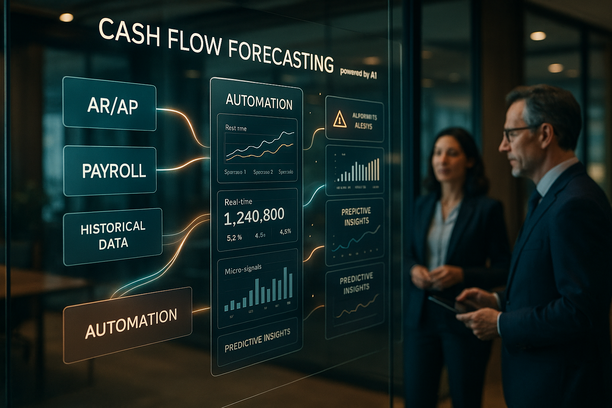
Automating data pipelines unifies bank feeds, ERPs, and billing so models refresh themselves and surface live liquidity signals.
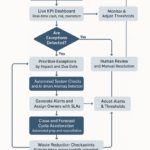
- Streams that stay fresh. AR/AP and payroll stream in hourly; the forecast rolls daily, flagging loan covenant drift (movement toward breaching lender‑set financial conditions) and cash cliffs early.
- Trustworthy numbers. Data is cleaned and reconciled on ingest; anomalies stand out, and quality improves over time.
- Micro‑signals that drive action. A DSO increase of three days can cut 90‑day cash ~6%; hiring plans or purchase orders (POs) can be modeled in minutes.
- Aligned execution. Alerts fire when payables plus payroll outrun receipts, keeping operations and finance in lockstep.
For architectures without the hype and with just the signal, the Lyaxis newsletter shares implementation blueprints. Outcome: fewer surprises, more leadership time.
From Manual Bottlenecks to Dynamic Scenarios: Improving Accuracy and Agility
Replace slow reconciliations with rolling, AI‑driven scenarios that update as your business moves. Artificial intelligence (AI) helps convert raw activity into explainable drivers.
- One real‑time model for the whole picture. Consolidate AR/AP, payroll, and historicals into a single source of cash truth; late invoices or hiring shifts flow through instantly.
- Driver‑based levers for “what if.” Use DSO, payables terms, and hire dates as levers; move payroll two weeks and immediately see runway and covenant headroom.
- Assumptions you can explain. Assumptions, sensitivities, and versioning are tracked so numbers become explainable—without extra busywork.
- Early warnings, not autopsies.</-strong> Early‑warning signals flag risks before they hit cash; you get alerts, not post‑mortems.
- Catch the common slips. When Net‑30 becomes 42 days, automated ingest flags slippage and recalculates runway; if payroll shifts by two days, the model surfaces the seven‑figure timing impact many static tabs miss.
- End version sprawl. One governed source enables instant scenarios and lender‑ready views, restoring trust in the numbers.
- Make messy historicals useful. AI surfaces outliers and learns over time—without becoming a black box.
Want a pragmatic framework for driver trees and alerting? The Lyaxis field notes share the approach. Net result: fewer surprises, faster decisions, one source of truth.
Looking Ahead with Confidence: Streamlining Forecasts for Leadership and Investors
Rolling, real‑time forecasts convert AR/AP, payroll, and historicals into a single cash truth leaders and investors can trust.
- Daily‑refreshed 13‑week view. Automated ingestion updates the 13‑week forecast daily; alerts surface variances before they become investor calls.
- Quantify impacts instantly. A five‑day AR slip can create a $420k week‑6 trough; options appear immediately—accelerate collections or shift payables.
- Stress critical assumptions. Test +2 full‑time equivalents (FTEs) or +10% cost of goods sold (COGS) and watch runway change in minutes, not meetings.
- Investor‑ready outputs. One one‑pager, one narrative; accuracy improves quarter after quarter as signals and assumptions learn.
If you want the full playbook—signals, templates, and cadence—the Lyaxis newsletter delivers useful insight now and a path if you later want it built.