Introduction: Why Being Busy Doesn’t Equal Being Productive
Some of my busiest weeks produced the least progress. My calendar was full, my inbox overflowing—yet the metrics that mattered barely moved. The lesson was painful and clear: a full calendar isn’t a leading indicator of growth. Productivity is measured by outcomes shipped, not hours filled. The CEO’s job is to convert time and attention into compounding impact with the least possible coordination cost. Here’s the operating system that helped me (and the teams I work with) make that shift.
- Anchor work to outcomes. Tie every project to a clear OKR (Objectives and Key Results), leading indicators, and an exit criterion (for example, “increase qualified pipeline by 15% via X”). If an item has no owner, metric, or date, pause it. Review weekly and cull low-signal activity.
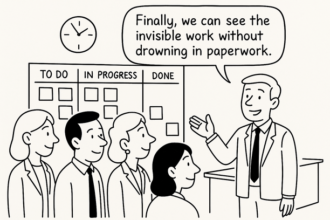
- Visualize flow and limit WIP. Stand up a single Kanban board (for example, in monday.com) as the source of truth for priorities, status, and dependencies. Set WIP (work in progress) limits by team/role to cut context switching and unblock throughput; finish before starting. Use priority lanes and explicit policies for “ready,” “doing,” and “done.”
- Prioritize by impact/effort and time-to-value. Score backlog items on expected revenue/retention lift, strategic fit, effort, and risk. Fund the few highest-leverage bets; kill or park the rest. Protect a fast lane for high-ROI (Return on Investment), small bets that can ship this week.
- Cut coordination overhead, protect focus. Replace status meetings with async updates and live dashboards (cycle time, throughput, blockers, forecast). Standardize handoffs with checklists and SLAs (Service-Level Agreements). Redesign calendars: 2–3 daily focus blocks, meeting-free mornings, and batched decision windows.
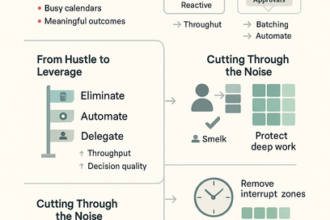
- Automate and delegate repeatable work. Use automations for handoffs, approvals, updates, and nudges. Templetize recurring projects; assign clear ownership (RACI: Responsible, Accountable, Consulted, Informed) and due dates. Leaders review dashboards, make decisions, and remove blockers—without chasing status.
Takeaway: Busy is a cost; productive compounds value. Make work visible, enforce WIP limits, prioritize by ROI, and automate coordination so teams ship measurable outcomes faster—with less burnout.
Visualizing and Prioritizing Value-Producing Work for Maximum Impact
Start by centralizing and visualizing all work so decisions are made on signal, not noise.
Centralize and visualize all work. Stand up a single board (for example, in monday.com) with fields for owner, due date, OKR link, customer outcome, leading indicator, effort (S/M/L), impact (1–5), status, and dependencies. View it as a Kanban by stage to expose bottlenecks and hidden queues. This becomes the source of truth.
Prioritize by value, not noise. Use a simple, defensible score: WSJF (Weighted Shortest Job First) = (Business Value + Time Criticality + Risk Reduction/Opportunity Enablement) ÷ Effort. Score 1–5 for each dimension; pick the top 3–5 initiatives per team. Re-score weekly in an ops review; kill or park low-scoring work.
Protect flow with WIP limits. Cap strategic WIP to 1–2 initiatives per leader and 3–5 per team. Enforce pull-based work; no new starts until something finishes. Move status to async updates tied to the board and reserve meetings for decisions. Per Little’s Law (Cycle Time ≈ WIP ÷ Throughput), lower WIP shortens cycle time and increases throughput without longer hours.
Automate handoffs and low-value tasks. Trigger next-owner assignment on status change, auto-update stakeholders, sync commits/tickets/CRM (Customer Relationship Management), and generate rollups. Route all new requests through an intake form that captures impact, effort, and OKR alignment; auto-reject misaligned work.
Instrument outcomes, not activity. Build a dashboard with cycle time, throughput, percentage of work aligned to OKRs, blocked items, and forecasted value delivered. Track leading indicators (for example, qualified demos, adoption, churn-risk mitigations) and tie them to financial outcomes.
Takeaway: When every task is visible, scored, and flowing with automation, you free leadership time, reduce burnout, and concentrate capacity on the few bets that move the business.
Implementing WIP Limits and Scoring Frameworks to Boost Team Focus
WIP limits paired with objective scoring frameworks shift teams from starting more to finishing faster, with fewer handoffs and clearer trade-offs.
- Map and cap WIP to cut cycle time. Visualize your value stream (Intake → In Progress → Review/QA [Quality Assurance] → Done) and set column limits: In Progress ≤ team size; Review ≤ 50% of team size; Blocked counts against limits. Use Little’s Law (Cycle Time ≈ WIP ÷ Throughput) and reduce WIP until cycle time stabilizes. Policies matter: pull, don’t push; no new starts until something is finished.
- Score work objectively to align to OKRs. Use RICE (Reach × Impact × Confidence ÷ Effort) for growth/features. Suggested scales: Impact = 0.25, 0.5, 1, 2, 3; Confidence = 0.5–1.0; Effort in person-weeks. Use WSJF (Weighted Shortest Job First) for platform/ops: WSJF = (Business Value + Time Criticality + Risk Reduction) ÷ Duration. Tie scores to OKRs so only top-scoring, outcome-linked work enters “Ready.”
- Operationalize in monday.com. Create a central board with WIP counters per column, RICE/WSJF fields, and a formula to compute scores. Automations: when a WIP limit is hit, prevent status changes to In Progress; auto-sort “Ready” by score; alert on aging items beyond X days; roll up to OKR dashboards showing throughput, cycle time, and value delivered.
- Protect focus and manage intake. Route all requests through an intake form that assigns an owner and triggers scoring. Limit active work per person to 1–2 items. Reserve maker-time blocks; cap expedited work at 10% with explicit policy.
- Measure what matters. Track leading indicators: WIP, cycle time, throughput, aging WIP, and flow efficiency. Review weekly in a 30-minute async-first cadence; adjust WIP and scoring thresholds based on data.
Takeaway: Cap work, score objectively, and automate the flow to get faster, more predictable delivery and a shared source of truth that frees leadership time and reduces burnout.
Leveraging Automation and Work Management Platforms to Free Leadership Time
Automation and a single, visual work hub eliminate status chasing and scattered updates so leaders reclaim time for coaching, strategic decisions, and revenue-critical work.
Identify and score automation candidates. Build an “automation hit list” by ranking recurring tasks on frequency and rules-based complexity. Start with status pings, handoffs, data entry, report compilation, approvals, and reminders. Use an impact/effort matrix to prioritize quick wins.
Centralize execution in a platform (for example, monday.com). Create one board per value stream with standard fields: Owner, Status, Due Date, Priority, Effort, Dependencies, and linked OKR. Run Kanban with WIP limits to cut thrash. Dashboards roll up progress, bottlenecks, and throughput so leaders see status without meetings.
Replace meetings with an async operating cadence. Daily async updates replace standups; weekly dashboard reviews replace status meetings. Use SLA (Service-Level Agreement)-based alerts for blocked work and overdue items. Maintain decision logs and clear ownership to reduce interruptions and rework.
Automate the routine to remove handoffs and reporting. Examples: when CRM (Customer Relationship Management) deal = Closed–Won, auto-create delivery tasks and assign owners; when Status = Ready, auto-assign next role; if due in 3 days and Not Started, notify owner and manager; auto-generate weekly executive summaries and OKR rollups; sync comments/files to the item to reduce context switching.
Prove ROI (Return on Investment) and reinvest the time. Track hours saved, cycle time, on-time delivery, blocker age, WIP, and percentage of work tied to OKRs. Use regained leadership hours for hiring, customer meetings, and strategic bets.
Takeaway: Centralize work, cap WIP, and automate handoffs and reporting to convert busyness into measurable outcomes—freeing leadership time without adding headcount.
Building an Operating Cadence: Dashboards, Delegation, and Sustainable Execution
When companies scale, busyness increases but impact stalls. A lightweight operating cadence aligns work to outcomes, surfaces risks early, and sustains execution without micromanagement.
Define outcome dashboards with leading indicators. For each OKR, select 3–5 metrics that move before results (for example, pipeline coverage, cycle time, activation rate, deployment frequency, NPS [Net Promoter Score] trend). Make a single dashboard per team with owners, targets, thresholds, and weekly trends; coach to signals, not opinions.
Set the rhythm. Use async daily updates in your platform (status, blockers, next step) and a 20-minute weekly outcome review focused on exceptions. Hold a biweekly decision forum to unblock cross-functional issues, and a monthly retro to refine WIP limits, policies, and automation. Decisions are logged with owners and due dates.
Delegate with decision rights. Assign a DRI (Directly Responsible Individual) to each metric and workflow. Publish a simple RAPID (Recommend, Agree, Perform, Input, Decide)/RACI (Responsible, Accountable, Consulted, Informed) for key decisions and clear escalation rules (what to decide, by whom, by when). Leaders stay out of tasks and hold DRIs accountable to metric movement.
Protect flow with Kanban and WIP limits. Visualize work by stage, cap “In Progress,” and use pull policies. Track throughput, lead time, and SLA adherence; reserve maker time and institute a meeting budget. Fewer starts, faster finishes, less burnout.
Automate handoffs and reporting in a central platform like monday.com. Auto-route work, update statuses from source systems, trigger reminders, and flag SLA breaches. Use workload and dependency views to balance capacity and a simple ROI board linking initiatives to revenue, cost, or risk reduction.
Takeaway: A clear cadence plus visible metrics, ownership, and automation reduces meetings, accelerates cycle time, and frees leadership to focus on growth.