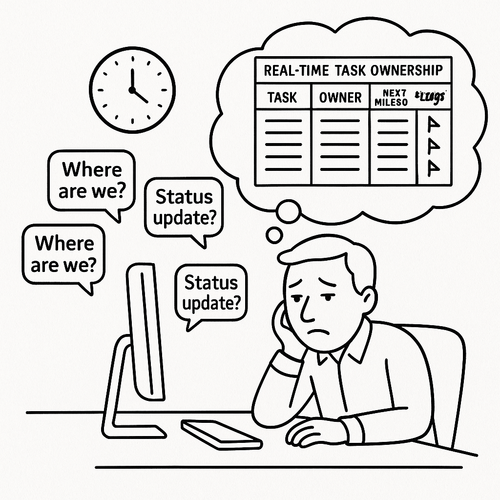
I’ve led teams where a simple “Where are we?” Slack ping spiraled into a half day of chasing updates. The more I checked, the worse the flow got—people lost focus, handoffs slipped, and meetings multiplied. The breakthrough came when we made ownership and progress visible without asking. Below is the playbook I wish I had earlier: how to reduce status-chasing, cut delays, and scale execution with calm, real-time signals.
Why Status-Checking Kills Flow and Drags Down Execution
Status-checking can feel like control, but it fractures flow. Every “Where are we?” injects motion and waiting—the Lean (waste-reduction) principles call these avoidable drains on throughput.
- Interruptions are expensive. Interruptions cost roughly 20–40% productivity, and it takes about 23 minutes to refocus; multiply that by Slack pings and you lose days each week.
- Scattered updates create unclear owners and late blockers. This drives rework and stalled handoffs because no one knows who is moving what, by when.
- Progress theater soaks meetings. Cycle times stretch and Work in Progress (WIP) hides dependency risk when updates are performative instead of operational.
- Use lightweight, real-time signals. Show owner, stage, blocker, and ETA (estimated time of arrival)—auto-updated, trust-first—to replace pings with clarity.
Result: visible work, fewer meetings, faster execution.
Creating Real-Time Task Ownership to Slash Lean Waste
Make every task unmistakably owned in real time, and Lean waste falls fast. When ownership and progress are visible without asking, waiting, motion, and overprocessing shrink.
- Make the live owner, next step, and ETA visible to all. The “Where are we?” ping disappears; handoffs move work, not people.
- Adopt async heartbeats. Asynchronous (async) status updates surface blockers early; teams often cut cycle times 15–30%.
- Treat visibility as support, not surveillance. Fewer meetings, less micromanagement optics, and more focus.
Result: fewer pings, faster throughput, leadership time back.
Building Progress Visibility That Prevents Waiting and Interruptions
Status-chasing is motion waste; waiting hides in handoffs. Make progress self-serve and interruptions drop, cycle times shrink.
- Name the owner and next milestone on every task. Ambiguity creates queues; clarity unblocks flow.
- Auto-refresh status where work lives. Stale docs trigger pings. Real-time sources beat standups (daily stand-up meetings).
- Surface blockers and dependencies early. Alerts beat surprises. Provide escalation paths, not heroics.
- Show WIP limits and service levels. Flow over fire drills. Service levels can be simple expectations, like Service Level Agreements (SLAs), to keep work moving without surveillance.
Scaling Operations with Accountability, Not Meetings or Micromanagement
Accountability scales when outcomes and stewardship are explicit—not when calendars swell. Meetings often hide flow debt and create motion and waiting waste.
- Assign one visible owner per task with current status and next milestone. The status-checking ping vanishes.
- Expose lead time, WIP, and aging. Leaders coach trends instead of chasing updates.
- Set light agreements. Use handoff SLAs (Service Level Agreements), a clear definition of done, and blocker tags so waiting surfaces fast.
- Auto-sync async updates from tools. Fewer standups, less context switching, and more uninterrupted work.
Net: faster cycles, clearer accountability, more executive focus.
Finding Relief: Less Status-Chasing, More Focus with Smarter Insights
Status-chasing is motion masquerading as management. Replace pings and check-ins with calm, real-time signals that show who owns what and where work stands.
- Clear ownership shrinks waiting waste. Handoffs become visible, not hopeful.
- A single source of truth reduces context switching. Interrupt costs fall as updates become self-serve.
- Early blocker flags pull problems forward. Cycle time and rework shrink without heroics.
- Asynchronous progress signals cut meetings. Visibility without surveillance optics builds trust.
For steady, low-noise ways to get there, the Lyaxis newsletter shares practical, field-tested patterns you can adapt—no pressure, just insight. Start here: Lyaxis Newsletter.