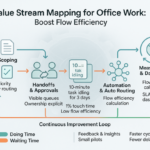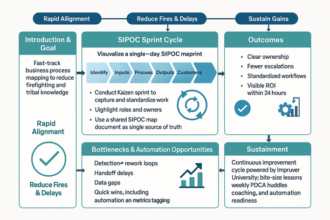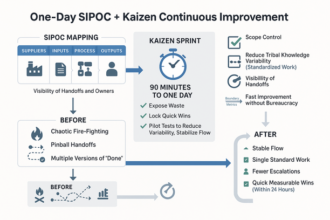

After years leading ops and product teams, the fastest way I’ve found to calm the chaos is to put today’s workflow beside the one we want tomorrow. The moment both maps are visible, the Kaizen (continuous improvement) gap becomes obvious—waste to remove, value to amplify—and improvement stops being a debate and starts being a plan.
Introduction: Revealing the Kaizen Gap Through Current vs Future State Mapping
Place today’s flow beside tomorrow’s target to expose the Kaizen gap—the waste to cut and the value to grow. When it’s visible, improvement becomes measurable.
- Map the current state: owners, handoffs, and queue times; baseline cycle time and defects.
- Design the future state: fewer touches, clear Service Level Agreements (SLAs), automated checks; set targets.
- Quantify the delta: identify where waits, rework, or approvals stall flow; pick a few 10x moves.
- Operationalize in Monday: centralize work, automate handoffs, and surface real-time metrics with Monday.
Documenting Today’s Reality: Expose Bottlenecks and Handoff Gaps
Map how work flows today—steps, owner, and timestamps—to reveal the Kaizen gap. Once reality is visible, the next fixes become obvious and measurable.
- Expose bottlenecks: compare wait time versus touch time; approvals and Quality Assurance (QA) often dwarf the actual work.
- Clarify ownership: name a Directly Responsible Individual (DRI) for each step; Monday boards make handoffs explicit and time-bound.
- Create one view: centralize requests, documents, and metrics to cut status meetings and firefighting.
- Baseline to target: track cycle time, first-pass yield, and SLA hits; pilot one lane to prove lift.
For lightweight templates and examples, skim the Lyaxis newsletter: https://lyaxis.com/category/newsletter/.
From Visibility to Action: Measuring Continuous Improvement with Clear Baselines
Continuous improvement sticks when visibility is anchored to a baseline. Map current versus future to expose the Kaizen gap and turn debate into data.
- Baseline the now: capture cycle time, handoff latency, and first-pass yield with clear owners on a Monday board.
- Tie 3–5 metrics to outcomes: connect measures to what leaders care about—cash, throughput, and Net Promoter Score (NPS)—and make wins visible with a scorecard.
- Visualize and automate the gap: current-versus-future swimlanes highlight bottlenecks; Monday automations remove wait time.
- Run a 30-day pilot: centralize updates and retire recurring status meetings that don’t change decisions.
For clean scorecards and metric menus, explore the Lyaxis newsletter: https://lyaxis.com/category/newsletter/.
Aligning Teams and Automating Workflows to Free Leadership Time
Map current versus future state to expose the Kaizen gap—and give leaders back focus hours. When improvement is visible and measured, firefighting recedes.
- Baseline today: make owners, handoffs, and queues explicit; quantify cycle time and Work in Progress (WIP) to surface rework.
- Design tomorrow: collapse handoffs, set SLAs, and automate triggers; one reliable view becomes the norm.
- Quietly underpin with Monday: use Monday for central boards, clear owners, auto-routed steps, and live dashboards.
- Pilot one workflow: track lead time and meeting hours saved, then iterate weekly.
- Deliver the result: faster cycles, calmer updates, and time reclaimed across the org.
For practical playbooks and tools, the Lyaxis newsletter offers case-backed frameworks: https://lyaxis.com/category/newsletter/.
Sustainable Improvement Cadence: Building Confidence with Practical Pilots and Metrics
Confidence compounds when improvements ship weekly, not yearly. Map current versus future state to expose the Kaizen gap, then prove value with small, instrumented pilots.
- Set baselines: capture cycle time, handoff latency, and rework rate so gains are visible.
- Pilot small and fast: run one workflow, track one metric for two weeks; a 10–20% lift beats big-bang bets.
- Run reviews in Monday: use Monday to see flow, pick the next bottleneck, and cut status meetings.
- Templatize wins: automate handoffs and lock clear owners in one shared view.
- Publish before/after deltas: make improvements transparent to build trust and momentum.
For patterns and metrics that sustain this cadence, explore the Lyaxis newsletter: https://lyaxis.com/category/newsletter/.