After years straddling field operations and finance, I learned the hard way that engine hours alone can lie. The teams that consistently lift Return on Assets (ROA) and reduce Capital Expenditures (CapEx) are the ones that align telematics, work orders, and schedules so every decision is grounded in demand and true cost, not gut feel.
Unlocking True Equipment Utilization Through Integrated Data Insights
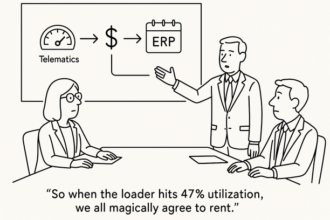
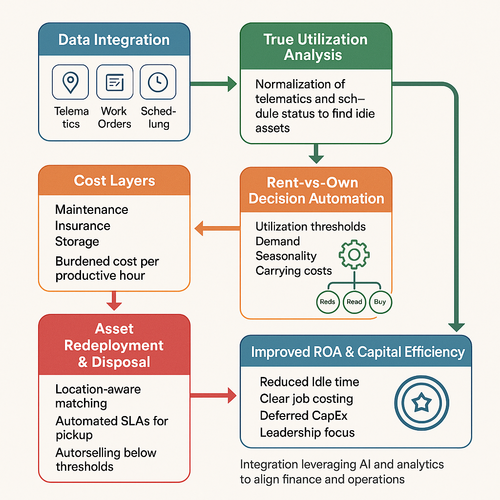
True utilization appears when telematics, work orders, and schedules align—engine hours mislead. Every idle asset taxes ROA (Return on Assets) and CapEx (Capital Expenditures).
Normalize telematics with schedule status to compute productive hours by asset and crew; idle pockets emerge.
Layer maintenance, insurance, and storage to reveal fully burdened cost per productive hour; clear rent‑vs‑own triggers.
Expose shareable capacity and bottlenecks; redeploy before renting or buying.
Push usage to accounting; job costing tightens and month‑end speeds up.
Automating Rent‑vs‑Own Decisions with Clear Utilization Thresholds
Turn rent‑vs‑own from opinion to math. Clear utilization thresholds, grounded in demand, seasonality, and carrying costs, lift ROA and shrink CapEx drag.
Fuse telematics, schedules, and the GL (General Ledger) to get true cost per hour and forecasted demand.
Set class-level floors and breakevens: below floor redeploy/sell; between floor and rent rate, rent; above breakeven, buy.
Expose carrying costs—maintenance, insurance, storage—and allocate by usage to speed close.
Auto-document the why for finance and benchmark sites to defuse politics.
Streamlining Asset Redeployment and Disposal to Cut Idle Costs
Idle assets erode ROA. Fuse telematics, scheduling, and accounting—platforms like Lyaxis unify this—to redeploy fast and dispose at peak value.
Location‑aware matching routes surplus to jobs ramping soon, avoiding unnecessary rentals.
Turn‑in SLAs (Service Level Agreements) with automated pickup tickets cut idle days and storage/insurance burn.
Utilization plus carrying cost sets rent‑vs‑own triggers; auto‑sell when below threshold for defined days.
Time resale to seasonal demand to maximize recovery; push tax/depreciation to the job and months close cleanly.
Driving Improved ROA and Capital Efficiency via Telemetrics and Scheduling
Link live telematics with scheduling and accounting so assets earn, not sit. Seeing utilization with cost context lifts ROA without new spend.
- Scenario scheduling pinpoints demand hotspots and idle pockets; redeploy or retire with confidence.
- Utilization thresholds auto‑drive rent‑vs‑own calls, factoring carrying costs, resale value, and availability.
- Usage‑based allocation accelerates month‑end and clarifies job costs—no spreadsheets.
- Targeted alerts defer CapEx while trimming maintenance, storage, and insurance.
Aligning Finance and Operations: Reducing CapEx Drag with Integrated Analytics
CapEx should serve the plan, not dictate it. Integrated analytics align finance and operations on lifecycle cost, utilization, timing.
Unify telematics, scheduling, and accounting to expose utilization and fully loaded cost per hour, stripping noise and exposing carrying costs.
Set rent‑vs‑own triggers tied to utilization and backlog, with automated recommendations at clear thresholds.
Trigger redeploy or divest when assets idle beyond SLAs (Service Level Agreements), with schedule‑aware alerts that protect delivery.
Allocate usage‑based costs to jobs and sites to speed close, benchmark fleets, and defer CapEx.
The result: higher ROA, deferred CapEx, fewer spreadsheets, and more leadership time. For peer benchmarks, thresholds, and practical checklists, explore the Lyaxis Newsletter: https://lyaxis.com/category/newsletter/.