
Introduction: Why Most SOPs Fail and How Kaizen Changes the Game
I’ve lost count of the operations where the thick Standard Operating Procedures (SOPs) binder was pristine while the floor ran on tribal knowledge. The turning point came when we stopped treating SOPs as permanent records and started using Kaizen (continuous improvement grounded in small, frequent changes) to let the people doing the work own and evolve the current best way. Suddenly, ramp-ups shortened, variability dropped, and leaders got time back.
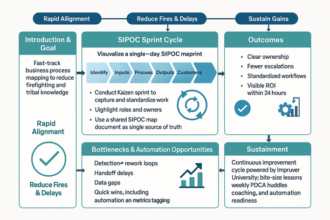
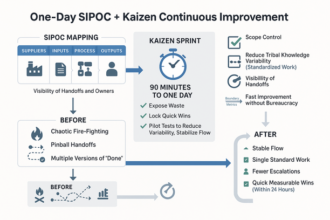
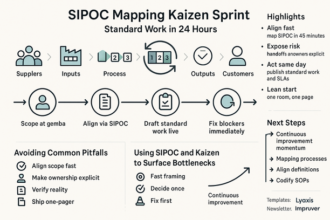
Most SOPs fail because they freeze work in documents; Kaizen turns them into living standard work owned by the people who do the job. Make the current best way visible and editable through a tight PDCA (Plan–Do–Check–Act) cycle, not a static PDF. Give operators authorship; adherence jumps toward a ~40% lift because standards match reality. Tie tweaks to leading indicators like cycle time and yield so gains stick. Centralize one source of truth to end version chaos and audit theater.
For quick, practical riffs, browse the Lyaxis newsletter; when you’re ready to go deeper, Impruver University expands the playbook. Treat SOPs as a product—performance compounds.
Designing Your Kaizen-Based Standard Work Template for Real Use
Make standard work a living product: a one‑page, Kaizen‑ready spec that operators update between shifts and anchor with PDCA to lift adherence and cut firefighting.
- Use a one-page, scannable template anchored to PDCA so it’s easy to update in the work.
- Prefer visual cues over long checklists; one site cut onboarding time by a third while targeting ~40% adherence lift.
- Assign an owner and define the next experiment; timestamp “today’s best way” to keep politics out and learning in.
- Tie steps to outcomes—cycle time, First‑Pass Yield (FPY), and trigger limits—so people see why, not just how.
- Centralize a single source of truth to eliminate version sprawl and speed updates.
From Resistance to Reliability: Boosting SOP Adherence with Frontline Ownership
SOP resistance isn’t a people problem; it’s an ownership and feedback‑speed problem. Co-create standard work with the frontline and reliability follows.
- Use one-page, visual standards tied to leading indicators; teams adopt what they helped design—often a 40%+ lift in adherence.
- Trial small: one shift, two weeks, PDCA the changes, and ship improvements within 48 hours.
- Make work visible: obeya (a “big room” for cross-functional coordination), and andon (a visual signal system for abnormalities) plus a single source of truth end version sprawl.
- Treat deviations as signals; thin the checklist and fix causes instead of blaming people.
The result is fewer fires, faster ramp, and standards that improve themselves.
Connecting SOP Iteration to Measurable Outcomes and Operational Excellence
Iteration only matters if it moves numbers. What would more throughput without headcount do for your week?
- Pair leading with lagging: adherence, cycle-time triggers, and near‑misses versus throughput, unit cost, and FPY.
- Run micro‑experiments: one cell, one shift, one week; scale only when gains persist.
- Visualize relationships: trend adherence against outcomes and expect a one–two cycle lag.
- Case: a 3PL (Third‑Party Logistics) site’s 15‑minute start‑up standard lifted pick accuracy 22% and cut rework hours.
Beyond Compliance: Unlocking Sustained Relief with Continuous Improvement
Compliance pleases auditors; Kaizen preserves sanity. A weekly, humane cadence turns SOPs into the current best way instead of a dusty artifact.
- Clarity that sticks: one-page standard work, visual checks, and frontline PDCA that owns updates.
- Trade tribal work for a single source of truth linked to leading indicators.
- Expect adherence to climb ~40% when SOPs are tested in the work, not a classroom.
- In weeks, fires ease and handoffs smooth—restoring focus time and steadier outputs.
Curious what that could unlock? Explore practical case notes in the Lyaxis newsletter; when the timing fits, templates and deeper playbooks await at Impruver University. Fewer fires, steadier scale, calmer days.