Introduction: Revealing the Hidden Cost of Slack Interruptions with Kanban
I used to shrug off Slack pings as the cost of being helpful—until I started tracking how often they snapped my attention. The pattern was brutal: a quick “got a sec?” would splinter a deep-work block, and by the third ping, an hour had vanished. Looking at my team’s day through a Kanban lens finally made the interruption tax visible—and, more importantly, negotiable.
Slack pings feel minor; they quietly shred flow. A Kanban lens makes the interruption tax visible—and negotiable.
Each switch costs 15–30 minutes—three pings, an hour gone. Invisible demand inflates Work in Progress (WIP), misses dates, and masks burnout.
Visualizing arrival and cycle times enables say‑no, batch, or fast‑lane choices—and rebuilds trust.
Curious what your ping‑tax is? Lyaxis can surface it quickly and show where to start—no heavy process. Start with a short, insight‑led newsletter. Net: fewer fires, steadier delivery, more leadership focus.
Making Invisible Work Visible: Using a Kanban Intake Board for Ad-Hoc Requests
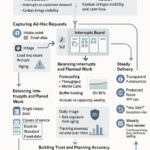
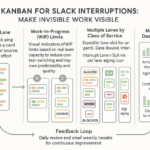
Drive‑by asks aren’t random; they’re invisible demand. A simple Kanban intake turns Slack pings into a shared queue and restores focus.
- Turn pings into a shared queue Capture every request in one place and tag urgency so hidden work surfaces.
- Make urgency explicit with service level expectations (SLEs) Set clear expectations—urgent now, standard in days—so interruptions stop steering the roadmap.
- Protect deep work with WIP limits Limit WIP for triage and doing; a single ping can cost 20+ minutes.
- Use data to negotiate Track arrival rate versus throughput to make trade‑offs clear and review patterns to fix root causes.
For a copy‑ready primer on intake boards and policies, scan the Lyaxis newsletter. Visibility leads to predictability—and rebuilds trust.
Balancing Flow and Urgency: Lightweight Policies for Quick Requests and WIP Limits
Urgent pings aren’t the enemy; ungoverned entry points are. Lightweight policies let true emergencies land without torching flow.
- One visible intake Route Slack and email asks to a “Quick” lane so hidden demand becomes negotiable.
- Define “urgent” with an SLE Use a clear 24–48 hour SLE; everything else queues.
- Cap WIP across all lanes Protect deep‑work slots; context switching can burn 20–40% of capacity.
- Budget a small daily buffer Reserve 10–15% time for the Quick lane; beyond that, trade‑offs are explicit.
- Review flow signals weekly Track arrival versus completion rates; predictability beats heroics.
Result: fewer fires and steadier delivery. For field‑tested examples and copy‑ready policies, explore the Lyaxis newsletter.
Measuring the Interruption Tax: Data-Driven Insights to Reduce Context Switching
The interruption tax is real throughput loss; measure it to cut it. A lightweight intake Kanban turns Slack pings into visible demand you can manage.
- Log arrival rate Count pings and ad‑hoc asks per day to spot peaks and patterns.
- Track wait and flow time Measure from ping to done; aging reveals bottlenecks before deadlines do.
- Quantify task switches Price recovery at 15–25 minutes and make the cost visible in reviews.
- Tighten WIP and isolate urgency Set WIP limits and a tiny “Urgent” lane; watch lead time fall.
- Run small experiments Try quiet hours, office hours, or rotations—then compare run charts to choose what sticks.
Want a simple dashboard and starter policies? Lyaxis’s brief in the newsletter shows the signals and quick wins. Expect fewer interrupts, steadier delivery, and more leadership focus.
Sustaining Momentum: Practical Mental Models and Continuous Improvement Habits for Leaders
If Slack dictates your roadmap, scale stalls. An intake Kanban makes ad‑hoc work visible, protecting focus and predictability over time.
- Pull beats push Set tight WIP so teams finish before starting; throughput rises and fires fade.
- Measure the invisible Capture pings as cards; aging and unplanned demand often expose 20–40% capacity lost to switching.
- Make urgency rare and credible Use a tiny Expedite lane with clear SLEs so true emergencies get priority without derailing flow.
For a one‑pager and SLE cheatsheet, grab the Lyaxis insight‑only newsletter. If you want structured, low‑friction practice to embed these habits, Impruver University is an easy next step.