Introduction: Revealing Hidden Waste by Capturing Ad‑Hoc Requests
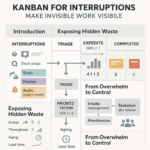
I learned the hard way that most teams don’t lose days to big disasters—they lose them one Slack ping at a time. The moment we started funneling every quick ask and DM (direct message) into a tiny Kanban intake, the hidden queues, context breaks, and quiet waste lit up on the board. What followed wasn’t bureaucracy—it was clarity: steadier flow, calmer planning, and fewer fire drills. This article walks through how to visualize interruptions, set lightweight triage policies, plan with data, and keep improving without burning people out.
Visualizing Interruptions with Kanban to Cut Context Switching
Interruptions quietly tax your P&L (profit and loss). Putting every Slack ping and quick ask on a visible Kanban makes context switching measurable—and fixable.
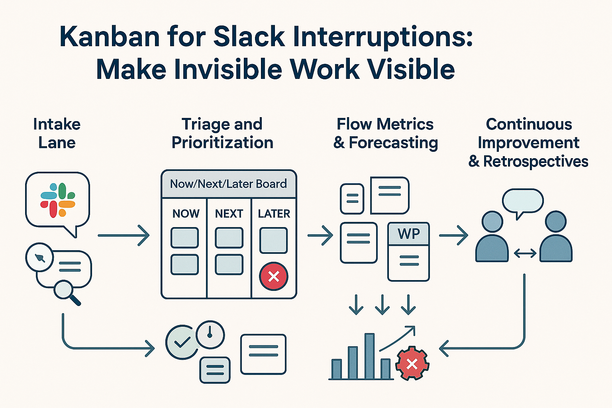
- Create one intake lane: Centralize Slack and ad‑hoc asks in a Now/Next/Later board or a Jira/Trello lane; tag the source and estimated effort.
- Use explicit policies: Add a tiny fast‑track with WIP (work in progress) caps to protect focus and keep emergencies truly exceptional.
- Track flow basics: Measure arrival rates and lead times to set SLAs (service level agreements) and produce simple, reliable forecasts.
- Expose hotspots: Surface where work bounces or stalls and simplify handoffs to cut avoidable back‑and‑forth.
- Review weekly: Use evidence to trade scope for responsiveness, tuning policies instead of relying on heroics.
Designing Lightweight Triage Policies That Protect Focus and Flow
Unplanned work erodes focus unless you bound it. Lightweight triage makes Slack noise visible without adding red tape.
- Route everything to one place: Auto‑forward DMs (direct messages) and quick asks into a Kanban board in tools you already use.
- Timebox triage: Do same‑day triage; set standard 24–48 hour SLAs (service level agreements) and maintain one capped fast‑lane for true urgencies.
- Define escalation: Specify what qualifies for the fast‑lane, who approves it, and how many can run at once.
- Protect focus blocks: Reserve maker time on calendars; WIP (work in progress) limits stop pileups and reduce context switching.
- Turn interrupts into data: Track arrival rate, lead time, and demand patterns to plan capacity and negotiate priorities with facts.
Data‑Driven Insights: Improving Planning and Capacity with Kanban
Kanban turns random pings into reliable capacity by making demand and flow explicit—so you plan calmly instead of guessing.
- Reveal hidden demand: Centralize Slack and ad‑hoc asks; arrival rates show true load and help set sane WIP (work in progress) to protect focus.
- Right‑size SLAs: Use lead‑time distributions to set response bands and reserve interrupt capacity without sacrificing projects.
- Forecast with throughput: Throughput trends support credible commitments and justify staffing with evidence.
- Filter low‑value work: Lightweight policies deflect or batch asks that don’t merit interruption.
Sustaining Continuous Improvement: Trust‑Building and Next Steps
Sustain improvement by treating interruptions as data. As Slack pings and ad‑hoc asks flow through a visible Kanban, trust grows and planning stops relying on guesswork.
- Make hidden work negotiable: Capture quick asks in a single intake so priorities can be discussed openly.
- Publish simple metrics: Share arrival rate, WIP (work in progress), and lead time to right‑size SLAs (service level agreements) and staffing.
- Use Now/Next/Later policies: Clarify what’s happening now, what’s queued next, and what waits for capacity; responsiveness improves without heroics.
- Run weekly retros: Inspect interruption patterns and run small experiments so gains stick.
- Plan from real demand: Forecast capacity from observed arrivals and throughput so commitments stop slipping.
Want practical playbooks and benchmarks? Explore the Lyaxis newsletter for templates and examples you can adopt today: Lyaxis Newsletter. If you’re looking for a structured, practitioner‑led way to build these habits, there’s a practical path via Impruver University. Clarity beats chaos—and it starts by putting every ping on the board.