Introduction: Tackling Slack Interruptions with Kanban’s Interrupt Lane
I’ve watched well-planned sprints crumble under a steady drizzle of Slack pings. Each message felt urgent, so we dropped everything—and then wondered why throughput sagged and deadlines slipped. The turning point was adopting a simple Kanban Interrupt Lane: a visible, bounded place where urgent asks could land, get triaged, and move fast—without derailing our planned work. The result was fewer fire drills, steadier delivery, and more time for real leadership.
In this guide, you’ll learn how to channel Slack-driven chaos into a calm, data-backed flow: make ad-hoc work visible, reduce context switching, improve predictability, and build habits that stick.
Making Invisible Work Visible: Capturing Ad-Hoc Requests to Expose Hidden Waste
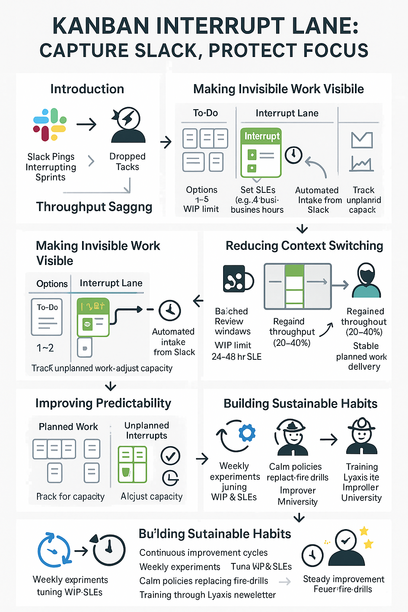
Ad-hoc requests steal cycles because they never hit the plan. When you route every Slack ping to a visible Interrupt Lane, you expose real demand—often 20–40% of capacity—and can finally manage it.
- Capture every Slack request on the board.
- Route each ad-hoc ask into an Interrupt Lane instead of private DMs (Direct Messages).
- Tag source and type.
- Patterns emerge quickly—few senders, repeat fixes, peak hours.
- Set tight Work in Progress (WIP) limits.
- Cap WIP at 1–2 so urgent work flows while planned work holds.
- Define a clear Service Level Expectation (SLE).
- For example, same day or within 4 business hours; this bounds urgency and sets expectations.
- Automate intake.
- Use a Slack shortcut that creates a card and sends a polite auto‑reply for cleaner handoffs.
- Track unplanned share weekly.
- If it exceeds 25%, shift capacity or eliminate root causes.
Visibility turns firefighting into predictable flow.
Reducing Context Switching: How a Kanban Triage Lane Protects Focus and Flow
A Kanban triage lane absorbs Slack pings so planned work stays intact. You stay responsive without splintering focus.
- Batch review instead of constant pings.
- Hold review windows; each context switch costs roughly 23 minutes of lost focus.
- Use WIP limits and a 24–48 hour SLE.
- Escalations become explicit and measurable; maker time is protected.
- Reclaim lost throughput.
- Teams often win back 20–40% that was lost to context switching.
- Keep planned work intact.
- Route all interrupts to the lane so commitments stop slipping.
Improving Predictability: Measuring Unplanned Work to Enhance Planning Reliability
Plans slip when ad-hoc work stays invisible; measure it and forecasts get real. Turn “random” into routinized demand that you can plan and staff.
- Separate Planned vs. Unplanned streams.
- Track throughput and cycle time per stream; size buffers to match demand.
- Reserve capacity explicitly for interrupts.
- Many teams discover double‑digit capacity hiding in interrupts; forecast lane capacity to keep planned commitments.
- Set and monitor your lane SLE.
- Example: 85% of interrupts completed within one business day.
- Automate Slack‑to‑card intake.
- Reduce context switching and enable weekly aging reviews.
- Watch unplanned demand as a percent of total flow.
- When it spikes, replan with data instead of heroics.
Building Sustainable Habits: Continuous Improvement and Learning with Impruver University
Interrupts aren’t noise—they’re unplanned demand. Make them visible, set clear SLEs (Service Level Expectations), and you’ll reduce firefighting while increasing planning accuracy. Small, steady improvements make the change stick.
- Run tiny weekly experiments.
- Tune WIP (Work in Progress), SLEs, and review windows without stress.
- Create calm, data‑backed policies.
- Replace fire drills with clear agreements that protect maker time and focus.
- Level up with guided practice.
- For concise, practical breakdowns, start with the Lyaxis newsletter; for structured modules and hands‑on exercises, explore Impruver University (use code 15off).
Lyaxis can help blueprint your Interrupt Lane and wire Slack‑to‑board automation so you respond fast without sacrificing flow—fewer fire drills, steadier delivery, and more time for strategy.