Introduction: Scaling Lean Without Consultants — The Kanban & Kaizen Advantage
In my experience leading busy ops and product teams, the biggest unlock never came from a massive transformation or a pricey playbook. It came from making work visible with Kanban (a visual workflow management method) and committing to Kaizen (continuous improvement). Once we surfaced where work actually stalled, a steady cadence of tiny fixes compounded into meaningful throughput gains—without adding headcount or hiring consultants.
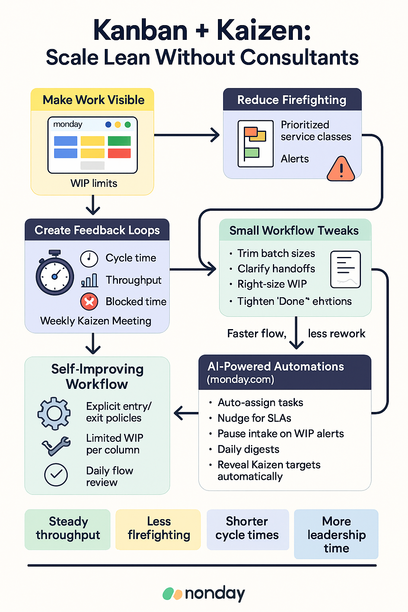
Scaling Lean doesn’t require consultants or a transformation program. Kanban surfaces where work stalls; Kaizen turns tiny fixes into compounding throughput.
- Make work visible: unify intake in one monday.com board; WIP (work in progress) limits expose bottlenecks.
- Reduce firefighting: service classes and aging alerts calm priorities without meetings.
- Create feedback: track cycle time, throughput, and blocked time; a 15‑minute weekly Kaizen trims waste.
- Standardize lightly: definition of done and templates keep flexibility while improving predictability.
Explore real‑world patterns in the Lyaxis newsletter—boards, metrics, and cadences you can adapt today.
Outcome: shorter cycle times, steadier delivery, and more leadership time with the team you have.
Building a Self-Improving Workflow: Embrace Kanban for Sustainable Efficiency
With a visual system in place, you can turn day‑to‑day operations into a self‑improving engine that steadily reduces wait time and coordination overhead.
Kanban turns operations into a self-improving system—visible work, capped overload, smarter flow.
- Set explicit entry/exit policies per stage: ambiguity drops and handoffs speed up.
- Limit WIP per column: queues shrink, quality rises, firefighting recedes.
- Run a 10‑minute daily flow review in monday.com: unblock aged items, not people.
- Instrument cycle time, throughput, and aging: weekly Kaizen standardizes gains—often double‑digit cycle‑time cuts—without bureaucracy.
When you want calm, field‑tested cadences and dashboards, the Lyaxis newsletter unpacks them with examples you can copy.
Result: steadier throughput, fewer status meetings, and leadership time back.
Small Workflow Tweaks That Reduce Cycle Time and Boost Throughput
You don’t need a big-bang rollout—small, observable changes compound quickly when you focus on flow.
- Trim batch sizes: slice epics into 1–2‑day deliverables; queues shrink and cycle time often falls 15–30%.
- Clarify handoffs: one owner, next owner named, exit criteria visible; in monday.com, automations ping the receiver on status change.
- Right-size WIP: set lane limits to real capacity; when breached, stop starting and swarm blockers for steadier flow.
- Tighten “Done”: include tests, docs, deployable; rework stops before release.
Lyaxis turns this into measurable micro-experiments—the newsletter offers checklists and examples. Result: faster flow, fewer fires, more leadership time.
Harnessing Flow Metrics and Visual Management to Expose Bottlenecks
To decide where to intervene, let data guide you. Flow metrics turn opinions into operating leverage. Make cycle time, throughput, WIP (work in progress), and aging-in-progress (how long each item has been in process) visible, and bottlenecks stop being political—they become obvious.
- CFDs (cumulative flow diagrams) show where work piles up: trim WIP there to drop cycle time fast.
- Control charts separate noise from signal: fix the constraint, not add headcount.
- Aging-in-progress flags stuck items: set pull limits and service-level expectations.
- Boards and monday.com dashboards keep this in view daily: status meetings shrink.
For practical dashboards and pattern reading, the Lyaxis newsletter offers working examples. Net: smaller fixes, steadier throughput, calmer teams.
Empowering Teams and Freeing Leadership Time with monday.com Automations
Work should move itself. monday.com automations turn Kanban signals into updates, handoffs, and gentle nudges—keeping flow and giving leaders focus time.
- Status change auto-assigns and @mentions next owner: handoffs are silent and clear.
- SLAs (service level agreements) hook to column timers: overdue items nudge before fires start.
- WIP-limit alerts pause intake and surface blockers: queues shrink without heroics.
- Daily digests replace status meetings: leaders review exceptions, not play-by-plays.
- Aging-in-column and lead-time views reveal Kaizen targets automatically: improvement work is always in sight.
Explore the Lyaxis newsletter for copy‑paste automations and hard‑won lessons.
Small tweaks, big calm: faster throughput, fewer surprises, more leadership time.