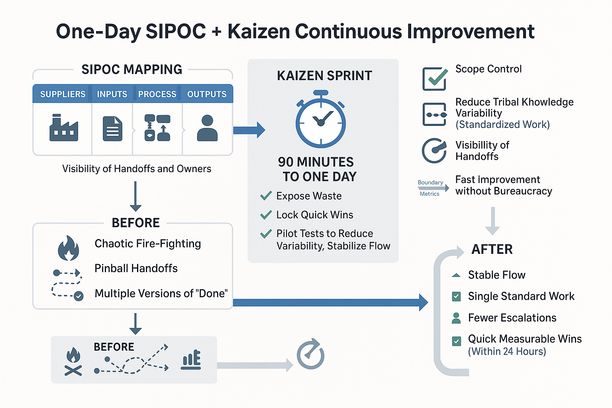
After years of firefighting and late-night escalations, the fastest, cleanest wins I’ve seen came from pairing a simple SIPOC map with a short Kaizen sprint. In a single day, we aligned owners, exposed waste we’d walked past for months, and launched small tests that stabilized flow—without the usual bureaucracy. This article distills that one-day pattern so you can kickstart real improvement tomorrow.
Kickstart Lean BPM: Why SIPOC + Kaizen Sprint Works in One Day
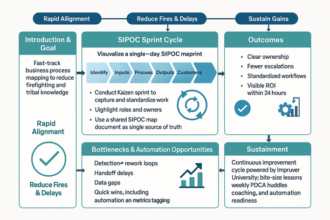
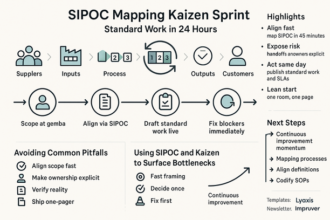
One day beats six weeks. Pair a fast SIPOC (Suppliers, Inputs, Process, Outputs, Customers) with a focused Kaizen sprint (a short, structured continuous-improvement event) to align owners, expose waste, and launch tests—no bureaucracy. Lean BPM (Business Process Management) gets traction when you make the system visible and act the same day.
- Scope, fast: Bound inputs/outputs and customers so meetings stop wandering.
- Handoffs, visible: Surface where tickets, parts, or data stall; assign one owner per step.
- From heroics to habit: Convert tribal know-how into one best way, ready for onboarding.
- Variability down: Pilot two or three tests by day’s end; measure stability within 24 hours.
Unveiling Hidden Process Flaws: How SIPOC Makes Inputs and Handoffs Visible
Most delays don’t start in the process—they start before it. SIPOC makes inputs and handoffs visible; with a one-day Kaizen sprint, you standardize fast without bureaucracy.
- Ready inputs: Define supplier, data, and timing; defects fall.
- Ownership: Make giver/receiver explicit; ping‑pong stops.
- Handoffs: Set acceptance criteria; queues shrink.
- Tribal knowledge: One‑page SIPOC becomes onboarding; variability drops.
- Boundary metrics: Track lead time (total elapsed time from request to delivery) and first‑pass yield (percent completed correctly the first time) to expose 24‑hour wins.
Before: tickets pinball across five teams. After: a SIPOC reveals missing CRM (Customer Relationship Management) fields causing 30% rework—fixed the same day.
Aligning Teams Fast: Turning Tribal Knowledge into Clear Standard Work
Your bottlenecks aren’t people; they’re mismatched maps. Yesterday: five versions of “done.” Today: a one‑day SIPOC + Kaizen sprint turns tribal knowledge into visual, checklisted standard work without handcuffing experts.
- See the system: SIPOC surfaces inputs, outputs, owners, and risky handoffs fast.
- Define done: Visual steps and crisp Definitions of Done (DODs) cut rework and speed onboarding.
- Make improvement safe: Kaizen isolates quick wins and builds training assets.
- Prove stability: Track a few flow and quality signals within 24 hours.
Result: smoother handoffs, fewer escalations, and more time for actual strategy.
From Chaos to Stability: Capturing Quick Wins and Reducing Variability
Fire drills aren’t strategy. A one‑day SIPOC + Kaizen sprint turns chaos into stable flow.
- Expose variability: Map inputs, outputs, steps, owners; hidden rework surfaces.
- Lock quick wins: Lightweight controls and poka‑yoke (simple mistake‑proofing) on the vital few.
- Tighten loops: Hourly checks and visible limits cut cycle time, steady delivery.
- Convert tribal to standard: Clear work becomes training and automation‑ready.
Before: fuzzy handoffs, late nights. After: one page, one way, wins.
Your Next Step to Operational Excellence: An Easy Guide to SIPOC + Kaizen
Swap firefighting for flow on one critical process—in a day. SIPOC + a 90‑minute Kaizen turns “who owns this?” into one way everyone follows.
- See the flow: Make inputs, outputs, and owners visible to expose handoffs and missing metrics.
- Name the edges: Define suppliers and customers to stop scope creep and rework.
- Fix the friction: Tackle the biggest blocker now; cut variability fast.
- Lock the win: Codify the new standard, enable onboarding, and show stability within 24 hours.
For practical templates and a no‑fluff walkthrough, start with the Lyaxis newsletter and the concise guide from Impruver University. Expect alignment, fewer escalations, and time back.