
Grasping Business Processes Fast with One-Page SIPOC
Introduction: Grasping Business Processes Fast with One-Page SIPOC
I’ve watched smart teams lose weeks debating scope and ownership. The turnaround always came when we sketched a one-page SIPOC (Suppliers, Inputs, Process, Outputs, Customers). In minutes, the fog lifted: who starts, what’s needed, the steps that matter, and who signs off. This article shares how I use a simple SIPOC to align executives fast, expose handoffs early, and turn the map into living workflows where work actually happens.
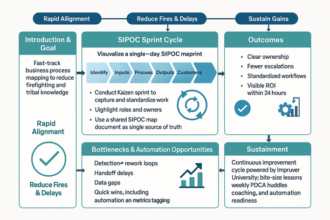
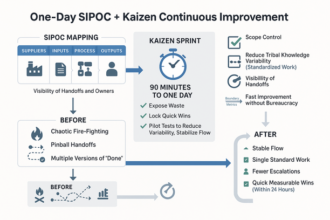
A one-page SIPOC gives executives fast, shared understanding—suppliers, inputs, steps, outputs, customers on one screen. Use it to align scope before automation or tooling spend.
- Clarify boundaries in minutes; stop scope creep and orphan requirements.
- Surface handoffs and dependencies; assign owners and service-level agreements (SLAs) early.
- Park it in Monday.com as a living board; link outputs to tasks, automations, and dashboards.
- Reuse the template across teams; common language, fewer meetings, faster onboarding.
Lyaxis’ 2‑minute insights offer practical SIPOC prompts and examples; when ready, an optional Monday.com workspace awaits.
Faster alignment, less rework, lower risk—on a single page.
SIPOC is a one-page lens to lock scope, create shared language, and define outputs that count. Use it first to end debate and de‑risk work.
Unlocking Clarity: How SIPOC Defines Scope, Customers, and Outputs
SIPOC is a simple, executive-ready frame that removes ambiguity up front. For chief executive officer (CEO)-level clarity, Lyaxis shares brief SIPOC patterns; when ready, explore our Monday.com template to move from map to action.
- Scope: draw start/finish—lead captured to invoice issued, not all of revenue operations (RevOps).
- Customer: who consumes the output—Finance, Sales, or the buyer? That choice changes the deliverable.
- Output: set measurable deliverables with acceptance rules; link owners, SLAs (service-level agreements), automations in Monday.com.
- Inputs/Suppliers: surface missing data and handoffs early; fewer surprise blockers.
Result: faster alignment, fewer meetings, cleaner launches.
Aligning Teams Seamlessly: Revealing Handoffs and Dependencies Early
Use a one-page SIPOC to reveal handoffs and dependencies before work starts. It turns fuzzy scope into clear ownership and timing, lowering risk early.
- Clarify customer and output in one line; who signs off, by when?
- Name suppliers and owners; when the sales development representative (SDR) books a demo, who owns the lead?
- List must-have inputs and a simple “ready” definition; stop rework.
- Expose dependencies; set dated, SLA‑style handoffs.
- Keep it live in Monday.com; link owners, tasks, automations so changes stick.
For leverage, Lyaxis shares templates and CEO patterns via a newsletter; explore a Monday.com build when useful. Outcome: fewer meetings, cleaner handoffs, faster execution.
Living SIPOC Templates: Centralizing and Connecting Process Maps in Monday.com
A one-page SIPOC gives fast clarity—when it lives where work lives. Make it a living template in Monday.com: centralized, versioned, and linked to boards.
- Update once; every team sees suppliers, inputs, outputs in real time—scope creep loses oxygen.
- Link fields to docs, owners, automations, and status; handoffs stop hiding.
- Enforce shared terms with synced columns across boards; meetings shrink and decisions speed up.
- Version by product or region; learning compounds instead of fragmenting.
Want the pragmatic pattern? Lyaxis unpacks it in our newsletter; when ready, try the Monday.com setup we use. The payoff: fewer surprises, faster throughput, cleaner accountability.
Beyond Mapping: Turning SIPOC Insights into Clear Workflows and Confident Decisions
A one-page SIPOC turns fuzzy processes into clear workflows and defensible decisions. Align in minutes—before you automate.
- Clarify scope by naming the customer and the one outcome; whose “done” wins—making trade‑offs explicit and keeping scope creep out.
- Expose handoffs and missing inputs; then assign owners and link them to a living Monday.com board and automations.
- Turn outputs into 3–5 measures; trigger alerts, not meetings.
- Prioritize fixes by impact versus effort; sequence sprints you can fund.
Want ready-to-use patterns? Browse the Lyaxis newsletter for field‑tested templates; explore the optional tool setup later. Outcome: faster clarity, fewer misfires.