I learned the hard way that cramming more work into the system doesn’t make it finish any faster—it just makes everything wait. The first time I piloted one-piece flow with a cross-functional squad, our lead times fell, predictability jumped, and the team stopped firefighting. This post shares the essentials behind that shift: why one-piece flow works (the math is kind), how to spot and remove hidden delays, and practical steps to pilot it with confidence—plus real-world results you can benchmark against.
Harnessing One-Piece Flow: The Key to Faster, Predictable Delivery
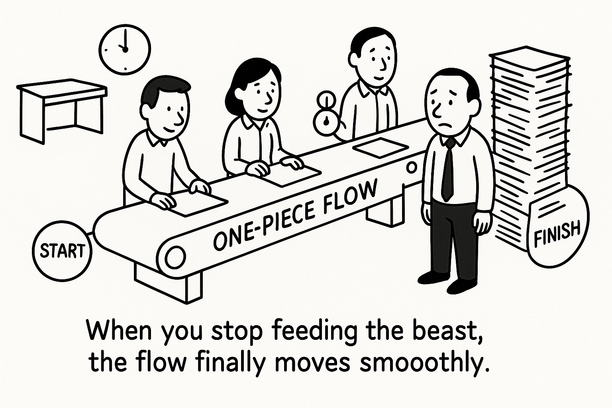
One-piece flow cuts queues, handoffs, and batch size so delivery gets faster and more predictable. It trades utilization theater for throughput.
Little’s Law puts it plainly: lower WIP (work in process), lower lead time. Measure flow efficiency (value-added time divided by total elapsed time) to expose idle time hidden in queues and handoffs.
- Give one team start-to-finish ownership. Reduce coordination overhead and decision latency by minimizing handoffs.
- Pull one item at a time. Let work be pulled when capacity is available instead of pushing batches into queues.
- Guard the bottleneck with a single first-in, first-out (FIFO) queue. Preserve order, prevent priority thrash, and keep the constraint visible.
The Science Behind Flow: Little’s Law and Reducing Queues & Batch Sizes
Little’s Law: Lead time = WIP ÷ Throughput. When WIP swells, everything waits—no tool outruns the math.
- Cap queues to the bottleneck’s weekly capacity. Lead time falls when arrivals match the slowest step.
- Shift to one-piece or micro-batches. Rework and handoffs drop as variability is surfaced earlier.
- Expose the true constraint. Match arrivals to the slowest step so improvement targets are unambiguous.
- Cut WIP 30–50% in the worst queue. Service-level agreement (SLA) variance shrinks as waits drain.
A software as a service (SaaS) team moved from weekly to daily flow: WIP −40%, lead time −35%, throughput +22% in 30 days.
Want the one-page playbook—and help setting limits you can live with? The Lyaxis newsletter breaks it down. When you’re ready to go deeper, Impruver University is a pragmatic next step.
From Bottlenecks to Breakthroughs: Real-World Impact of One-Piece Flow
One-piece flow turns queues into throughput by shrinking batches and handoffs. Less WIP, shorter lead time—capacity appears without new hires.
- SaaS onboarding: From weekly batches to single-customer pull; WIP 42→12, lead time 18→6 days, throughput +27%, Net Promoter Score (NPS) +12.
- Electronics cell: One-piece transfer with embedded changeovers; first-pass yield (FPY) 93%→98%, output +22%, overtime down.
- Revenue Operations (RevOps): Killed the Monday batch; flow efficiency 14%→37%, on-time 64%→92%, leaders reclaimed +5 hours/week.
- Fintech delivery: Handoffs 12→4, flow efficiency 9%→32%, cash 10 days sooner—no new headcount.
Takeaway: cut WIP, cut waits, and cash moves sooner. If you want a quick way to spot similar wins, the Lyaxis newsletter can help you map your current-state flow.
Overcoming Hidden Barriers: Tackling Handoffs, WIP, and Context Switching
Handoffs, excess WIP, and context switching quietly tax speed. Little’s Law is blunt: lower WIP, shorter lead time.
- Shrink batch sizes to drain queues. Throughput rises without overtime as idle time is removed.
- Cut handoffs to slash defects. Leaders stop acting as routers and teams make faster, clearer decisions.
- Protect focus. Task switching crushes flow; finish before starting the next item.
- Spot bottlenecks with data. Watch WIP, queue time, and age of work to see where items stall.
In one onboarding pilot, one-piece flow cut WIP 35%, handoffs 6→3, lead time −45%, and on-time delivery +20% in four weeks.
For measures that matter and simple diagnostics you can run this week, explore the Lyaxis newsletter. If it proves useful, Impruver University offers hands-on drills to lock in the gains.
Unlocking Sustainable Growth: Pilot One-Piece Flow with Confidence and Clarity
One-piece flow turns stalled queues into speed—fewer handoffs, smaller batches, faster cash conversion.
- Pick a thin slice near the bottleneck. Clarify “Done” and remove optional handoffs to simplify flow.
- Instrument four signals. Track lead time, WIP, flow efficiency, and escaped defects (issues that reach customers) daily.
- Set humane limits. Cap WIP to one per person (per Little’s Law), switch push to pull, and finish before starting.
- Close loops fast. Same-day triage and weekly experiments create steady improvement without disruption.
Vignette: One squad cut lead time 30% in three weeks by dropping WIP 7→2.
Want a one-page pilot canvas and metrics glossary? Start with the Lyaxis newsletter for a fast walkthrough. When you’re ready to expand, Impruver University provides a practical, optional lab to scale one-piece flow. Small moves. Faster cash. Fewer fires.