
Introduction: Unlocking Leadership Time with Proven Productivity Hacks
After years of coaching founders and operators, one pattern shows up every time: leaders don’t struggle because they’re unfocused — they struggle because their time is trapped. Meetings, status updates, and reactive work quietly consume the hours required for strategy, growth, and innovation. I’ve seen leaders recover 5–15 hours a week simply by tightening processes, clarifying decision rights, and introducing light‑weight automation. This article distills the same playbooks I’ve used with scaling teams to help you reclaim capacity fast, build leverage, and create the operational clarity your team needs to move with speed.
Leaders don’t lack effort; they lack leverage. The average CEO spends 72% of working time in meetings and only 28% on alone work—yet strategy needs uninterrupted attention (HBR—Porter & Nohria, 2018). Meanwhile, meeting loads and “digital debt” keep rising, crowding out focus time (Microsoft Work Trend Index, 2023). The upside: a significant share of knowledge work is automatable, freeing hours without adding headcount (McKinsey, 2023).
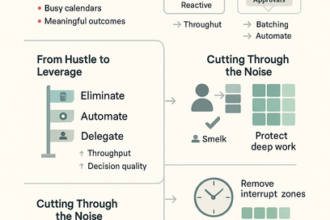
Use this Time-Leverage Ladder to reclaim capacity fast:
1) Eliminate
– Run a two-week calendar audit; cancel or halve recurring meetings; move status updates async.
– Quick win: Copy Shopify’s reset—purge large recurring meetings, keep <50% attendance, and default to async updates (Shopify, 2023).
– Tools: Loom for async updates; Notion/Confluence for written briefs; Reclaim.ai/Clockwise to auto-protect focus blocks.
– Metric: Meeting hours per leader per week; target −30% in 30 days.
2) Automate
– Identify top 5 repetitive workflows (intake, approvals, updates) and automate first.
– Tools: Zapier/Make; email rules + AI triage with Microsoft Copilot/Gmail; Calendly for scheduling; Scribe/Tango to capture steps.
– Metric: Hours automated/week; aim for 5–10 hours per leader (McKinsey, 2023).
3) Delegate with decision clarity
– Assign decision rights (Bain RAPID) and document 80% solutions in SOPs to avoid escalations.
– Tools: Asana/ClickUp for SOP-linked tasks; Loom for handoffs.
– Metric: % decisions made without leader; target >70%.
4) Protect deep work
– Block 2×90-minute focus windows daily; enforce DND. It takes ~23 minutes to recover from interruptions (Mark, 2008; 2022).
– Tools: Focus modes (OS), RescueTime.
5) Measure leverage
– Dashboard weekly: meeting hours, focus hours, automations live, cycle time, and “leader hours saved.”
– Review monthly; cut or scale what moves the needle (Microsoft, 2023).
Streamline Your Workflow: Building SOPs and Automating Repetitive Tasks
A 5-step playbook to cut cycle times and errors while scaling:
1) Prioritize the right processes
– Pick top 5 workflows by volume, cycle time, and risk (lead intake, order-to-cash, onboarding, support triage).
– Baseline metrics: cycle time, touches per item, error/rework rate, SLA hit rate.
– Use diagnostics like time-in-motion sampling and process mining. Up to 60–70% of work activities are automatable with today’s stack (McKinsey, 2023).
2) Document crisp SOPs
– SOP template: Purpose, Trigger, Owner/RACI, Inputs/Outputs, SLA, Step-by-step, Exceptions, QA checks, Metrics.
– Capture walk-throughs (Loom), convert to steps (Scribe/Tango), publish in Notion/Confluence.
3) Automate the repeatable
– Decision matrix: Frequency × Rules Clarity × Volume × Risk; start High-High-Low.
– Tools: Zapier/Make/n8n, Power Automate/UiPath, Workato.
– Patterns: auto-triage tickets, enrich leads, route approvals, sync records, generate invoices.
4) Pilot, measure, iterate
– 2–4 week pilots; measure cycle time, errors, SLA, and hours saved.
– Hyperautomation + redesign can reduce operating costs by ~30% (Gartner, 2020).
5) Govern and scale
– Assign owners, review quarterly, retire outdated steps.
– Communicate “why,” involve users, and train for adoption.
Mini-case: A 70-person B2B SaaS automated triage and routing with Zendesk + Zapier. Results: 42% faster first response, 28% fewer escalations, ~0.6 FTE capacity unlocked in 3 weeks.
Mastering Delegation: Strategies to Build Leadership Capacity and Accountability
Delegation playbook (10 minutes to set up, hours saved weekly)
– Define outcomes: Create a 1-page Delegation Brief with objectives, metrics, constraints, scope, stakeholders, risks, timeline, budget.
– Assign decision rights: Set a DRI; map roles with RAPID or RACI.
– Set autonomy level: Match oversight to Task-Relevant Maturity (Grove, 1995).
– Establish check-in rhythms: 15-minute weekly 1:1s or milestone reviews.
– Build feedback loops: Use SBI + After-Action Reviews.
– Lock accountability: Publish SLAs, escalation rules, and WIP limits.
Delegation Brief template
– Objective + Key Results
– Definition of Done
– Constraints/Guardrails
– Decision Rights
– Resources
– Milestones + Cadence
– Risks + Escalation rules
Tools
– SOPs: Loom, Scribe; Notion for playbooks.
– Execution: Asana/Jira; dashboards for leading indicators.
– Automation: Zapier/Make.
Metric stack
– Cycle time, on-time delivery, rework rate, blocker time, autonomy score, hours of leader time freed.
Choosing and Implementing the Right Automation Tools for Scalable Growth
Use the F.I.R.S.S. scorecard
– Fit: Prioritize high-volume, rule-based steps.
– Integration: APIs, SSO, event logs, avoid custom one-offs.
– ROI: Target 3–10x within 6–12 months.
– Security: SOC 2 Type II/ISO 27001, least-privilege, audit trails.
– Scalability: Validate governance, limits, versioning.
Pilot-to-scale playbook (4–8 weeks)
1) Pick 1–2 workflows tied to revenue/cost.
2) Build in sandbox with feature flags.
3) Instrument metrics.
4) Security review + change control.
5) Gradual rollout to 100%, then lock SOPs.
Change management and adoption
– Stakeholders: RACI + automation champions.
– Training: Playbooks with Loom walk-throughs.
– Incentives: Tie OKRs to adoption.
– Governance: Monthly automation council.
– KPIs: Time saved/employee, coverage, failure rate, realized ROI.
Recommended stack
– Orchestration: Workato, Zapier, Make; MuleSoft/Boomi.
– RPA: UiPath, Power Automate, Automation Anywhere.
– Data sync: Fivetran, Airbyte.
– Process intelligence: Celonis, Process Advisor.
– Documentation: Scribe, Tango.
Why now: Knowledge workers spend ~58% on “work about work,” and hyperautomation can cut operating costs by ~30% (Asana, 2023; Gartner, 2022).
Measuring Success: KPIs and Benchmarks to Track Operational Efficiency Gains
Define outcome-aligned KPIs
– Speed: lead/cycle time, SLA adherence.
– Cost: cost per transaction, labor hours per unit, automation rate.
– Quality: first-pass yield, error/rework rates.
– Capacity: throughput, WIP, resource utilization, leadership time reclaimed.
– Experience: CSAT/NPS, eNPS.
Baseline quickly
– 2-week snapshot via system logs (Salesforce, Jira, Zendesk).
– Time-sample 20–30 manual executions.
– Identify bottlenecks with process mining.
Set targets and benchmarks
– Use APQC benchmarks (e.g., AP invoice processing cost ~$5–6).
– Track DORA metrics for engineering flow.
– Compare support metrics with Zendesk CX Trends.
Build a KPI dashboard
– One-page view linking process → KPI → business outcome.
– Tools: Looker Studio, Power BI.
Review cadence
– Weekly Ops Review: R/A/G + countermeasures.
– Monthly ROI review.
– Quarterly target resets.
Simple ROI math
Time Saved = executions × minutes saved
Annual Savings = (Time Saved / 60) × loaded hourly rate
ROI = (Annual Savings − Tool + Build Cost) / Cost
Mini-case: A 120-person SaaS automated onboarding steps, achieving −38% cycle time, −42% tickets, and reclaiming 9 leadership hours/week with payback in 2.5 months.
Author: J. Morgan — Operations strategist and workflow architect helping teams scale through systems, automation, and decision clarity.