Introduction: Unpacking the Hidden Cost of Context Switching in Scaling Teams
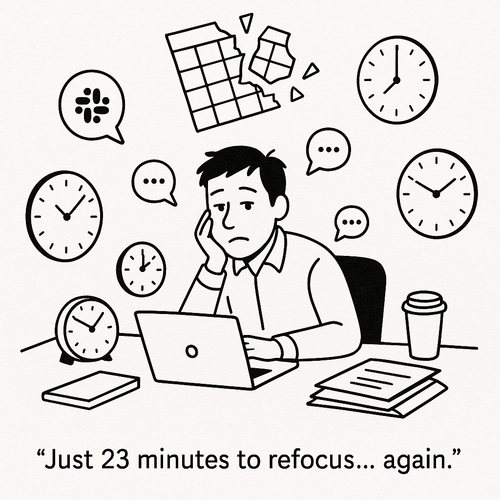
When our team hit rapid growth, I watched calendars splinter into 30‑minute shards and Slack pings creep into every quiet gap. It felt like we were moving faster, but delivery slowed and quality slipped. The culprit was context switching—an invisible tax I’d underestimated. Each hop cost roughly 23 minutes to refocus, and across a week it quietly shaved 20–40% off throughput. What finally helped was measuring where focus was leaking, then rebuilding our operating rhythm around deep work, clear ownership, and lightweight automation.
Context switching is an invisible tax that compounds as you scale. Each hop costs about 23 minutes to refocus and 20–40% output over a week.
- Spot the symptoms: Stretched cycle times from fragmented calendars; quality dips and rework from dropped threads; decision drag from fuzzy ownership and ping‑pong handoffs; and interrupts amplified by tool sprawl and noisy automations.
- Quantify fast: Track the deep‑work ratio on calendars, work in progress (WIP) per person, and handoff latency.
- Start relief: Use workflow batching, crisp automation triggers, and role clarity to free hours for strategy. For benchmarks and playbook snapshots, the Lyaxis Field Notes favor practical lenses first and vetted tools second.
For an ongoing library of patterns and benchmarks, the Lyaxis newsletter curates what works—insight first, tools when earned. Explore it here: Lyaxis Newsletter.
Workflow Batching: Structuring Time to Minimize Cognitive Load and Maximize Focus
Context switching often costs around 23 minutes to refocus and cuts throughput 20–40%. Batch work by cognitive mode to regain focus and quality.
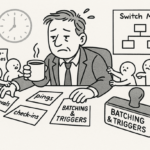
- Design weekly rhythms: Maker blocks in the morning; manager blocks in the afternoon; decisions handled in fixed windows, not ad‑hoc.
- Batch by cognitive mode: Group similar tasks (e.g., writing, analysis, approvals) to reduce mental gear changes and error rates.
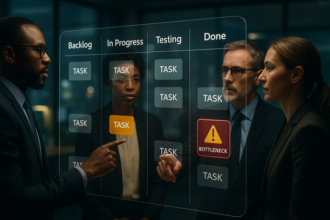
- Codify automation triggers: Status changes auto‑advance work; handoffs fire checklists; service‑level agreement (SLA) rules drive asynchronous (async) updates.
- Use lightweight templates: Definition of ready/done, decision logs, and briefs prevent rework.
- Clarify role boundaries and ownership: Remove the ambiguity tax by making decision rights explicit.
- Measure the impact: Expect faster cycles, fewer fire drills, and better output as batching takes hold.
Automation Triggers and Role Clarity: Streamlining Handoffs and Reducing Interruptions
Context switching quietly taxes 20–40% of throughput. The antidote: crisp automation triggers and unambiguous ownership so work advances without pings.
- Define “ready” by artifact, not opinion: Status flips only when acceptance criteria and a checklist are met.
- Appoint a single owner per stage: One accountable owner; collaborators are informed asynchronously (async) without derailing focus.
- Add no‑code nudges: Auto‑assign on stage change, service‑level agreement (SLA) timers, and templated briefs keep momentum without meetings.
- Batch handoffs into intake windows: Protect deep work while staying responsive by routing transitions at set times.
- Instrument the flow: Track handoff latency and rework rates as leading indicators of process health.
- Expect cleaner outcomes: Faster cycles, fewer interruptions, and clearer accountability—patterns Lyaxis has mapped in repeatable playbooks.
Building an Interruption-Resistant Rhythm: Reducing Meetings and Managing Async Communication
Every interruption can cost 20+ minutes to regain depth—slowing cycles and draining leaders. Build a cadence that defaults to clarity and quiet.
- Shrink meetings to decisions: Use 25‑minute huddles; push updates to asynchronous (async) channels; log outcomes for recall.
- Batch work and communications: Establish org‑wide focus blocks; set channel windows with clear service‑level agreement (SLA) expectations.
- Automate status and handoffs: Triggers move work, post summaries, and tag owners without manual nudges.
- Clarify owner/approver lanes: Stop ping‑pong and protect maker time with explicit roles.
- Instrument depth and speed: Track maker hours and decision latency to tune cadence over time.
The payoff: quieter calendars and faster throughput as the operating rhythm stabilizes.
Sustaining Deep Work: Measuring Focus Time and Freeing Leadership for Strategic Impact
Deep work compounds outcomes; measure and protect it to free leadership for strategy.
- Quantify focus time: Schedule 60–90‑minute blocks; leaders target 12–15 hours weekly. Interruptions add about 23 minutes and can cut throughput 20–40%.
- Limit work in progress (WIP): Cap to 1–2 streams per leader; speed and quality both rise.
- Tame interruptions at the source: Map ping hotspots; batch workflow updates; use automation triggers for status and handoffs.
- Clarify roles and decision rights: Reduce escalations by making ownership explicit.
- Add clear guardrails: Maker mornings, no‑meeting zones, and deliberate delegation protect depth.
For compounding refinements and benchmarks, the Lyaxis newsletter offers pragmatic guidance—insight first, tools when earned. Outcome: reclaimed strategic hours and faster, cleaner execution.