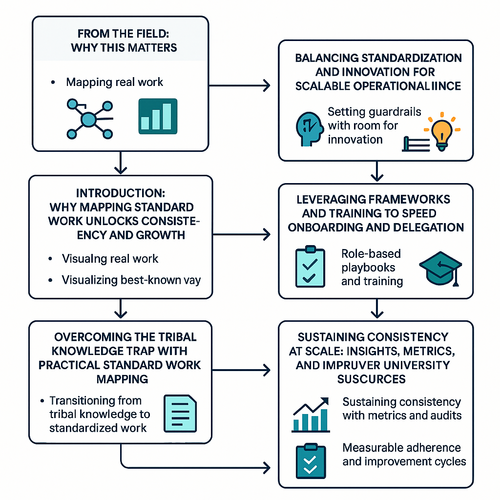
From the Field: Why This Matters
I’ve led teams where two shifts ran the “same” process and delivered wildly different results. The turning point came when we mapped the real work—what people actually did—not just what the old binder said. Once we made the best-known way visible and measurable, onboarding sped up, quality stabilized, and leaders finally had the confidence to delegate. This article shares the practical playbook we used: how to map standard work, escape tribal knowledge, balance guardrails with innovation, accelerate training, and sustain consistency at scale.
Introduction: Why Mapping Standard Work Unlocks Consistency and Growth
Standard work mapping converts tribal knowledge into a repeatable system. Visualizing the best-known way cuts variability and clarifies handoffs.
- Clarity and control: roles, triggers, and inputs/outputs become visible so sites work the same.
- Faster onboarding: simple visuals and one-point lessons speed ramp without drift.
- Continuous improvement: the standard is today’s best; changes become deliberate experiments.
- Measurable adherence: lightweight, at the gemba (the place where work happens) metrics surface gaps early.
For field-tested examples you can adapt, explore the Lyaxis newsletter for concise patterns and templates you can apply quickly: Lyaxis Newsletter.
Takeaway: fewer surprises, faster scale, confident delegation.
Overcoming the Tribal Knowledge Trap with Practical Standard Work Mapping
When know-how lives in a few heads, quality drifts. Practical standard work maps turn tacit steps into one-page visuals anyone can run.
- Target handoff hotspots: map trigger-to-done, owners, inputs, and timing to expose dependencies.
- Make it visible and measurable: maintain a single, versioned source with leading metrics.
- Co-create with top performers: draft quickly together; capture photos and tolerances.
- Keep it living: use 10-run feedback; retire bloated SOPs (standard operating procedures).
- Case: a 60-person logistics team cut ramp time 35% using one-page maps.
Takeaway: faster ramp, steadier quality, leaders freed to scale.
Balancing Standardization and Innovation for Scalable Operational Excellence
Standardization is your scale engine; innovation is your moat. Win by setting guardrails—nonnegotiable musts—while inviting safe experiments.
- Define Musts vs. Maybes: quality, safety, and compliance are red lines; everything else is testable.
- Convert tacit to visual: use one-page job aids, a clear owner, and a simple metric.
- Instrument adherence and learning: track a few leading indicators, hold weekly reviews, focus on fixes not blame.
- Wrap innovation in short cycles: run PDCA (Plan–Do–Check–Act) sprints, timebox pilots, set exit criteria, and share wins across sites.
Outcome: consistency where it matters, creativity where it pays—and time back.
Leveraging Frameworks and Training to Speed Onboarding and Delegation
Onboarding stalls when knowledge lives in heads. Lightweight frameworks convert tacit know‑how into repeatable results—fast.
- Role-based playbooks and checklists: cut ambiguity so new hires deliver in days, not weeks.
- Bite-size training with shadow-to-solo paths: build confidence while protecting quality.
- Tight feedback loops: daily huddles, SOP (standard operating procedure) comments, and 5‑minute Loom videos keep standards current.
- Simple visuals and leading metrics: surface drift across sites and trigger timely coaching.
Sustaining Consistency at Scale: Insights, Metrics, and Impruver University Resources
Consistency fails quietly, then costs loudly. Guard it with a few drift signals, light audits, and learning loops.
- Drift metrics: track first-pass yield, cycle-time variance, and schedule adherence by shift; review weekly to intercept slippage.
- Light audits: 5-minute layered checks at the point of work verify critical steps—not paperwork.
- Living standards: one-screen visual SOPs (standard operating procedures) embedded where work happens speed ramp and cut handoff friction.
Enablement: For concise, field-tested signals and templates you can apply tomorrow, browse the Lyaxis Newsletter. For pragmatic templates and training that help teams fix problems (not just document them), explore Impruver University here: Impruver University (15% code: 15off).
Outcome: faster onboarding, fewer escalations, and repeatability you can trust across sites.