Introduction: Unlocking Capital Efficiency Through Equipment Telematics Integration
After years sitting in weekly utilization reviews for fleet-heavy teams, I watched budgets balloon not because people were careless, but because data lived in silos. The moment we piped equipment telematics into the Enterprise Resource Planning (ERP) system and scheduling tools, the conversation changed—from anecdotes to actions. This article outlines how integrating telematics unlocks capital efficiency, protects Return on Assets (ROA), and gets Operations, Finance, and Scheduling on the same page.
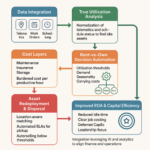
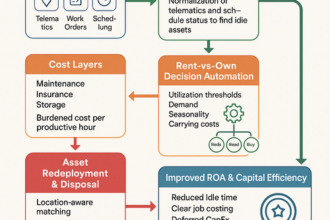
When telematics data flows into your ERP and planning tools, it turns into capital decisions that compound.
- Utilization clarity: See actual hours versus fully loaded cost per asset; expose idle units tying up cash.
- Rent vs own automation: Set thresholds (for example, cost per hour versus market) and trigger rentals or divestment automatically.
- ROA protection: Flag end‑of‑life windows to sell before value decay; cut depreciation, insurance, and storage costs.
Curious how to operationalize this? Lyaxis aligns telematics with accounting identifiers (IDs) and gives CEOs the thresholds; the newsletter unpacks the playbooks and benchmarks. Expect tighter Capital Expenditures (CapEx), higher ROA, and fewer meetings to get there.
Seeing Clearly: Using Integrated Data to Track True Equipment Utilization and Costs
Integrate telematics, maintenance, and job-cost data and utilization stops being a guess. You see true dollars per hour and where CapEx is dragging ROA.
- Right-size use: Meters plus schedules reveal idle and ghost assets; a dozer at 38% use costs $142/hour versus $120/hour to rent.
- Rent vs own: Hour thresholds auto-trigger redeploy, rent, or sell actions, aligned to seasonality.
- Cost leaks: Idling, underbilled jobs, and maintenance creep; role-based views Operations (Ops) and Finance trust.
- Exit timing: Alerts before resale curves dip; redeploy to higher-demand sites fast.
Want the benchmarks behind these thresholds? The Lyaxis brief shares them; the platform wires data and surfaces actions.
Automating Smart Decisions: Rent-Versus-Own Thresholds to Maximize ROA
Rent-versus-own should be automated, not debated. Linking telematics, schedules, and accounting ensures decisions hit before ROA erodes.
- Utilization thresholds: Own when projected utilization is 65–70% or higher for the next two quarters; rent below roughly 40%; auto-return after 21 idle days.
- Lifecycle economics: Compare fully loaded cost per hour (depreciation, maintenance, insurance) to live rental rates; for example, $78/hour versus $102/hour.
- Forward view: Merge backlog and meter trends to trigger buy/rent/return dates 30–60 days ahead.
- Redeploy/dispose: Flag low-demand assets for transfer or resale at peak value.
Takeaway: CapEx drag drops, uptime stays high. Lyaxis can surface your thresholds and send an insight brief—no commitment, clarity.
Turning Idle Assets into Opportunity: Strategies for Redeployment and Timely Disposal
Idle assets quietly tax ROA. Treat them like inventory—redeploy fast and sell at peak.
- Reveal true cost/hour: Link telematics, scheduling, and accounting to reveal true cost per hour and 90‑day utilization; auto rent‑versus‑own at under 40%.
- Internal marketplace: Route underused units to hot jobs in 24–48 hours, with Service Level Agreement (SLA) guards.
- Trigger disposal: When next‑12‑month carry plus maintenance exceeds resale decay; recover 8–15% more and free cash.
- Sharper negotiations: Clean meters and job‑cost tie‑outs sharpen rental negotiation and shrink buffer fleets.
Lyaxis surfaces these signals and timing—see field‑tested playbooks in the newsletter. Outcome: higher utilization, lower CapEx drag, steadier ROA.
From Chaos to Clarity: Aligning Operations, Finance, and Scheduling for Scalable Asset Management
Operations (Ops), Finance, and Scheduling in silos leave assets idle and cash trapped. One source of truth—telematics plus dispatch plus accounting—creates a cadence that scales.
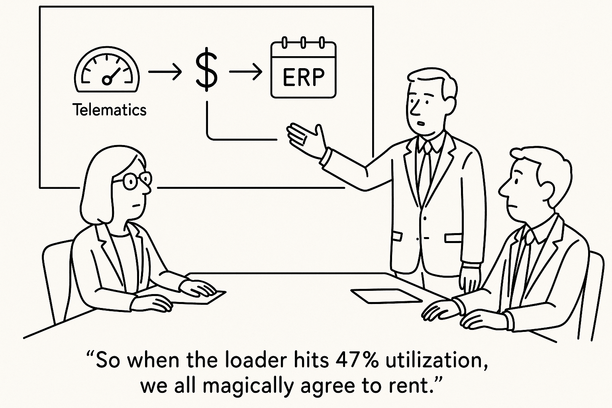
- See utilization versus cost: A loader at 47% with $22/hour carrying cost should shift or exit.
- Automate rent‑versus‑own: Greater than 65% for 90 days means buy; less than 45% means rent or transfer—no politics.
- Redeploy and sell on time: Meters plus forecasts surface idle units; aging curves and comps lift ROA.
Lyaxis turns these thresholds and integrations into an insight brief you can use to benchmark policy—leading to higher utilization, lower carrying costs, and time back.