Introduction: Why Fixing Processes Before Tools Unlocks Real Automation ROI
I learned the hard way that buying more software doesn’t fix broken work. Early in my career, we automated a clunky handoff between sales and finance. The result? We scaled the clunk. Errors multiplied, cycle times stretched, and the “solution” created new rework. Since then, I’ve seen the opposite approach win repeatedly: fix the process first so the tool becomes a force multiplier—faster payback, cleaner data, fewer surprises. In other words, focus on the flow, then let technology amplify the return on investment (ROI).
Takeaway: Fix flow first; then tools amplify ROI, not waste.
Uncovering Hidden Waste: Mapping Your Current State to Reveal Bottlenecks and Rework
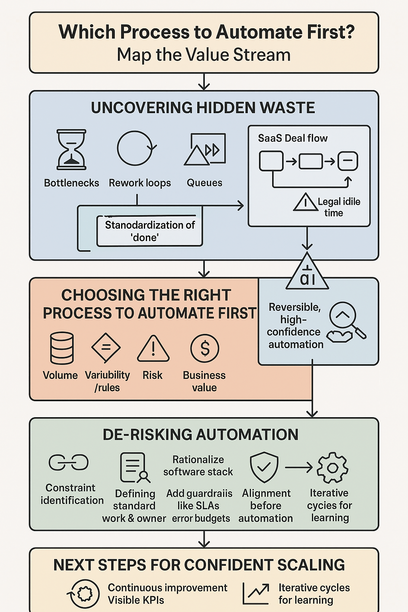
Automating a broken flow just scales the breakage. Start by mapping your current state to expose where value gets stuck—bottlenecks, rework loops, and silent queues you might otherwise hard‑code into software. Standardize “done” so handoffs click and errors drop; otherwise, “done” means different things to different teams.
- Follow the work, not the organization chart (org chart): trace trigger‑to‑cash to expose stalls, loops, and risky handoffs.
- Quantify queues vs. touch time: most delays are waiting, not working—make them visible before you automate them.
- Align the “definition of done” across teams: misalignment drives do‑overs and dirty data.
- Mini‑case (Software as a Service, SaaS): mapping a SaaS deal flow revealed Legal idle time; adding structured intake plus a Service Level Agreement (SLA) cut a week off cycle time before any automation.
Choosing the Right Process to Automate First: Prioritizing Impact and Feasibility
Your first automation should relieve the value‑stream bottleneck, not cement it. Map the current state to surface rework, handoff friction, and queue time; then score candidates to pick a reversible, high‑confidence win.
- Volume: high throughput plus repeatability equals leverage.
- Variability and rules: stable inputs and a clear “definition of done” beat edge cases.
- Risk: choose reversible, low‑blast‑radius pilots; parallel‑run to de‑risk outcomes.
- Business value: tie improvements to customer impact and cash—cycle time, error rate, and Days Sales Outstanding (DSO).
- Quick win first: faster cash, fewer errors, and more trust build momentum for the next bet.
De-Risking Automation: Aligning Teams, Reducing Tool Sprawl, and Building Standard Work
Automation fails when it codifies broken work. De‑risk ROI by aligning people, pruning the stack, and locking in standard work before you add new tools.
- Map end‑to‑end and identify the constraint: find the cash‑throttling bottleneck before you invest.
- Define “done” and standard work with clear owners: ambiguity is the priciest integration and the root of most handoff errors.
- Rationalize the stack: cut overlapping apps and rebuild around the minimum viable platform that best serves the constraint.
- Add lightweight guardrails: SLAs (Service Level Agreements), error budgets, and leading indicators help gains stick without firefighting.
- Align first, then automate the constraint: cut cycle time, errors, and spend—without adding headcount.
Next Steps for Confident Scaling: Ongoing Insights, Continuous Improvement, and Impruver University
Scale with confidence by fixing the process before the tool. Turn early wins into a flywheel with visible Key Performance Indicators (KPIs), tight retrospectives, and micro‑learning that reinforces Continuous Improvement (CI).
- X‑ray the value stream first: expose rework, handoff friction, and queue time—before automating.
- Pick the first bet by impact × feasibility: tie choices directly to customer outcomes and cash flow.
- Standardize “done” and owners: reduce errors and de‑risk vendors and integrations.
- Make KPIs visible and run weekly retros: convert noise into throughput and keep improvements compounding.
For ongoing, practical frameworks you can apply immediately, explore the Lyaxis newsletter. When you’re ready to deepen skills with bite‑size lessons and templates, Impruver University accelerates CI—use code 15off to save 15%.