Introduction: Revealing the Invisible Cost of Excessive Concurrent Work
I learned the hard way that the hidden drag in scaling teams wasn’t a lack of effort—it was asking good people to juggle too many things at once. The more we started, the less we finished. When we finally limited work-in-progress (WIP), throughput, quality, and morale all improved—fast.
The hidden drag in scaling isn’t effort; it’s excessive concurrent work. Flow beats frenzy—starting less finishes more.
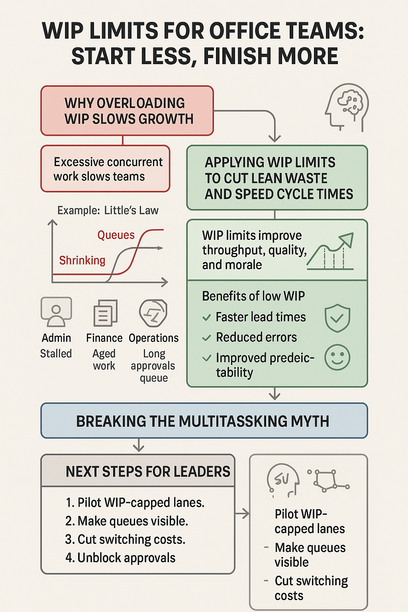
Each added in‑flight item lengthens lead time (Little’s Law), triggering missed closes and late launches. Context switching burns 20–40% capacity and invites rework. Invisible queues and approvals stall handoffs while status meetings mask aging work. High utilization looks efficient; clear work‑in‑progress (WIP) limits raise throughput, predictability, and quality.
Prefer insight over pressure? The Lyaxis newsletter distills office‑ready WIP tactics; when you’re ready, Impruver University turns them into habit. Takeaway: limit concurrency to unlock speed, clarity, and a humane pace.
Why Overloading Work-in-Progress Slows Growth: Insights from Admin, Finance, and Ops
Overloaded WIP looks like progress but behaves like sand in the gears. Most office lead time is waiting, so starting more simply makes everything later. In administration (admin), finance, and operations (Ops), here’s how it shows up:
Admin: tickets balloon, handoffs stall, and context switching quietly burns 20–40% capacity.
Finance: 200 “in‑flight” reconciliations means more aged items, errors, and last‑minute closes.
Ops: approvals queue behind busy managers; small decisions wait days, cycle times stretch weeks.
High utilization is not throughput; fewer parallel items cut rework and shorten lead time.
Lyaxis helps you see queues and set WIP limits. For low‑effort insight, explore our newsletter, then Impruver University when you want practice.
Applying WIP Limits to Cut Lean Waste and Speed Cycle Times in Back-Office Teams
Back offices drown in “work started” that waits. Small WIP limits convert busyness into flow—often 20–30% faster cycle times without new hires.
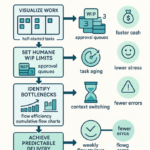
Cap in‑flight items per role/process and visualize queues; Little’s Law turns lower WIP into faster lead times. Prioritize by cost of delay and service level expectations (SLEs) so teams finish before starting; predictability rises. Protect focus blocks and reduce parallel handoffs; errors and rework fall. Add pull policies and aging limits so blockers surface fast.
Want the practical playbook? Lyaxis field‑notes unpack office WIP limits; when ready, explore Impruver University. The payoff: faster service at a humane pace.
Breaking the Multitasking Myth: Real-World Benefits of Focused Workflow and Clear Priorities
Multitasking feels productive but quietly taxes throughput, quality, and morale.
Finance: cap WIP at three reconciliations; close time fell from 10 to 6 days, errors down 35%.
Ops desk: two tickets per analyst cut average lead time 48% in a week; escalations halved.
Approvals: one daily batch beat ad hoc pings; context switching shrank, first‑pass yield up 20%.
Lower WIP shortens queues—Little’s Law made useful—so predictability climbs.
Want relief, not another initiative? Lyaxis can pinpoint WIP limits and visualize queues; our newsletter shares the playbook—then explore Impruver University. Takeaway: fewer things in flight; more done—faster, calmer, repeatable.
Next Steps for Leaders: Embracing Practical WIP Limits with Continued Learning and Impruver University
Excess concurrent work in admin, finance, and ops quietly inflates lead times and rework. Practical WIP limits swap overload for flow and restore predictability.
- Pilot one lane. Cap invoices‑in‑progress or hiring reqs; watch cycle time drop.
- Make queues visible. Track WIP, lead time, and throughput on one board to guide priorities.
- Cut context switching. Fewer items raise quality and free leadership attention.
- Unblock approvals. Treat handoffs as work; limit them to speed decisions.
Curious what “low WIP” looks like in practice? Browse the Lyaxis newsletter for quick cues—then turn them into habits with Impruver University. Outcome: faster closes, calmer teams, steadier forecasts.