Introduction: From Inbox Chaos to Actionable Clarity with AI-Powered Email Workflows
I’ve lived the 7 a.m. firefight—skimming long threads, forwarding to the “right” person, and hoping nothing mission‑critical slipped through. The day I wired our inboxes to a structured workflow and let artificial intelligence (AI) do the heavy lifting, the noise dropped and predictability returned. Inbox firefighting drains focus; when messy threads become assigned, time‑bound tasks, work starts moving on time and leadership attention goes back to priorities that matter.
Transforming Emails into Structured Tasks: How NLP Unlocks Efficiency in Monday.com
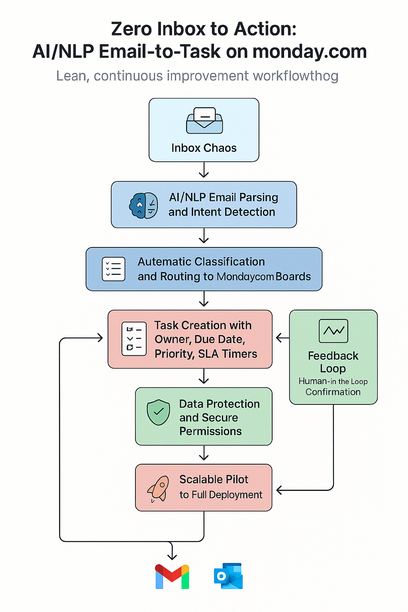
Your inbox hides work. Natural language processing (NLP) turns each email into a Monday.com item with owner, due date, priority, and linked context—so nothing gets lost in the shuffle and every handoff is accountable.
- Detects intent and routes fast: Classifies requests, escalations, and approvals, then sends them to the right board—cutting triage from minutes to seconds.
- Extracts entities from messy threads: Pulls out amounts, purchase orders, dates, and names while preserving attachments and a link back to the original email.
- Applies service level agreement (SLA) timers: Auto‑starts deadlines and status updates that roll up into real‑time workload and SLA reports.
- Respects permissions and policies: Honors team boundaries with configurable access and on‑platform controls.
- Deploys with low lift: Works with Gmail and Outlook and requires minimal information technology (IT) effort to pilot.
Here’s how it looks in practice:
- Sales escalations: Auto‑classified and routed with owner, due date, and SLA; the original email stays linked for context.
- Vendor invoices: Parsed for amount and purchase order, sent to Finance with approval path and audit trail—no copy‑paste required.
- Customer requests: Gmail/Outlook emails become tickets with priority derived from intent and key entities, improving response time and visibility.
Outcome: faster throughput, clearer ownership.
Overcoming Integration and Adoption Barriers for Seamless Gmail and Outlook Sync
Gmail/Outlook‑to‑Monday.com sync rarely fails because of code; it fails on permissions, security, and habits. Fix those and the inbox becomes an actionable pipeline.
- Permissions: Use least‑privilege service accounts with domain/tenant consent and scoped labels to keep control tight.
- Security: Redact personally identifiable information (PII), encrypt end‑to‑end, enforce single sign‑on (SSO), and log every message event.
- Reliability: Deduplicate by the message identifier (Message‑ID), run idempotent retries, and backfill via change tracking.
- Adoption: Map folders to statuses, pilot one high‑volume inbox, auto‑link email context, and highlight early SLA (service level agreement) gains.
A small, well‑scoped pilot proves value quickly while de‑risking scale‑up.
Achieving Zero Inbox: Real-World Impact on SLA Compliance, Visibility, and Leadership Focus
Zero inbox isn’t a tidy mailbox; it’s work moving on time. When messy emails auto‑become structured tasks in Monday.com, SLAs stabilize and leaders get signal over noise. NLP tags intent, owner, due date, and priority; responses land faster and escalations taper. Linked email context travels with the task, ending forwards and restoring accountability. Real‑time workload views expose bottlenecks so you can reallocate before breaches, not after. It runs on Gmail/Outlook with Monday.com—minimal IT, secure permissions, full audit.
Calm Control: Practical Next Steps and Tools to Automate Your Email-to-Task Pipeline
- Start with one inbox: Choose a high‑volume queue (support@ or ap@) and map folders/labels to statuses.
- Template the flow: Use ready‑to‑run connectors; define owners, SLAs, and escalation rules up front.
- Keep humans in the loop: Let AI draft fields; require quick human confirmation for edge cases.
- Protect data from day one: Apply least‑privilege access, PII redaction, SSO, and auditing before scaling.
- Instrument outcomes: Stand up dashboards for intake volume, SLA attainment, and reassignments to prove impact.
- Expand thoughtfully: After the pilot, add teams and refine entity extraction for your domain (invoices, RFPs, approvals).
Want grounded plays, not hype? Explore case studies in the Lyaxis newsletter. When you’re ready to feel the relief, try a lightweight Monday.com template and automation—insight first, tools when you need them.