Introduction: When Chat Decisions Disappear into Thin Air
I’ve watched it happen more than once: a late-evening Microsoft Teams thread ends with a clear “yes, proceed,” and by morning that decision has evaporated—no task, no owner, and a leader (often me) chasing it down. After repeating this cycle, I adopted a simple rule that changed everything: every decisive moment in chat becomes a task in Monday.com automatically. The result has been tighter follow-through, clearer ownership, and real time back for leadership that used to be spent playing scribe.
The Event-Based Automation Model: Turning Teams Messages into Monday.com Tasks
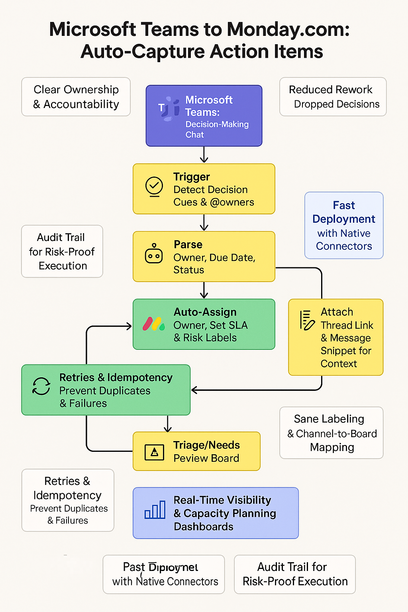
Decisions get made in Teams, then vanish by morning. An event-based model fixes this by turning decisive messages into structured Monday.com items—instantly and reliably.
- Trigger: Detect decision cues, @owners, and dates; parse into owner, due date, and status.
- Ownership: Auto-assign the @mentioned person, respect dates, and add SLA (service-level agreement) and risk labels.
- Context: Attach the thread link and a brief meeting or message snippet for auditability and faster handoffs.
- Resilience: Use idempotency and retries; route any issues to a triage lane instead of failing silently.
- Visibility: Surface chat-born work on dashboards for capacity planning and follow-through.
Takeaway: fleeting chats become accountable execution without heavy information technology (IT) lift.
Why Automating Task Capture Boosts Execution and Frees Leadership Time
When decisions made in Teams evaporate, leaders end up as note-takers and follow-up coordinators. Automating capture shifts accountability from memory to system—so the work shows up where work gets done.
- Event-based automation: A Teams trigger creates a Monday.com item—messages or meeting notes become tasks with context and a clear owner.
- Ownership clarity and visibility: Dashboards reflect chat-born work in real time, reducing ambiguity and rework.
- Risk-proofed execution: Dedupe, retries, and an audit trail prevent brittle handoffs and missing tasks.
- Fast to deploy: Native connectors minimize information technology (IT) lift while standardizing capture across teams.
Net result: fewer dropped decisions, clearer ownership, faster cycles, and leadership time back.
Designing Reliable, Low-Maintenance Teams-to-Monday Workflows That Scale
Replace copy/paste with a simple, durable model: Teams event → Monday.com item—created once, owned instantly, and monitored lightly.
- Idempotent triggers: Ensure one task per decision; retries never create duplicates.
- Ownership at birth: Set assignee, due date, priority, and the source permalink the moment the item is created.
- Explicit intent signals: Use @task mentions, a checkmark reaction, or a meeting summary to convert intent into work.
- Channel-to-board mapping: Route ownership and place tasks correctly; auto-apply due dates and SLAs (service-level agreements).
- Resilient paths: Throttle gracefully, dedupe by message ID, and send uncertain cases to a “Needs Review” or Triage board with quiet alerts.
- Context carried forward: Keep deep links to the chat or meeting and include a short summary for fast handoffs and auditability.
- Sane conventions: Standardize labels by meeting or channel so reporting and capacity views scale without manual cleanup.
Done right, this delivers durable throughput without turning leaders into scribes—or your ops team into full-time bot babysitters.
Unlock Ongoing Insights and Practical Recipes to Enhance Your Automation Journey
If you want quiet, field-tested patterns and play-by-play breakdowns, explore the Lyaxis newsletter for practical blueprints and failure-mode checklists: Lyaxis Newsletter.
Prefer a ready-made build you can adapt today? The recipe from Impruver University is a fast start and pairs well with the approach above—use code “15off”: Impruver University.