Introduction: How AI-Driven Scheduling Transforms Multi-Location Operations
I’ve sat in too many back offices watching managers juggle sticky notes, texts, and spreadsheets while two stores ran thin and another paid for idle time. That whiplash between missed demand and wasted labor isn’t a people problem—it’s a planning problem. AI-driven scheduling centralizes rules, demand signals, and skills to auto-assign fair, compliant shifts, giving managers hours back and delivering consistent service across locations.
In practice, that means predicting demand from point-of-sale (POS) systems, bookings, or tickets; right-sizing coverage by hour and site; and honoring skills and preferences alongside union, overtime (OT), and certification rules. The result I’ve seen repeatedly: fewer fire drills, steadier margins, and measurable lifts in guest satisfaction.
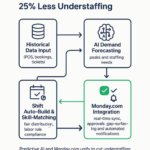
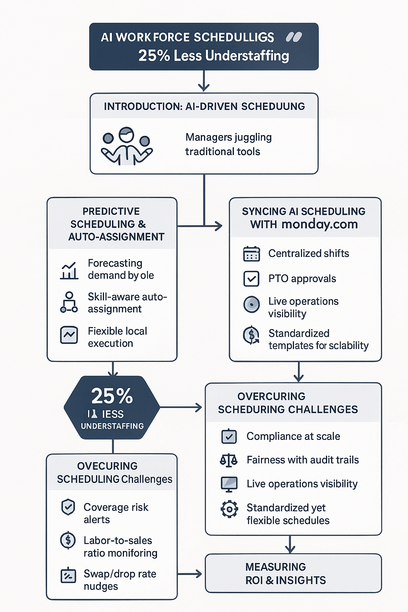
Predictive Scheduling and Auto-Assignment: Cutting Understaffing by 25%
Predictive scheduling pairs demand forecasts with skill-aware auto-assignment to right-size coverage and protect margin. It replaces last-minute scrambles with plans that flex by site and hour.
- Forecast demand by hour and role: Use orders, footfall, or ticket volume to translate demand into staffing needs at the role level.
- Auto-assign the best-fit people: Honor skills, preferences, fatigue limits, certifications, union agreements, and OT caps with a transparent audit trail.
- Plan by site, execute by exception: Shift leaders focus on exceptions while the plan adapts to local constraints.
- Track impact, not intentions: Measure before/after understaffing intervals, wait times, and labor efficiency to prove the model’s effect.
Operators consistently report about a 25% reduction in understaffed intervals without padding payroll. For benchmarks and model tips you can test on your own data, explore the Lyaxis newsletter: https://lyaxis.com/category/newsletter/.
Syncing AI Scheduling with Monday.com to Streamline Labor Management
AI scheduling delivers its full value when it’s embedded in daily tools. Syncing plans with Monday.com centralizes shifts, paid time off (PTO), and approvals—eliminating double entry and last-minute surprises.
- Forecasts flow into boards: Coverage gaps are flagged days in advance, trimming understaffing by roughly 25% without inflating hours.
- Compliance by design: Skills, region and union constraints, rest periods, and OT rules are enforced; PTO and swaps are approved in-stream with full auditability.
- Real-time visibility: See shift cost against forecasted demand, service risk, and change history directly where teams already work.
- Scalable control: Standardized templates span locations while honoring local constraints, giving managers back critical time.
When you’re ready to tidy the handoffs and integrations, the Lyaxis newsletter offers practical playbooks and automation ideas: https://lyaxis.com/category/newsletter/.
Overcoming Scheduling Challenges: Compliance, Fairness, and Demand Surges
Scheduling isn’t just filling slots—it’s balancing compliance, fairness, and sudden demand spikes that can erode margin. AI guardrails help protect both people and profit.
- Compliance at scale: Predict site-level surges and auto-assign with fair-workweek requirements, union provisions, and OT limits baked in.
- Fairness you can defend: Equitable rotation reduces favoritism; transparent audit trails raise trust and cut callouts.
- Live operations picture: Sync forecasts, constraints, and approvals in Monday.com to monitor coverage and cost in real time.
- Standardize, don’t straitjacket: Use templates to standardize across locations while giving managers authority to approve exceptions—not rebuild schedules.
To de-risk rollout, stress-test policies with checklists and pilots. You can find lightweight guides in the Lyaxis newsletter: https://lyaxis.com/category/newsletter/. The payoff: higher Net Promoter Score (NPS), steadier margins, and leadership time back.
Beyond Automation: Measuring ROI and Gaining Real-Time Scheduling Insights
Automation pays only when return on investment (ROI) is visible in real time. Focus on a few signals that expose coverage risk and cost—then let them trigger alerts and experiments.
- Coverage variance: Pinpoint thin floors and push shift offers before service dips.
- Labor-to-sales ratio: Guardrail profit per hour; same-day rebalancing via Monday.com keeps spend aligned to demand.
- Swap and drop rates: Surface fairness friction; nudge equitable, compliant assignments to reduce callouts.
- Forecast error: Use A/B (split) tests to compare models versus reality; tune auto-assignment to keep trimming understaffing near the 25% mark.
Lyaxis turns these metrics into lightweight dashboards, ROI templates, and Monday.com playbooks—see examples in the newsletter: https://lyaxis.com/category/newsletter/. The outcome: fewer fire drills, clear labor ROI, and consistent coverage across locations.