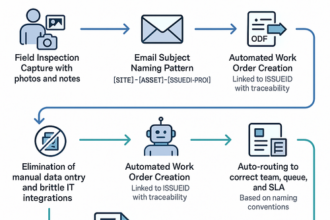
Walking plants and poring over audit binders taught me a hard truth: the slowest part of food safety isn’t finding issues—it’s turning findings into action before lines stop and shipments slip. The handoffs between audit, Quality Assurance (QA), operations, and suppliers are where days disappear. This article shares practical ways I’ve seen teams close that audit-to-action gap with smart, light-lift automation—cutting Corrective and Preventive Action (CAPA) cycle time, reducing holds, and giving leaders their hours back.
Bridging the Audit-to-Action Gap in Food Safety Compliance
Audits finish; action stalls. That audit-to-action gap stalls CAPA (Corrective and Preventive Action), triggers shipment holds, and drains leadership time. The cure is a consistent bridge from finding to owner to proof—without manual shuffling.
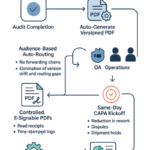
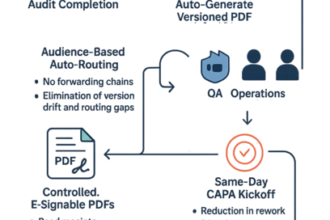
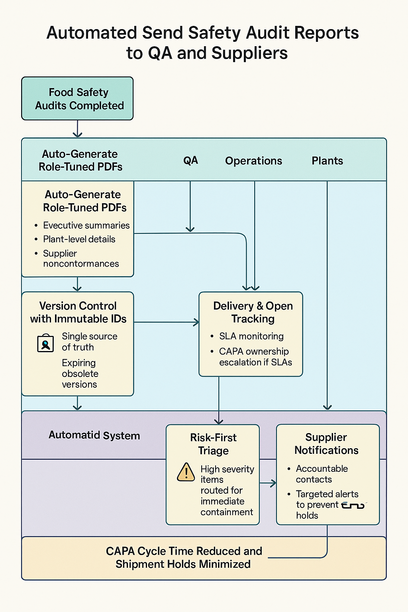
Auto‑versioned PDFs create a single source of truth and a defensible trail. Audience‑based routing delivers reports to QA (Quality Assurance), plants, and each supplier—role‑specific, within minutes. Delivery/open visibility, clear ownership, and Service Level Agreements (SLAs) keep actions moving and surface next‑best steps. Standardized rules by site, product, and supplier prevent misses and rework. Standardized checks also capture photos and timestamps, keeping evidence on tap for audits.
Streamlining Audit Report Delivery: Automate PDFs and Audience-Based Routing
Manual PDFs and “email roulette” keep CAPA waiting and shipments at risk. Automating PDF generation and audience-based routing closes the audit‑to‑action gap fast and keeps distribution lists from going stale.
- Role‑tuned PDFs: Executive summaries, plant‑level detail, and supplier nonconformances (NCs) without copy‑paste or misses.
- Versioned reports as a single source: Superseded versions are replaced automatically, preventing duplicate actions.
- Rules by site, product, and supplier: Instant routing; supplier alerts include due dates and owners.
- Delivery/open tracking and ownership: A defensible Global Food Safety Initiative (GFSI) and Food Safety Modernization Act (FSMA) trail that reduces holds.
Generate GFSI/FSMA‑ready PDFs and route to QA, operations, and suppliers by role, site, product, and vendor—so the right people see the right things right away.
Version Control and Supplier Notifications: Reducing Shipment Holds and Delays
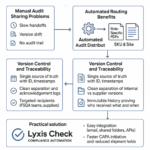
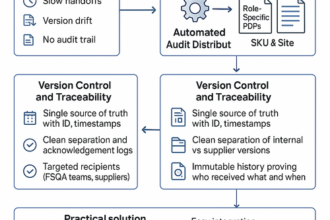
Shipment holds rarely come from bad product—they come from bad versions and slow signals. Lock specifications, Certificates of Analysis (COAs), and Standard Operating Procedures (SOPs) to one source of truth—and prove who saw what, when.
- Auto‑PDFs at audit close with audience‑based routing: Filter by role, site, product, and supplier; vendors get only what’s relevant.
- Versioned reports with immutable IDs: Obsolete links expire so actions always hit the latest revision—with a defensible GFSI/FSMA trail.
- Smart supplier notifications: Read/open tracking and CAPA ownership; escalate only when SLAs (Service Level Agreements) slip.
Accelerating CAPA Cycles Without Adding Headcount: Practical Automation Insights
CAPA lags rarely stem from poor intent; they stem from slow handoffs. Automate the audit‑to‑action bridge and you reclaim days without hiring.
- Auto‑PDFs and audience‑based routing: The right report hits QA, plants, and suppliers within seconds, filtered by site and product.
- Versioned, traceable records: One source of truth with delivery/open tracking, ownership, SLA nudges, and a defensible audit trail.
- Risk‑first triage: High‑severity items route for immediate containment; templates standardize root cause.
- Supplier‑specific alerts: Accountable contacts, not blasts; escalations prevent shipment holds.
Unlocking Relief: How Smart Tools Like Lyaxis Check Transform QA Workflows
Lyaxis Check quietly handles the heavy lifting—auto‑PDFs, audience‑based routing, versioning, supplier notifications—without a heavy IT lift. The result is shorter CAPA cycles, fewer holds, and leaders focused on improvement instead of inbox triage.
Prefer patterns over pitches? Our field notes break down the mechanics and benchmarks teams use to cut days from CAPA. Explore the newsletter at lyaxis.com/category/newsletter. Ready to try it? See Lyaxis Check on Google Play: Lyaxis Check.