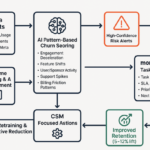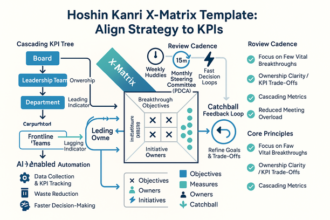

I’ve led teams through quarters where the dashboard looked great—right up until the forecast cratered. What fixed it wasn’t more charts; it was a simple shift in how we measured: start with the outcome we’re accountable for, then map the few inputs that actually move it. That “KPI tree” turned noise into clear, weekly levers teams could pull confidently.
Introduction: Why Traditional KPIs Fail and What a KPI Tree Can Fix
Traditional KPIs (Key Performance Indicators) celebrate the past, conflict in the present, and invite gaming. A KPI tree flips it—outcome at the top, causal inputs below—so teams move the right levers on time.
- Replace vanity. “Revenue up” while cash worsens? Tie to win rate, cycle time, and payback.
- End silo games. One North Star with shared drivers (lead quality → activation → retention).
- See early. First-week retention, quote-to-close, and lead SLA (Service Level Agreement) predict ARR (Annual Recurring Revenue).
- Save leadership time. Fewer charts, cleaner definitions, self-managing reviews.
Expect fewer surprises and cleaner tradeoffs. For lived examples, skim the Lyaxis newsletter; when you want reps, Impruver University (code 15off) pairs well.
Designing Your KPI Tree: Cascading from Outcomes to Behavior-Driving Inputs
Outcomes move by behaviors, not dashboards. A KPI (Key Performance Indicator) tree turns strategy into weekly, testable actions.
- Anchor one outcome. Set a hard line (e.g., 90‑day NRR (Net Revenue Retention) ≥ 105%); kill conflicts.
- Pick 2–3 predictive leads. Add thresholds (activation < 7 days, PQL (Product-Qualified Lead) → win%).
- Tie each lead to one controllable input and owner. Examples: onboarding touches, SDR (Sales Development Representative) connects. Test falsifiably; cap ~12 nodes.
Aligning Teams and Reducing Dashboard Noise with Focused Metrics
Dashboards don’t align teams; agreements do. Choose a North Star and a few leading signals that change behavior—retire the rest.
- Design a KPI tree. Outcome → drivers → controllable inputs (e.g., Net Revenue Retention → expansion pipeline/week → time-to-first-value).
- Lock definitions and handoffs. One definition per metric; owned MQL (Marketing-Qualified Lead) → SQL (Sales-Qualified Lead) in < 24 hours.
- Balance leading with guardrails. Pair activations with 30‑day retention to curb gaming.
- Make dashboards quiet. One page per team—trend, owner, next experiment.
Takeaway: fewer, clearer metrics speed decisions and free leaders. For practical patterns, browse the newsletter.
Detecting Leading Signals and Predicting Results for Agile Execution
Results slip when you stare at lagging KPIs. Predictable execution comes from catching leading signals and placing weekly bets.
- Build a KPI tree. One North Star, 3–5 drivers, each tied to a single team-owned input. Quantify cause → effect: win rate × qualified pipeline added this week forecasts revenue in three.
- Run tight loops. Compare predicted vs. actual; double‑down or pivot before month‑end.
- De‑noise. Pair metrics to prevent gaming (speed with quality) and retire vanity.
Takeaway: earlier signals, safer bets.
Building Scalable Measurement: Refining KPIs and Freeing Leadership Time
Dashboards don’t scale; decisions do—a KPI tree links outcomes to a few inputs teams can move now, freeing leadership time.
- Prune hard. Anchor on a North Star and cut metrics that don’t explain or predict it.
- Promote lead levers with line-of-sight. Time-to-first-value and qualified pipeline velocity; when they move, revenue follows.
- Standardize and automate. Common definitions, automated capture; reviews become 15-minute owner–target–countermeasure huddles, not reporting theater.
- Cascade ownership. Each team owns one lever that ladders up (Onboarding: TTFV (Time to First Value) < 3 days; Sales: ICP (Ideal Customer Profile) win rate).
Grab templates and examples in the Lyaxis newsletter. For guided practice, Impruver University has a quick primer (code 15off). Result: calmer ops, faster bets.