
Introduction: Stop Optimizing Everything—Focus on the Bottleneck
I learned the hard way that chasing every alert and squeezing every machine rarely ships more. Early in my ops career, our ERP (Enterprise Resource Planning) had me maximizing local utilization while the real constraint—one finicky paint booth—dictated everything. The week we stopped “optimizing” the whole plant and scheduled to that single constraint, chaos eased and output jumped.
When everything looks important, nothing moves. Throughput jumps when you schedule to the constraint—the small hinge that swings the big door.
- ERPs chase local utilization; the bottleneck gets starved or buried. Release only to its hours.
- Upstream overproduction triggers changeover churn and overtime. Protect it with a small, visible buffer.
- Conflicting KPIs (Key Performance Indicators) fuel firefighting and late orders. Tie priorities to constraint capacity for predictable lead times.
- Simple rules beat reschedules. One plan paced by the constraint lifts throughput ~20% without capex (capital expenditures).
Want quick relief and practical plays? Skim the field notes in the Lyaxis newsletter for constraint-first insights you can apply today, and explore a concise skills boost via Impruver University when you’re ready.
Lyaxis Newsletter | Impruver University
Unlocking Hidden Capacity: How Constraint-Based Scheduling Boosts Throughput 20%
Optimize the bottleneck, not everything. Sequence to the true constraint and many plants unlock ~20% more throughput—no new capex or overtime.
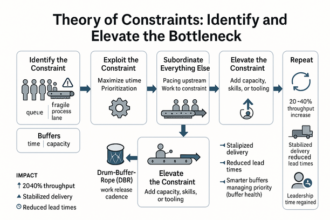
Run the constraint as the drum. Protect it with small time buffers, smart changeovers, and pre-staged tools. Release only to the drum; cap WIP (Work in Process) so non-constraints wait—and the bottleneck never does.
Use hour-by-hour signals; change the plan only on buffer red. Tie promises to drum capacity; upstream “efficiency” can fall while flow jumps. Net: steadier flow, faster lead times, and leadership time back.
Why ERP Overload Fails Us and How TOC + Lean Solve Bottleneck Challenges
ERP optimizes everything, so you drown in transactions while orders queue at one machine—the paint booth. TOC (Theory of Constraints) plus Lean flips it: schedule to the constraint and make ERP the servant.
- One drum: release only what the bottleneck can run today.
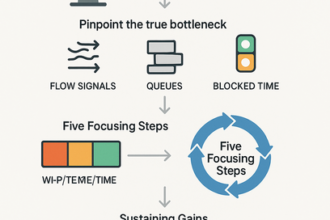
- Buffer signals, not reports: green/yellow/red at the constraint set priorities in minutes.
- Cap WIP by lane: Little’s Law turns chaos into predictable lead time.
- Align KPIs: commit to buffer, measure throughput, not local efficiency.
Plants routinely gain ~20% output without additional capex by shifting to this constraint-first, signal-driven approach.
Building Buy-In and Stability: Practical Scheduling Rules That Align Teams
Simple, shared rules make the schedule trustworthy and end firefighting fast.
- Freeze: Lock the next 24–48 hours; Tuesday’s list freezes at noon. Break only to keep the constraint fed.
- Buffers: Run to green/yellow/red at the constraint; upstream makes what the buffer needs, nothing more.
- Expedite: Only red-buffer jobs or signed must-ship promises move ahead.
- Sales sync: Quote to buffer color and constraint slots, not idle assets.
Result: 10–30% (often ~20%) more shipped, steadier lead times, and less WIP across the floor.
Next Steps for Leaders: Low-Friction Training and Insights to Sustain Gains
Constraint-focused scheduling (TOC + Lean) can lift throughput ~20% without new capex. Start with a 10‑minute constraint huddle and lock the next 24 hours to end firefighting. Use red/yellow buffers so upstream makes to buffer, not MRP (Material Requirements Planning)—WIP falls and changeover churn eases.
Give schedulers a one‑page rule—e.g., a simple two‑card kanban (a visual pull signal) before the constraint—and short drills to build trust. Sanity‑check releases by the constraint’s true takt time (the rate needed to meet customer demand) and align KPIs to flow.
For steady, no‑pressure insight, the Lyaxis newsletter breaks down these plays in the field; when you’re ready to formalize the skills, a concise course such as Impruver University can help your team lock in the gains.