Introduction: Unlocking Throughput by Pinpointing Your True Bottleneck
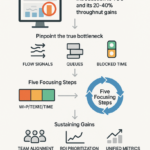
I’ve led teams where everyone was sprinting, dashboards were green, and yet delivery still slipped. The breakthrough came when we stopped pushing everywhere and instead found the one spot gating release. Throughput moves fastest when you fix one thing: the true constraint. Using the Theory of Constraints (TOC) and its five focusing steps, plus well-placed buffers, we unlocked 20–40% more output without adding headcount.
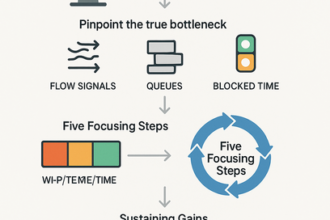
Find signal, not noise. Trace rising queues and missed SLAs (Service Level Agreements) back to the single resource that governs what leaves the system. Takeaway: pinpoint and protect the constraint to turn chaos into predictable throughput.
Decoding the Theory of Constraints: Flow, Buffers, and the Five Focusing Steps
Throughput jumps when work flows to the constraint, not when everyone runs faster. TOC (Theory of Constraints) names the leverage point and quiets firefighting. One weakest link sets output; chasing utilization elsewhere only swells WIP (Work in Process) and stretches lead time.
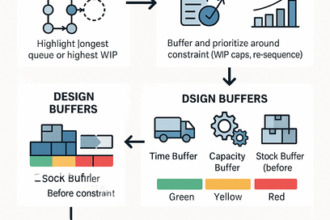
Buffers—time, WIP, and capacity—protect the constraint; DBR (Drum-Buffer-Rope) sets the release cadence across sprints, pick‑pack, or creative lanes. Here’s how TOC’s Five Focusing Steps translate in practice:
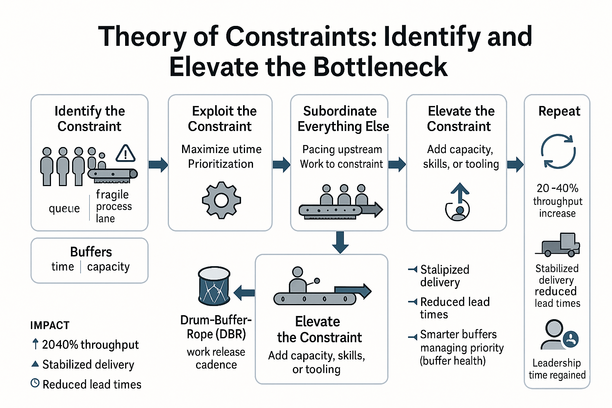
- Identify the constraint: Find it by watching where queues grow and due dates slip; the longest, most fragile lane sets your pace.
- Exploit the constraint: Maximize its uptime and sequence; give it clean priorities and zero interruptions.
- Subordinate everything else: Pace upstream work to the drum; stop starting too much; align policies and staffing to feed the constraint first.
- Elevate the constraint: Add targeted capacity, skills, or tooling only at the constraint when exploitation and subordination are tapped out.
- Repeat: As the constraint moves, cycle back to step one and keep flow balanced.
For practical, real-world examples and a simple way to apply this weekly, explore the Lyaxis newsletter: Flow Notes. The result is typically 20–40% more throughput, steadier delivery, and leadership time back.
Beyond Local Efficiency: How to Exploit and Then Elevate Your System Constraint
Local efficiency feels busy; one point sets your speed. Make that point the drum—exploit it fully before you elevate it. Then, repeat with discipline as the constraint shifts.
- Find the true constraint: Look for queues, rework, and schedule churn building at one stage (for example, code review, an oven, or a picker).
- Exploit fast: Protect the constraint’s time, add a buffer before it, cap WIP, and run DBR (Drum-Buffer-Rope) to sequence release.
- Subordinate others: Pace upstream to the drum; stop starting; track flow and due‑date hit rate instead of raw utilization.
- Elevate surgically: Add capacity, skills, or tooling at the constraint; then re‑identify the new constraint and repeat the cycle.
Expect 20–40% more throughput and calmer lead times when you move beyond local optimizations and focus on the global constraint.
Smart Buffers and Drum-Buffer-Rope: Stabilizing Delivery and Reducing Lead Time
Variability isn’t the enemy; unprotected constraints are. Smart buffers plus DBR (Drum-Buffer-Rope) create a steady beat that slashes WIP and lead time. Set the drum at the true bottleneck—whether that’s a weld cell, a QA (Quality Assurance) lane, or deploy—and release only to its pace.
Exploit before you elevate: protect the constraint and shipping with right‑sized buffers. Let buffer penetration drive priority: when the buffer goes red, you swarm; when it’s green, you wait. The rope caps WIP upstream, stabilizing lead time while throughput rises 20–40%. You gain clearer signals, steadier delivery, and leadership time back.
From Firefighting to Control: Building a Repeatable Constraint-Led Improvement Rhythm
Trade heroics for control by anchoring improvement on the constraint. A light weekly cadence can lift throughput 20–40% and steady delivery. Find the true drum with the Five Focusing Steps; stop polishing non‑bottlenecks. Exploit then elevate: feed the constraint first, align staffing, and defer nice‑to‑haves. Protect it with smart buffers and DBR; visible WIP caps cut thrash and missed SLAs (Service Level Agreements).
- Track constraint load: Is the drum starved or blocked? Fix starvation and interruptions before adding capacity.
- Track buffer health: Use buffer penetration to set priorities and trigger swarming when protection is at risk.
- Track due‑date performance: Lead time and due‑date hit rate confirm whether flow is predictable.
Simple visuals around these three signals let teams self‑correct so leaders can exit triage. For a quiet, fast start, Lyaxis maps flow, sets DBR buffers, and surfaces what matters—see examples and playbooks in the Lyaxis newsletter: Flow Notes. If you want a deeper dive into tactics, the Impruver TOC playbook (code 15off) is a solid complement.