Introduction: Unlocking True Bottlenecks to Boost Throughput by 20–40%
I learned the hard way that you can’t outwork a bottleneck. In two turnarounds—one in a SaaS (Software as a Service) platform team and another on a CNC (Computer Numerical Control) machining line—we stopped chasing local wins and started guarding the single constraint. Within a quarter, both teams lifted throughput by more than 30% without adding headcount or capex. The pattern was the same: find the real choke point, protect it with simple buffers, and align everything else to feed it first.
Most teams chase wins while one constraint sets output. Focus there and you can lift throughput 20–40% without new headcount.
- Spot it where work queues and promises slip: measure flow, not utilization. Whether it’s SaaS onboarding or a CNC cell—the same logic applies.
- Exploit before elevate: re-sequence, offload, standardize, and protect constraint hours; elevate last, then repeat.
- Buffer smart: add small work‑in‑process (WIP) and time buffers before the constraint, plus a shipping buffer to hit dates.
- Subordinate everything else: align priorities, metrics, and cadences to the constraint; stop expediting elsewhere.
For a pragmatic cadence, tap Lyaxis insights via the newsletter: Lyaxis Newsletter. If you want a ready-to-run toolkit, consider Impruver’s TOC playbook (code 15off). The result: more predictable flow and freed leadership time.
Pinpointing the Real Constraint: Overcoming Local Optimization and Conflicting Metrics
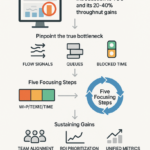
Local optimization hides the real constraint; conflicting KPIs (Key Performance Indicators) add noise. Pinpoint the constraint and you can lift throughput 20–40% without new hires.
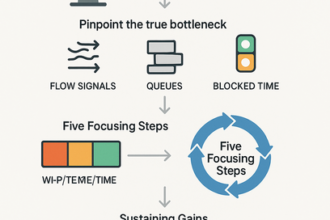
- Find the longest, most variable queue and aging WIP: that’s your constraint.
- Exploit before elevate: raise uptime, cut changeovers, protect it with time/WIP buffers, and stop expediting.
- Subordinate metrics to flow: track throughput, buffer health, and constraint uptime—not utilization.
- Watch cross‑functional tells: promises slip when shipping is full; tickets age while deploy idles.
- Recheck weekly: when the constraint moves, your buffers and focus move with it.
Crave relief‑first insight? The Lyaxis Newsletter breaks down real cases; if helpful, Impruver’s TOC playbook (code 15off) can operationalize the cadence.
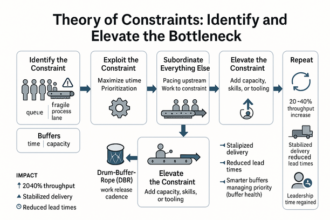
Mastering the TOC Five Focusing Steps to Exploit and Elevate Your Bottleneck
TOC (Theory of Constraints) turns firefighting into flow, often lifting throughput 20–40% without hiring. One mental model: guard the constraint with buffers.
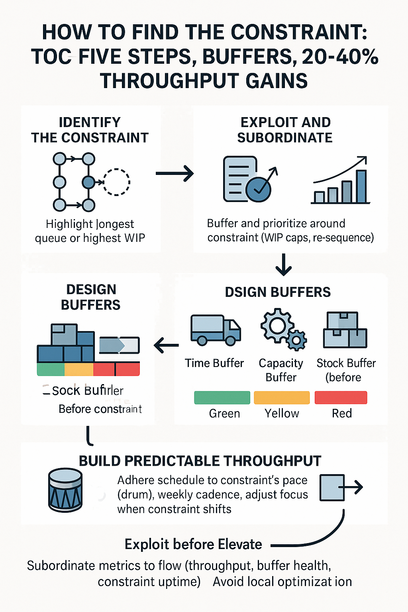
- Identify: follow the longest queue—often deploy in SaaS (Software as a Service) or a machine with rising WIP (work in process)—not the busiest team.
- Exploit + Subordinate: add small buffers at the constraint and at shipping, assign your best people there, cap upstream WIP, and route priorities to feed it first.
- Elevate (then repeat): invest after stable buffers prove demand exceeds capacity; repeat weekly, tracking throughput and buffer health.
As buffers stabilize the system, the pace becomes clear and improvement compounding gets easier.
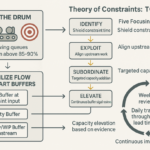
Designing Effective Buffers: Stabilizing Flow Without Guesswork or Excess WIP
Buffers stabilize the constraint, turning chaos into predictable throughput without excess WIP (work in process). Size three buffers, then manage by color.
- Time buffer (shipping): set 20–30% of total lead time; adjust weekly by buffer penetration.
- Capacity buffer (non‑constraints): keep 15–25% protective slack at non‑constraints; never schedule to 100%.
- Stock buffer (before the constraint): keep about one shift (or sprint) of the right mix; cap system WIP to that via rope/CONWIP (Constant Work in Process).
- Visual cadence: use a daily board; only “red” jobs jump the queue.
Expect 20–40% throughput gains before capex. Curious what “right‑sized” is for you? Lyaxis can help map your constraint and buffers—get the walkthrough via the Lyaxis Newsletter; or try Impruver’s TOC playbook (code 15off).
Building Predictable Throughput: Practical Tools and a Reliable Improvement Rhythm
Predictable throughput comes from one idea: protect the constraint and the promise. A light weekly rhythm makes 20–40% gains stick—no new headcount.
- Find the constraint: track queue length and buffer consumption, not utilization.
- Exploit before elevate: faster changeovers, aligned staffing, capped WIP; size buffers to variation.
- Schedule to the drum: release only what buffers can absorb; “drum” = the constraint’s pace; review weekly.
- Let it move: when the constraint shifts, leading indicators point to the next bet.
For working cadences and templates, the Lyaxis Newsletter offers relief‑first insight. Optional: Impruver’s TOC playbook helps (code 15off). Result: steadier promises, fewer fires, and faster cash.