I’ve led teams where every week felt like a new emergency. Everything looked like the bottleneck, yet adding people or pushing harder never fixed the jams. The turning point came when we applied the Theory of Constraints (TOC), a method that forces focus on one real constraint at a time. Within a few cycles, throughput rose by roughly 20–40%—without new headcount—fire drills faded, and we got our evenings back. This article shares how to get there: how to spot your true bottleneck, apply the Five Focusing Steps, stabilize flow with smart buffers, and turn improvement into a repeatable, scalable engine.
Unlocking Growth: Applying the Theory of Constraints for 20-40% Throughput Gains
Growth stalls when everything looks like the bottleneck. The Theory of Constraints (TOC) focuses attention on the single pace-setting step that limits system throughput. By aligning work around that point—protecting it, feeding it the right work at the right time, and avoiding local optimizations elsewhere—organizations commonly unlock 20–40% throughput increases without adding headcount.
Your system has one real bottleneck; everything else is a distraction. Replace firefights with flow evidence and treat the constraint as the drum that sets the beat for the entire operation.
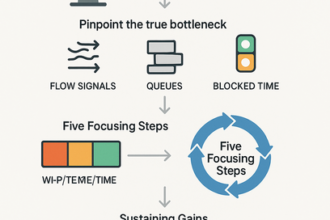
Pinpointing Your True Bottleneck: Beyond the Noise of Local Firefights
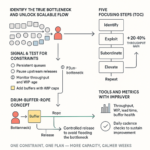
When everything feels critical, data and simple signals cut through the noise. In Drum‑Buffer‑Rope (DBR)—a TOC scheduling approach—the “drum” is the constraint that paces the system; buffers protect it; the “rope” governs release so upstream work doesn’t overwhelm flow.
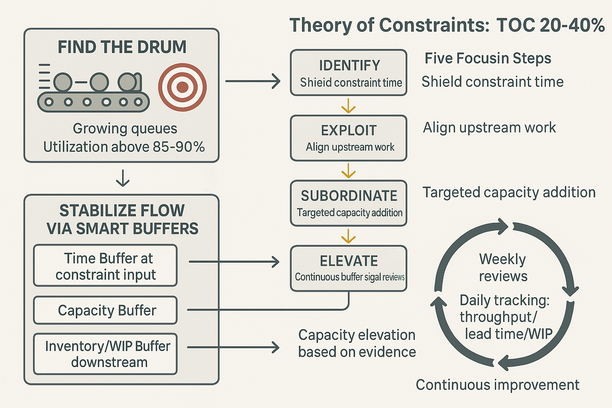
- Find the drum (the constraint): Look for the step with the fastest-growing queue, the longest wait, and sustained utilization above ~85–90%.
- Track flow evidence: Follow queue length, blocked time, and due‑date misses back to a single step; that’s your constraint.
- Stop firefighting, start observing: Watch the longest, most stable queue over time; measure flow time and wait time—not just utilization.
Mastering the Five Focusing Steps: Exploit, Elevate, and Sustain the Constraint
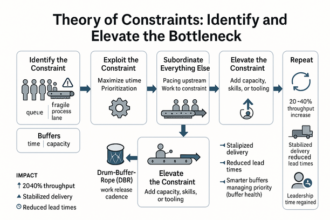
The Five Focusing Steps convert reactive firefighting into predictable flow. Apply them in order and resist skipping ahead.
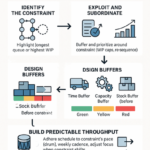
- Identify: Confirm the constraint by evidence: stable, longest queue and chronic delays at one step.
- Exploit: Shield the constraint’s time; kill multitasking, cut changeovers, shrink batches, pre‑kit inputs, and feed only ready, high‑leverage work.
- Subordinate: Align everything else to the constraint. Cap upstream Work in Progress (WIP; the amount of work started but not finished), release to buffer signals rather than to idle capacity, and stop expedites that jump the line.
- Elevate: After two improvement cycles, add targeted capacity only at the constraint—offload tasks, add focused hours, minor tooling, cross‑training, or sequence tweaks. Measure throughput and on‑time performance daily.
- Sustain (and repeat): Use simple buffer‑signal reviews to see when the constraint moves. Track throughput, WIP, and lead time so gains compound without new headcount.
Buffers and Flow: Crafting Stability Without Starving Your System
Right‑sized buffers turn chaos into predictable flow by protecting the constraint from variability. Done well, they raise throughput 20–40% while calming operations.
- Time buffer at the constraint’s input: Hold enough ready work (often 1–1.5× typical upstream variability) so the constraint never starves.
- Capacity buffer on the constraint: Maintain 10–15% flexible capacity—via cross‑trained float or a spare instance—to absorb spikes without long delays.
- Inventory/WIP buffer downstream: Keep a small, capped “supermarket” so output doesn’t flood or starve subsequent steps.
- Subordinate release (the “rope”): Gate starts to the drum’s pace; flow beats utilization. Starting less, at the right time, finishes more.
From Chaos to Clarity: Building a Repeatable, Scalable Improvement Engine
A simple cadence keeps improvements compounding and the constraint in clear view.
- Weekly 30‑minute review: Re‑scan the system, read buffer signals, confirm the current constraint, and agree on one to two focused experiments.
- Daily visibility: Track throughput, lead time, and WIP at the constraint; adjust release to keep the input buffer healthy.
- Elevate last: Only add capacity at the drum when exploit and subordinate are tapped out—and measure the impact immediately.
Expect faster, more predictable flow, fewer fires, and clearer bets for leadership—often with 20–40% throughput gains and steadier weeks. For low‑friction, field‑tested heuristics and examples, explore the Lyaxis newsletter at https://lyaxis.com/category/newsletter/. When you’re ready to go deeper, tools like the Impruver TOC playbook can help operationalize these steps.