Introduction: Unlocking Scalable Flow by Pinpointing Your True Bottleneck
I learned the hard way that busy isn’t flow. In one operations turnaround, we were drowning in status meetings and heroics while orders still slipped. The breakthrough came when we stopped chasing every fire and found the single pace‑setter—the true bottleneck—where work piled up and commitments went late. Once we protected that point and synchronized everything else to its rhythm, throughput jumped without hiring, and the week felt calmer. Every system has a pace‑setter; everything else is noise. Pinpoint it, protect it, and throughput often climbs 20–40% without new headcount.
Spotlight on Constraints: Identifying the Real Bottleneck Beyond Symptoms
Busy doesn’t equal productive flow. The real constraint is where queues persist and due dates slip. In practice, that could be quoting in services, a specific press in a plant, or onboarding in a Software as a Service (SaaS) team.
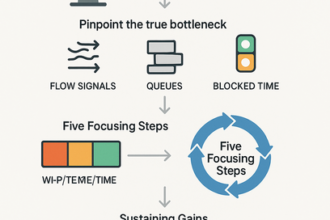
Here are practical signals and tests that separate causes from symptoms:
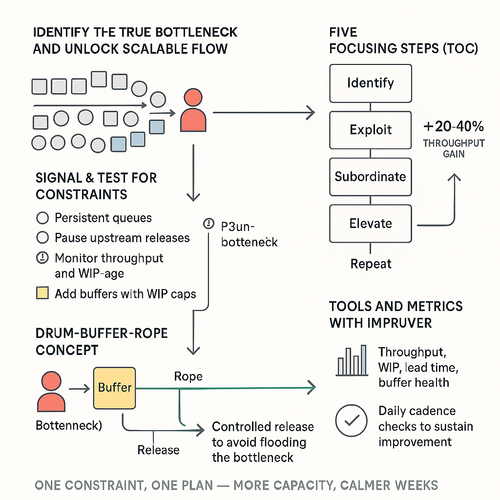
- Signal: persistent queue at one resource — One station’s queue grows while others wait; expedites cluster there.
- Quick test: pause upstream releases briefly — Stop releasing new work to the suspected constraint for 60 minutes; if lead time drops, you were overfeeding it.
- Metric: watch throughput and WIP-age on a single board — The true constraint shows both rising throughput attempts and increasing Work in Process (WIP) age, the time items spend in WIP.
- Buffer: add a right‑sized time buffer and WIP cap feeding the constraint — This stabilizes inflow so the constraint can work steadily instead of in bursts.
Find the true constraint where queues grow and commitments slip—then exploit it before you elevate it. Cut changeovers, feed only what it can run, and sync schedules to its drum (the pacing resource).
Mastering the TOC Five Focusing Steps to Boost Throughput 20–40%
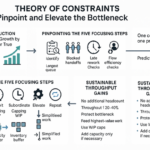
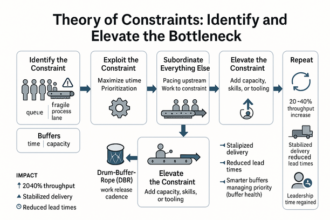
Throughput isn’t about working harder; it hinges on the true choke. The Theory of Constraints (TOC) offers Five Focusing Steps that repeatedly unlock 20–40% gains without adding people:
- Identify — Spot the longest queue and late promises. One plant discovered changeovers, not machine speed, were the choke.
- Exploit — Protect uptime and feed clean work. A SaaS team paused noncritical tickets and cut cycle time.
- Subordinate — Align schedules and Key Performance Indicators (KPIs) so everything serves the constraint’s pace.
- Elevate — When buffers hold yet demand still waits, add precise capacity; one tech operation lifted shipments 28%.
- Repeat — Once the constraint moves, go back to step one and find the next weakest link.
Track buffer health, throughput, and due‑date hit rate to know if changes stick. Exploit before elevate: trimming setups, batching smartly, and shielding the constraint usually beats adding capacity.
Strategic Buffers and Flow Stabilization: Using TOC to Cut Firefighting and WIP
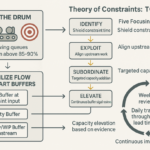
Firefighting is a symptom of unmanaged variability. TOC calms flow by protecting the constraint and pacing release. The classic “drum‑buffer‑rope” pattern works like this: the drum is the constraint that sets the pace; the buffer is a small stock or time cushion before the drum (and often at shipping) to absorb variability; and the rope is a controlled release mechanism so upstream stops flooding the system.
- Find the drum — Locate the bottleneck where queues persist and Service Level Agreements (SLAs) slip.
- Add small buffers — Place time, capacity, or stock buffers before the drum and at ship to absorb variability.
- Exploit the constraint — Protect uptime, cut setups, route specialists there first, and reduce changeovers.
- Control release (the rope) — Pace upstream work to the drum so you don’t drown the constraint in excess WIP.
- Cadence the review — Run a 10‑minute daily buffer check and decide weekly whether to elevate.
Outcome: lower WIP, steadier lead times, and materially higher throughput with fewer escalations.
Practical Tools and Metrics: Leveraging Impruver to Sustain Continuous Improvement
Improvement sticks when teams see the bottleneck daily and run small experiments. Impruver makes TOC a habit—clarifying signals, feedback, and buffers to lift throughput 20–40% without new headcount. Track throughput, WIP, lead time, and buffer health so gains endure.
- Pinpoint the constraint — Track queue, time, and flow at one resource—not everywhere at once.
- Exploit before elevate — Test batching, changeover windows, or specialist swaps; see the hourly impact.
- Buffer smart — Protect the constraint with right‑sized buffers; cut WIP to steady lead time.
- Simple cadence — Five‑minute check on one metric, one buffer, and one experiment per day.
Want copy‑ready patterns and signal definitions? Skim the Lyaxis newsletter for field‑tested examples: Lyaxis Newsletter. Ready to try a lightweight playbook? Explore the Impruver TOC playbook (use code “15off”): Impruver.
One constraint, one plan—more capacity, calmer weeks.