Introduction: Unlocking Growth by Mastering Your True Bottleneck
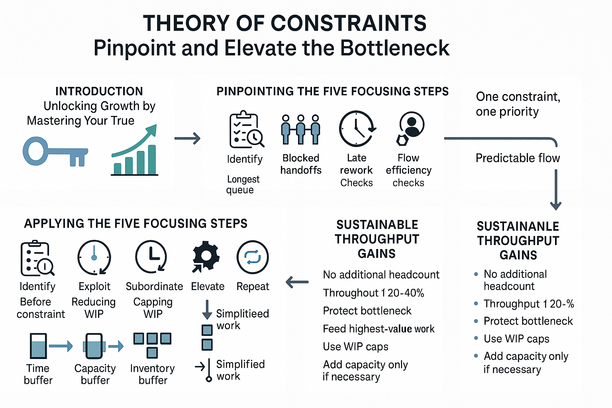
I learned the hard way that growth accelerates only when you elevate the single constraint that governs throughput. Early in my career, I kept polishing dashboards and pushing for higher utilization everywhere—only to see lead times stay stubborn. When I finally leaned into the Theory of Constraints (TOC)—a practical method for finding and managing the true bottleneck—and tightened work-in-process (WIP) limits, throughput jumped 20–40% without adding headcount. This article shows how to pinpoint the real constraint, apply the Five Focusing Steps, and use smart buffers to protect it so flow becomes both faster and predictably calm.
Pinpointing the Real Constraint: Clarity Beyond Data Noise
Dashboards shout; the true choke point whispers. Look for quiet, structural signals that reveal where revenue is gated.
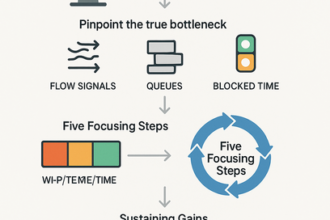
- Spot it fast: longest queues, blocked handoffs, and late rework reveal the constraint; verify with buffer signals.
- One-hour pause test: where a brief stop most endangers revenue is the constraint.
- Queue reality: the longest, oldest queue sits before it; starvation shows right after.
- Flow sanity check: efficiency gains without shorter lead time mean you optimized a non‑constraint.
One constraint, one priority, predictable flow.
Applying the Five Focusing Steps to Exploit and Elevate Your Bottleneck
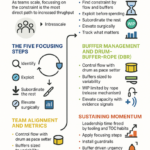
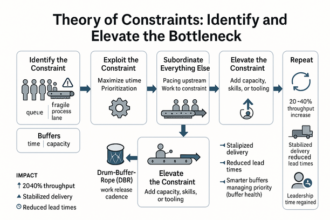
Throughput jumps when you treat your company as a chain: strengthen the weakest link, then repeat. The Five Focusing Steps compound gains—often 20–40% without hires.
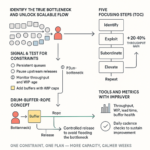
- Identify: track the longest queue, missed service level agreements (SLAs), or highest rework; validate with flow data.
- Exploit: maximize uptime; single‑thread work; add a small buffer before the constraint; cut WIP (work‑in‑process), sequence for the bottleneck, and shield it from interruptions.
- Subordinate: pause conflicting projects; cap WIP; shift metrics to flow, not utilization.
- Elevate: add capacity last—targeted automation, cross‑training, or scope cuts at the constraint.
- Repeat: once the current constraint relaxes, find the next weakest link and cycle again.
Smart Buffers and Flow Efficiency: Protecting the Constraint for Predictable Growth
Throughput rises when you protect the resource that sets pace. Smart buffers turn variability into boringly reliable delivery.
- Stabilize with buffers: time, capacity, and inventory buffers prevent starvation and overloading.
- Place buffers with intent: position them before (time/stock), at (dedicated support, WIP), and after (shipping) the constraint to absorb shocks.
- Protect with buffers: place a small buffer before the constraint; track buffer penetration to predict slippage.
- Run on buffer signals: promise dates from buffer status; review buffer health, not busyness.
- Simplify the work: shrink batches and pre‑kit work so the constraint never waits.
- Align metrics: manage release rate and due‑date performance; stop rewarding local utilization.
Find your true constraint via queue length and due‑date misses, not utilization; elevate it and starve non‑constraints with WIP caps.
Sustainable Throughput Gains Without Adding Headcount: Practical TOC Tools in Action
Stop optimizing everywhere; protect the constraint to unlock 20–40% throughput with the team you have.
- Locate: spot the slowest stage gating revenue (quality assurance, QA; onboarding; cutting).
- Exploit: feed it highest‑value work; fix sequence; remove interrupts.
- Subordinate + buffer: set WIP/metrics to serve it; small buffers before it and at delivery absorb variability.
- Elevate then repeat: add capacity only if flow still starves.
Curious without committing? Explore calm, practical examples—including Impruver’s TOC playbook—in the Lyaxis Insights newsletter. Fewer fires, faster cash, headcount optional. Read it here: Lyaxis newsletter.