Introduction: Unlocking Throughput Growth with the Theory of Constraints
The first time I walked a line with a team convinced they “just needed more people,” we found something else entirely: one step where work always waited. By shifting attention from keeping everyone busy to keeping that one step flowing, we lifted output in weeks—without adding headcount or buying new equipment. That lesson has stuck with me across factories, warehouses, and even software teams.
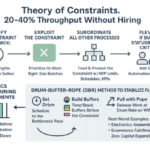
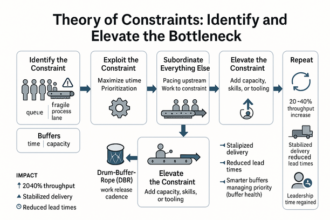
Throughput—not local efficiency—governs growth. The Theory of Constraints (TOC) pinpoints the single constraint and turns small fixes into 20–40% more output—often without added headcount or capital expenditure (capex). Busy isn’t the goal; flow is. The real bottleneck is where work waits, not where people look busy.
Pinpointing Your True Bottleneck: Seeing Past Local Efficiencies
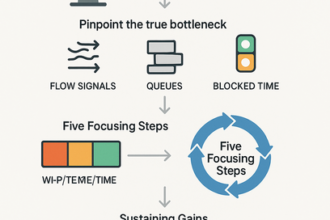
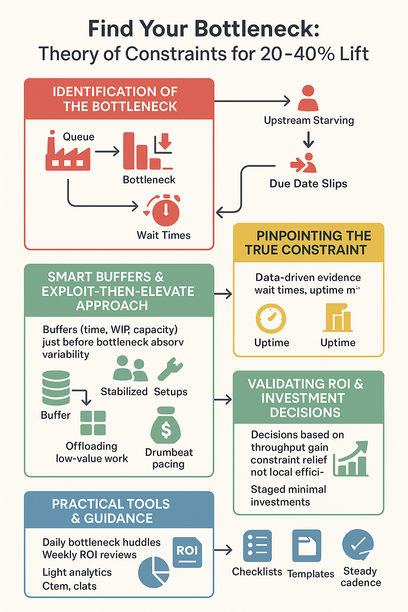
You’ll find your constraint where queues persist, upstream stages starve or downstream stages block, and due dates or service-level agreements (SLAs) start slipping. Track wait time and the constraint’s uptime to keep the signal current.
- Read flow signals: persistent queues, rising waits, and schedule slippage clustering around one node.
- Confirm with data: measure wait time at each step and monitor constraint uptime to see where flow actually breaks.
- Focus your view: the bottleneck is where work waits the longest—not where utilization looks highest.
Once you can see the constraint, the next move is to stabilize it with smart buffers and an “exploit then elevate” cadence.
Smart Buffers and the Exploit-Then-Elevate Approach to Flow
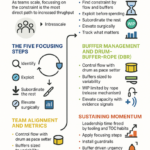
Flow breaks where variability hits your true constraint. Use smart buffers—time, Work-in-Process (WIP), or capacity—just before the constraint to absorb variability and stabilize flow. Exploit first: protect the constraint’s time, offload low‑value work, and invest only after results are proven there.
- Right‑size buffers ahead of the constraint and at ship; base on variability percentiles and watch buffer penetration, not averages.
- Exploit first: stabilize staffing, reduce setups, and offload tasks; then elevate with return on investment (ROI)‑proven debottlenecks—not reflex capex.
- Sequence to the drum (the system’s pacing point): run one priority lane, and release upstream only when the buffer dips—starve fire‑drills, not the constraint.
- Measure throughput dollars/hour, lead‑time predictability, blocking, and constraint uptime; shift from utilization metrics to flow outcomes.
Validating ROI and Making Constraint-Driven Investment Decisions
ROI is real only when it relieves your constraint. Tie every dollar to throughput at the bottleneck, not to local efficiency.
- Spot the constraint via persistent queues, starvation/blocking, and due‑date or SLA slips; refresh the diagnosis weekly.
- Price bets by throughput gain: estimate capacity added at the constraint times unit contribution to get payback in weeks.
- Exploit before elevate: add time buffers and damp variability; 20–40% lift often appears before any capex.
- Stage upgrades: fund the smallest change that moves the constraint in 30 days; pause or kill everything else.
Constraint‑validated ROI cuts firefighting and compounds margin per day.
Practical Tools and Ongoing Guidance: Exploring Impruver’s TOC Playbook
TOC sticks when it shapes daily decisions. Impruver’s TOC Playbook, paired with Lyaxis guidance, turns focus into throughput with light analytics and practical routines.
- See the real constraint fast with simple WIP, queue, and starvation signals; light analytics keep it current.
- Exploit then elevate: protect the drum with time and stock buffers, freeze priorities, then size the next investment—often yielding 20–40% gains before capex.
- Adopt a repeatable cadence: a 15‑minute bottleneck huddle and a weekly ROI review reduce firefighting.
- Use portable checklists and templates across lines, warehouses, and SaaS (software as a service) queues.
Prefer insight over pressure? Get steady, no‑fluff guidance here: Lyaxis Newsletter. When a pilot is right, Impruver slots in; Lyaxis makes it practical. Takeaway: faster flow, fewer fires, better cash.