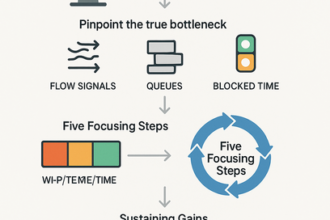
Introduction: Unlocking Flow by Pinpointing Your True Bottleneck
I’ve led teams that were drowning in “busy” yet starving for results. The turning point came when we stopped treating every delay as a separate fire and asked a simpler question: where does the work consistently pile up? Throughput is throttled by one hourglass neck, not general busyness. Pinpoint and protect it, and firefighting recedes while delivery times and cash flow steady. In practice, that meant looking for cause, not symptoms: queues repeatedly formed before the same step; work‑in‑process (WIP) spiked there; lead‑time scatter clustered there. Once we applied the Theory of Constraints (TOC) — a method for improving flow by focusing on the system’s most limiting step — delivery calmed, and cash came faster.
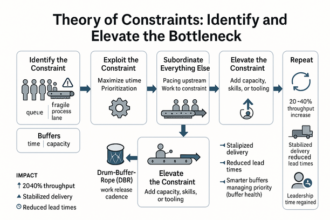
Apply TOC’s focus: identify the constraint, exploit it (dedicated time, clear standards, staggered releases), subordinate others, buffer it, then elevate. Prove it quickly: a two‑week exploit test can lift throughput 20–40% without adding headcount. Create one company focus while you test: a single constraint key performance indicator (KPI — the primary measure of success) beats many dashboards; pause local “efficiency” wins that starve the bottleneck. For practical how‑tos, I’ve found the bite‑size playbooks from Lyaxis’ flow newsletter useful — you can skim issues at this link.
Mastering the Five Focusing Steps to Identify and Exploit Constraints
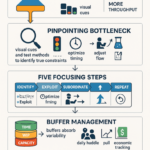
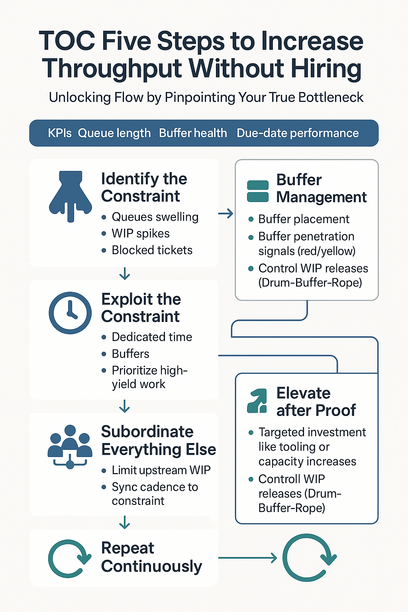
TOC’s Five Focusing Steps turn scattered effort into leverage — find the real bottleneck, exploit it, align the rest, elevate, then repeat. Expect meaningful gains in weeks when you stay disciplined about where the system truly limits flow.
- Identify the constraint: Spot it where queues swell and promises slip; watch WIP, blocked tickets, and aging work. Look for the longest queue or the oldest WIP — not the busiest team — and verify daily.
- Exploit the constraint: Protect it with a buffer, stop multitasking, feed only the highest‑yield work, and fix rework at the source so the constraint’s time creates maximum throughput.
- Subordinate everything else: Cap upstream WIP and sync cadence to the constraint’s “drum” — the pace at which the bottleneck can reliably process work.
- Elevate after proof: Once stable and saturated, invest surgically (targeted tooling, skills, or capacity) and measure the effect on flow before committing more.
- Repeat continuously: When one constraint eases, the next one appears. Keep the focus cycle alive to sustain improvements.
Buffer Management: Stabilizing Flow and Cutting Firefighting
Buffers turn variability into signals, shielding your constraint so throughput rises without extra headcount. A buffer is a small, intentional time or capacity cushion placed before the constraint; “buffer penetration” is how much of that cushion has been consumed and is your early‑warning system for priorities.
- Place a protective buffer: Add a time or capacity buffer before the constraint and use buffer penetration to set priorities — red items first.
- Control release with a simple “rope”: Cap WIP; pause non‑constraint work when the buffer goes red so you don’t starve the drum. Exploit first; elevate later. (“Drum–Buffer–Rope” is TOC’s method for pacing work to the bottleneck.)
- Right‑size and tune buffers: Size from actual variation; target about 5–15% red and 30–40% yellow, then tune weekly as the system stabilizes.
- Make queues visible on one board: One view for all teams turns firefighting into flow management; a 20–40% throughput lift is common as escalations fade.
Exploit Then Elevate: Scaling Throughput Without Adding Headcount
Throughput rises fastest when the whole system focuses on a single constraint. Exploit it first; elevate only when evidence says so and the buffer is frequently starved.
- Find the real bottleneck: Use facts — longest queue and oldest WIP — and verify daily rather than relying on utilization.
- Exploit with intent: Dedicate your A‑team, standardize setups, freeze priorities, and feed right‑sized buffers. Many organizations see material gains in weeks.
- Subordinate upstream and downstream: Throttle WIP, reroute low‑value work, and timebox decisions to the constraint’s cadence so it never waits.
- Elevate surgically when ready: Add targeted automation or a hire only after proof of stability, and tie decisions to the cash‑to‑cash cycle (the time from paying for inputs to receiving customer cash).
You don’t need new headcount to see impact. Start with a two‑week exploit experiment; if buffer health improves and due‑date performance stabilizes, you’re on the right track.
Aligning Teams and Sustaining Results with a Practical TOC Playbook
Shared constraint signals align teams and leadership around the same outcomes. TOC reliably unlocks more throughput without adding people when everyone reads the same cues and responds in the same cadence.
- Use three facts to locate the constraint: Queue length, buffer hits, and upstream idling — ignore utilization; it often misleads.
- Stabilize with protective buffers: A focused, 10‑minute daily review of buffer penetration and blocked work cuts firefighting dramatically.
- Exploit before you elevate: Stagger starts, right‑size WIP, and ring‑fence expert time; invest only if buffers are consistently starving.
- Run one scoreboard for all: Track constraint throughput, buffer health, and due‑date hits so executives and squads read the same three numbers.
Want it turnkey? Lyaxis shares the signals, visuals, and cadence in a short, insight‑first newsletter. When you’re ready to operationalize the playbook, you can test Impruver with code “15off” here: Impruver trial. The payoff: steadier delivery, calmer teams, and healthier cash flow.