After years running plants and improvement programs, the biggest jumps in performance never came from shiny new machines. They came from a simple discipline: find the one place flow truly chokes, protect it, and let everything else serve it. When we did that well, throughput jumped 20–40% without new capital, firefighting cooled, and cash started turning faster. This article shares the practical cues and cadences I use—grounded in the Theory of Constraints (TOC)—to help you do the same.
Introduction: Unlock 20–40% More Throughput by Spotting Your True Constraint
Your fastest path to 20–40% more throughput isn’t capex; it’s isolating and elevating the single constraint.
- Spot it where queues never clear expediters cluster, and schedules churn.
- Exploit-then-elevate level-load, staff first, feed only what it can digest; subordinate the rest.
- Use buffer management small, visible time buffers before the constraint; act only when red.
- Shift metrics to throughput, flow time, and buffer health; starve local utilization that bloats WIP (Work in Process).
Find, protect, and lift the constraint—lead times drop, firefighting fades, cash turns faster.
Pinpointing the Real Bottleneck: Avoiding Common Missteps in Constraint Identification
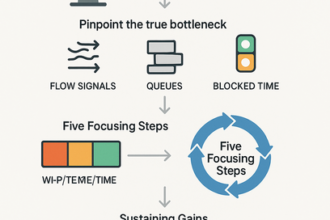
Your constraint isn’t the busiest station—it’s where flow starves or blocks. Find it fast to unlock 20–40% more throughput without new capital.
- Watch the pre‑queue that grows and never clears it likely feeds the constraint.
- Monitor buffer consumption and due‑date penetration persistent red is the tell.
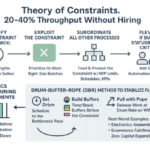
- Test with controlled release use Drum‑Buffer‑Rope (DBR) or Constant Work‑In‑Process (CONWIP); if WIP (Work in Process) falls while OTIF (On‑Time In‑Full) rises, you’ve nailed it.
- DBR sets a drum schedule at the constraint, protects it with a buffer, and releases work with a rope signal.
- CONWIP caps total WIP in the system so new work enters only when finished work exits.
- Exploit before elevating protect uptime, stagger changeovers, and sequence for throughput.
Mastering the Five Focusing Steps: Exploit, Elevate, and Shift Your Flow Metrics
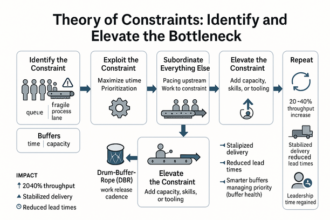
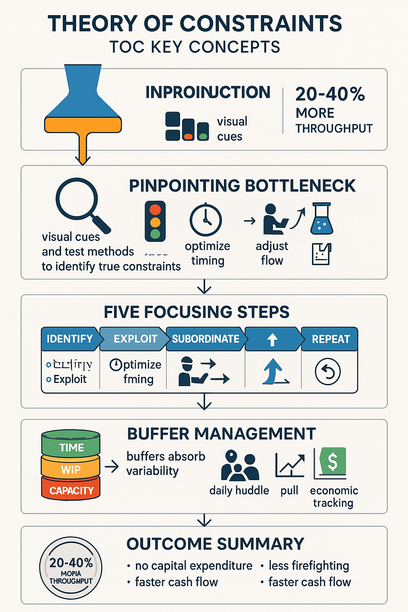
Use the Five Focusing Steps to convert busyness into predictable profit. Shift from local utilization to end‑to‑end flow to expose the true constraint and unlock 20–40% throughput without new capital.
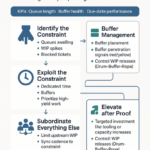
- Identify use buffer signals and queue hotspots to locate the constraint.
- Exploit ring‑fence the constraint’s time—sequence changeovers, staff first, feed first.
- Subordinate throttle release and sync upstream/downstream to the constraint’s pace.
- Elevate add targeted capacity or capability only after you’ve proven the gain from exploiting.
- Repeat as the constraint moves, refresh buffers and track throughput, lead time, and due‑date hit rate.
Smart Buffer Management: Absorbing Variability to Protect Throughput and Cut Lead Times
Variability kills flow; buffers protect the constraint and cut lead time. Use time, WIP, and capacity buffers to turn noise into predictable throughput.
- Time buffer protect the drum (the constraint’s schedule) with a short time buffer; act only on buffer burn, not every hiccup.
- WIP buffer cap release to the constraint; keep batches small and frequent to hold thin, fast‑moving queues.
- Capacity buffer hold protective capacity around the constraint; cross‑train so the team can absorb spikes.
- Signals use low‑noise red/yellow/green visuals; tune by buffer hits, not averages.
The payoff: 20–40% more throughput without capex and less firefighting.
From Insight to Action: Building a Lightweight TOC System and Exploring Impruver’s Playbook
TOC (Theory of Constraints) turns chaos into flow by finding the true constraint, exploiting it, then elevating it—protected by smart buffers.
- Expose the choke point manage by buffer consumption, not opinions.
- Daily constraint huddle a focused 15‑minute stand‑up to remove blockers and sequence for throughput.
- Right‑size WIP use visible pull gates so work moves by buffer status, cutting queues and lead time.
- Elevate last add capacity surgically or cross‑train; avoid blanket utilization pushes.
- Track economics prioritize Throughput per dollar (Throughput/$) over local efficiency to ensure improvements convert to cash.
Want templates, play‑cards, and cadences? Get the signal pack via the Lyaxis newsletter: https://lyaxis.com/category/newsletter/.
Prefer a guided path? Impruver’s TOC playbook can operationalize buffers, huddles, and controlled release with minimal lift (use code 15off): https://impruver.com/.