Introduction: Unlocking 20–40% Throughput Gains with Theory of Constraints
I’ve led teams where the dashboards looked great while customer promises still slipped. The turning point came when we stopped chasing “efficiencies” everywhere and, instead, named a single constraint. Applying the Theory of Constraints (TOC) reframed everything: make the whole system serve the one true bottleneck, and flow accelerates—often 20–40% more throughput without adding headcount.
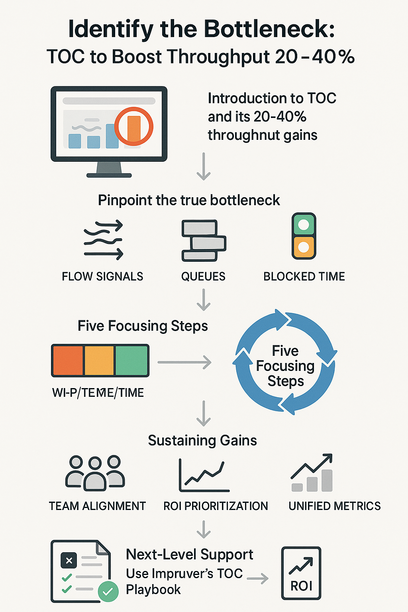
Teams chase “efficiencies” yet firefight. TOC flips it: find the one constraint and make everything serve it—often lifting throughput 20–40% without new headcount. Find the bottleneck where WIP (work-in-process) queues and promises slip; ignore busy non‑constraints. Exploit before you buy: level load, dedicate talent, and cut changeovers/rework at the constraint. Align KPIs (key performance indicators) and schedules to the constraint; stop local optimization. Elevate next. Takeaway: precise focus beats broad optimization.
Pinpointing Your True Bottleneck Amid Data Overload
Dashboards glow, yet lead times slip. Find the constraint with flow signals, not averages. Look where queues never shrink and cycle time swings; that step sets delivery. If it pauses and upstream piles while downstream starves, you’ve found the lever.
- Stabilize the constraint first Feed a small buffer, slow non‑constraint releases, and align KPIs (key performance indicators) to its throughput.
- Exploit before you buy Protect uptime, sequence for flow, and speed changeovers; only then consider capex (capital expenditures).
- Validate fast with three visuals Throughput trend; queue at the suspect step; starve/block minutes (time the constraint is waiting for input or unable to pass work downstream).
Clarity here lifts throughput 20–40%. For calm control, explore the curated insights in the Lyaxis newsletter: https://lyaxis.com/category/newsletter/.
Mastering the Five Focusing Steps to Exploit and Elevate Constraints
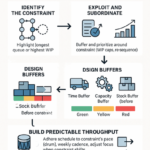
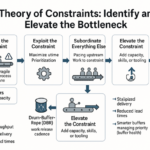
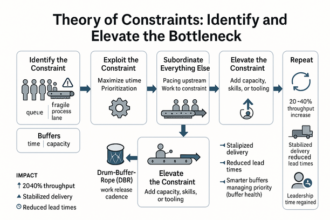
The Five Focusing Steps turn chaos into flow by treating constraints as assets—often lifting throughput 20–40% without capex (capital expenditures).
- Identify the true choke point Use visible queue or blocked time, not utilization; think quality assurance backlog in software as a service (SaaS), a picker lane in e‑commerce (eCom), or a changeover cell in manufacturing.
- Exploit the constraint Prioritize work, extend coverage, kill micro‑downtime, and add small time/WIP (work‑in‑process) buffers upstream.
- Subordinate everything else Slow non‑bottlenecks, pause side projects, and align KPIs (key performance indicators) to system throughput.
- Elevate when the case is clear Invest only when ROIC (return on invested capital) is obvious.
- Repeat as the constraint moves As flow improves, the bottleneck will shift—start the cycle again.
Want sharper moves? Get the next practical drop from the Lyaxis newsletter: https://lyaxis.com/category/newsletter/. If you’d like templates and checklists, Impruver’s TOC Playbook can help: https://impruver.com/toc-playbook?code=15off (use code 15off).
Stabilizing Flow with Buffers: Protecting the Constraint without Adding Capacity
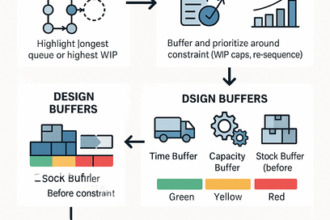
Buffers calm chaos. Small time and WIP (work‑in‑process) cushions around the true constraint absorb variability and lift throughput without new capacity.
- Size to typical variability, not worst‑case Begin with inbound WIP at the constraint (about 1–2 hours or 10–20% of daily output) plus a short downstream time buffer.
- Control release Keep the inbound buffer green; never starve or flood the constraint.
- Make buffer status visible Red/yellow/green charts trigger action only on red.
- Expect measurable gains Fewer starve/block cycles, 20–40% more shipped, and steadier lead times.
For practical illustrations of where buffers pay off, see the Lyaxis newsletter briefings: https://lyaxis.com/category/newsletter/. Templates are available in Impruver’s TOC Playbook: https://impruver.com/toc-playbook?code=15off.
Sustaining Gains: Aligning Teams, Prioritizing Investments, and Building a Low-Friction Improvement Rhythm
Sustained gains come from aligning everyone to the constraint and funding fixes that raise flow, not activity. A light cadence with simple metrics makes improvements hold quarter after quarter.
- Name and protect the bottleneck Use inbound/outbound buffers; speed elsewhere can wait.
- Exploit then elevate Unlock 20–40% more throughput before buying capacity.
- Unify metrics One flow metric and a shared queue reduce firefighting.
- Prioritize by ROI to throughput Fund the highest return‑on‑investment (ROI) improvements; pause work that doesn’t feed the constraint.
Want visuals and one‑pagers to keep everyone aligned? Explore the Lyaxis newsletter: https://lyaxis.com/category/newsletter/. If you’re tool‑curious, Impruver’s TOC Playbook (code 15off) helps you validate fast: https://impruver.com/toc-playbook?code=15off.
Next-Level Support: Exploring Impruver’s TOC Playbook as a Practical Aid
Amid noisy dashboards, TOC (Theory of Constraints) shows what to fix first. Impruver’s TOC Playbook makes the next move obvious.
- Find the real constraint with flow cues Stop optimizing non‑bottlenecks.
- Exploit before elevate Protect it with buffers, paced release, and aligned KPIs (key performance indicators).
- See tangible ROI Achieve 20–40% throughput gains without capex (capital expenditures); lead times fall, OTIF (on‑time, in‑full) steadies.
- Validate in one page Track WIP (work‑in‑process) trend, buffer health, and constraint uptime.
Prefer quiet insight? The Lyaxis newsletter curates what to try next: https://lyaxis.com/category/newsletter/. When you’re ready, Impruver’s Playbook adds checklists and templates—no sales gauntlet: https://impruver.com/toc-playbook?code=15off. Outcome: faster cash conversion, fewer escalations, clearer next bets.