Transforming Policy Governance with Kanban in BPM Operations
Introduction: Transforming Policy Governance with Kanban in BPM Operations
After years helping teams in Business Process Management (BPM) operations, I learned that most policy headaches don’t come from bad intent—they come from invisible queues, fuzzy ownership, and unpredictable reviews. The turning point for me was treating policy governance like product flow with Kanban: one transparent system, tight limits, clear owners, and signal-based decisions. The result was fewer fire drills, calmer audits, and leadership time back.
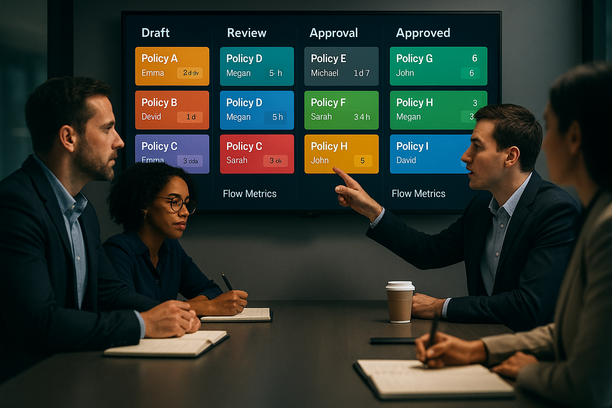
Policy governance often lives as static documents and hidden queues. Kanban makes it a living flow—boosting visibility, ownership, and speed without extra headcount.
- One board, one source of truth: every policy a card from idea to adopted.
- Backlog with WIP (Work in Progress) limits: stop thrash; finish the vital few faster.
- Explicit owners and SLAs (Service Level Agreements): clear handoffs, fewer stalls, audit‑ready trails.
- Flow metrics—lead time, throughput, aging: manage by signal, not escalation.
Curious what this looks like in practice? The Lyaxis newsletter shares the model and metrics with practical examples; for a deeper dive, explore Impruver University (use code “15off”). Fewer fire drills, faster approvals, leadership time back.
Making Policies Visible: Building a Prioritized, WIP-Limited Policy Backlog
Treat policies as flowing work, not static files. A prioritized, Kanban backlog with WIP (Work in Progress) limits stops overload and moves the right risks first.
- Map demand from audits, regulations, and incidents into cards: include clear “ready” criteria.
- Rank by business impact and risk: set explicit SLAs (Service Level Agreements) per state.
- Assign a single owner: publish handoffs to legal, security, and operations.
- Enforce WIP per column: surface blockers and aging to trigger pulls, not pings.
- Track lead time and throughput weekly: cut leadership drag and surprises.
Assigning Clear Owners and Defining Compliance SLAs That Accelerate Flow
Policy flow accelerates when every control has a single owner and a clear promise. Tie SLAs (Service Level Agreements) to risk and value so reviews move at the speed of business.
- One owner per policy ends RACI (Responsible, Accountable, Consulted, Informed) fog: cutting approval lead time 30–50%.
- A Kanban backlog with WIP (Work in Progress) limits and SLAs (e.g., 24h triage, 5d review, 10d adopt): shrinks queues.
- Aging and throughput metrics: flag stuck work before audits.
- Risk-tiered fast lanes: keep launches moving.
- Timestamped decisions: create clean audit trails.
Measuring What Matters: Flow Metrics to De-Risk Compliance and Boost Audit Readiness
Compliance gets calm when policy work flows like product: a Kanban with owners, SLAs (Service Level Agreements), and WIP (Work in Progress) limits. Measure flow, not documents.
- Lead time (request → adoption): signals predictability—trend it and see where time disappears.
- WIP age: exposes silent risk—anything past SLA needs an unblock, not a meeting.
- Throughput per week by owner: shows capacity versus commitments.
- Flow efficiency (active time vs. waiting time): surfaces handoff debt—fix the waits.
Turn these into a lightweight dashboard—Cumulative Flow Diagram (CFD), aging views, and SLA timers—so audits are calm and evidence is instant.
Creating a Lightweight, Repeatable Governance Rhythm for Sustainable Operational Excellence
Operational excellence sticks when governance runs on a light, repeatable rhythm. Cadences turn policies into visible flow, cutting leadership drag and audit risk with traceability.
- Replenishment: one policy backlog with owners, WIP (Work in Progress) limits, and SLAs (Service Level Agreements); commit by capacity, not wish lists.
- Delivery reviews: weekly show throughput and aging; unblock fast to cut time‑to‑approve and time‑to‑adopt.
- Retrospectives: monthly tune WIP/SLAs and remove failure demand so gains hold each quarter.
Want proven patterns and templates? The Lyaxis newsletter regularly unpacks boards, metrics, and cadences you can copy. If you’re ready to operationalize this approach end‑to‑end, explore Impruver University (use code “15off”) for a deeper, practical dive. Result: fewer fire drills, faster adoption, and trust.