Introduction: Unlocking 12% Energy Cost Savings with Smart Scheduling
I’ve sat beside operations leads watching the power bill creep while lines still hit their targets. The breakthrough wasn’t a shiny new motor or capex-heavy retrofit—it was simply scheduling work to match the price of energy. With a few practical guardrails and clear visibility for finance, we unlocked savings the next billing cycle without touching throughput.
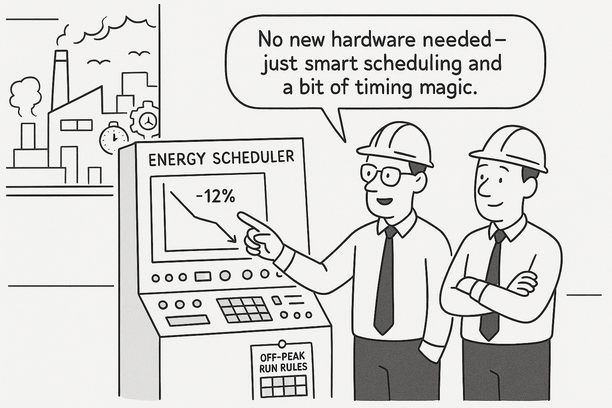
Energy spend is volatile. Smart run rules align energy‑heavy work to price signals, trimming about 12% with no new hardware and no missed SLAs (service-level agreements). Curious where your 12% hides? Lyaxis maps the rules and shares the playbook—insight first, rollout when ready, lower OPEX (operating expenditure) without drama. Explore examples in our newsletter.
How Smart Run Rules Shift Energy-Heavy Tasks Off-Peak Without Sacrificing Throughput
Time-of-use (TOU) volatility punishes overlapping energy-heavy steps. Smart run rules push those loads off‑peak without denting throughput.
- Batch by SKU (stock-keeping unit) and changeover windows. High‑draw cycles land off‑peak while daytime SLAs (service-level agreements) hold.
- Shift batch, charging, baking, or compute windows off‑peak. Keep guardrails for cutoffs and throughput so commitments stay intact.
- Stagger warm‑ups and chargers. Cap site demand (in kilowatts, kW) to avoid demand charges while maintaining flow.
- Time preconditioning near the end of off‑peak. First shift starts fast without triggering early peaks.
- Honor tooling, labor, and delivery constraints. Urgent work can burst on‑peak within a demand cap, with Monday.com attributing avoided charges by line and PO (purchase order).
Lyaxis can map these rules to your data—see a sample approach in our newsletter and spot your first 12%. Lower OPEX, steadier floors, audit‑ready proof.
Reducing Demand Charges and Smoothing Spikes Through Automated Operations Scheduling
Demand charges often exceed per‑kWh (kilowatt‑hour) energy rates; one five‑minute spike can set your month. Automating starts and ramps trims peaks without touching throughput.
- Sequence heavy jobs around TOU (time-of-use) windows. Finish queues off‑peak while SLAs hold.
- Stagger overlapping jobs to avoid demand charges. Demand caps and priority rules keep lines moving without costly spikes.
- Use soft‑start ramps and VFD (variable frequency drive) rules. Shrink inrush current; stagger compressors, ovens, and chargers by minutes.
- Apply predictive caps on site kW (kilowatt). Shift noncritical tasks before thresholds trip.
- Show finance what changed and what it saved. Boards track meter deltas, avoided kW, and dollar impact for sign‑off.
Tracking and Proving Energy Savings in Monday.com Dashboards with Real-World Examples
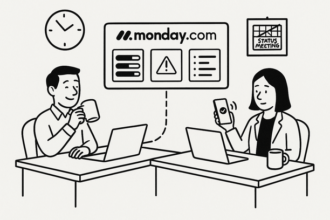
Energy savings only stick when they’re proven. Monday.com turns run data into audit‑ready evidence.
- Tag each job with kWh/run (kilowatt-hours per run), units, and TOU window. Attribute energy and timing to every batch or work order.
- Store a Baseline and Post‑Change run. A Formula column calculates cost per unit = (kWh*rate + demand_fee)/units for apples‑to‑apples comparison.
- Use dashboards for before/after visibility. Plot time series, a single Savings Number, and a cost‑per‑unit trend by line, SKU, or cluster.
- Automate scheduling and guardrails. Shift jobs to off‑peak, hold overlaps that spike demand, and log exceptions; meter or cloud tags feed actuals.
- Give finance monthly roll‑ups with variance notes. Net: predictable bills and 12%+ lower OPEX (operating expenditure).
Lyaxis’ field notes unpack the exact widgets and run‑rules to copy—see the playbook in our newsletter.
Scaling Energy Efficiency: Standardizing Run Rules and Gaining Leadership Confidence
Energy costs swing with TOU; scalable efficiency comes from standard run rules and governance. Shifting energy‑heavy work off‑peak can cut about 12% without hitting SLAs.
- Standardize run‑rule templates across sites. Tie them to tariffs, SLAs, and constraints; change control prevents drift.
- Automate orchestration across operations. Schedule batch curing, charging, and rebuilds off‑peak; throttle overlaps to avoid demand charges.
- Instrument metrics and alerts. Boards attribute kWh (kilowatt-hours) and dollars saved by job, line, and site for an audit‑ready trail.
- Pilot one line, then templatize. Prove savings in a single billing cycle and roll out network‑wide with confidence.
Ready to surface your first 12% and make it stick? Start by mapping rules in a quick pilot and stand up lightweight dashboards in Monday.com. For examples you can copy next bill, browse the Lyaxis newsletter.