Introduction: Why SOP Version Control Matters in Scaling Operations
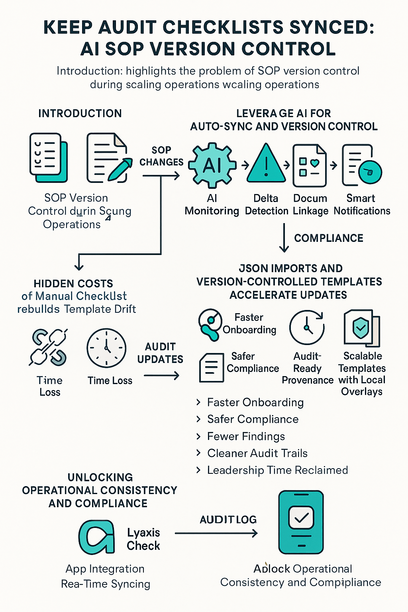
I’ve lived the pain of scaling operations: a small change to a Standard Operating Procedure (SOP) quietly ripples through checklists, training, and audits—until it isn’t quiet anymore. As you scale, minor SOP edits snowball into audit gaps, retraining, and rework. Tight version control keeps every team on the same page—fast. Operational consistency collapses when SOPs change faster than checklists; the fix is a single source of truth that ties each checklist to the exact SOP revision in use. Result: faster onboarding, safer compliance, fewer fire drills.
The Hidden Costs of Manual Checklist Rebuilds and Template Drift
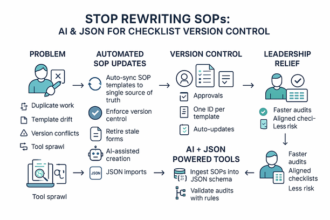
Manual checklist rebuilds seem cheap; they drain capacity and invite audit risk. Template drift fragments operations and pulls leaders into firefighting.
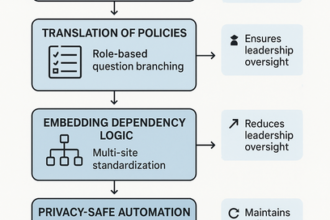
Version confusion fuels rework; SOP‑linked, single‑source checklists end debate. Change logs tied to templates restore traceability and ease training. Standardize across sites while parameters preserve local nuance, and lock core logic to stop drift.
For deeper teardowns and benchmarks, explore the Lyaxis newsletter: https://lyaxis.com/category/newsletter/.
Leveraging AI and Automation to Keep Audit Checklists Synced
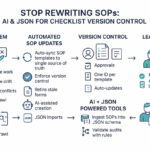
SOPs evolve fast; checklists lag—driving drift, findings, and rework. Artificial Intelligence (AI) can monitor SOPs, detect deltas, and sync audits without herding cats.
- Delta detection: maps changes to affected checklists, proposing edits and owners.
- Version control linkage: connects templates to SOP identifiers (IDs), preserving traceability while allowing site-specific fields.
- JSON import/export: refreshes forms in minutes, not rebuild cycles; JavaScript Object Notation (JSON) makes bulk updates predictable and reversible.
- Smart nudges: route approvals, update mobile checklists, and log adoption.
Auto‑sync SOP changes to checklists; AI drafts updates and flags differences (diffs) you approve. Outcome: fewer findings, cleaner trails, and time back for improvements. For patterns—not pitches—explore the Lyaxis newsletter: https://lyaxis.com/category/newsletter/.
How JSON Imports and Version-Controlled Templates Accelerate Updates
When SOPs shift fast, rebuilding checklists creates lag, drift, and risk. JSON imports plus version-controlled templates make updates traceable and reversible.
- Single source of truth: map each checklist to a specific SOP version; tag, diff, and roll back in minutes.
- Rapid adoption: import JSON to refresh fields and logic; mobile teams sync instantly.
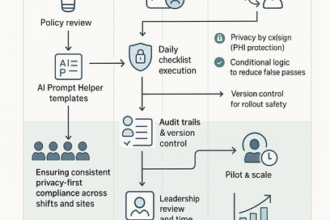
- Audit-ready provenance: change logs bind policy to form; auditors see lineage—not scattered Portable Document Format (PDF) files.
- Scale with nuance: a global template with site-level overlays standardizes without losing context.
Refresh via JSON import/export and push mobile updates in minutes. Want the mechanics and Return on Investment (ROI) math? Our newsletter unpacks it: https://lyaxis.com/category/newsletter/.
Unlocking Operational Consistency and Compliance with Lyaxis Check
Lyaxis Check makes audits routine by centralizing versioned templates that stay in lockstep with your SOPs. Every checklist ties to a specific SOP revision with an auditable changelog, ending version confusion. AI-assisted template creation turns SOP edits into updated forms in minutes, not quarters. JSON import/export mirrors policy shifts and scales standards across sites while preserving local nuances. Mobile teams always see the latest, eliminating PDF drift and rework.
If this operating model fits, Lyaxis Check can quietly keep SOPs and audits in sync so you see fewer rebuilds, faster change, and leadership time back. Get the app here: Lyaxis Check on Google Play.