Introduction: From Firefighting to Flow — Why Kanban Matters for Interruptions
I remember watching a carefully planned week evaporate by lunch on Monday: a 9:12 a.m. Slack ping, a 9:27 drive-by, then a “quick question” that wasn’t. My roadmap didn’t fail on strategy; it bled out from a thousand small interrupts I couldn’t see or steer. The turning point came when we put one visible front door for all incoming work and set clear work-in-progress limits—suddenly, the noise became navigable, and the team’s focus returned.
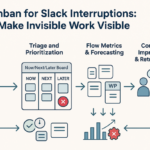
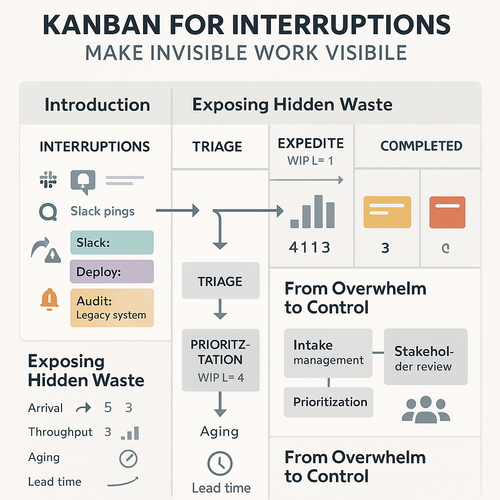
Your day isn’t lost to Slack; it’s lost to invisible queues. Kanban turns firefighting into flow by absorbing interruptions without drama. A 9:12 a.m. ping hits a visible intake, gets tagged and triaged, and hidden demand surfaces fast. Simple policies and WIP (work in progress) limits guard focus while a tiny, capped expedite lane handles true emergencies—shorter lead times (time from request to delivery), no derailments. Arrival rates versus throughput (rate of work completed) and aging charts (visualizing how long items have been in process) anchor forecasts in real demand. Stakeholders align to capacity; queue-jumping fades.
Capturing Chaos: Using Kanban to Make Invisible and Ad-Hoc Work Visible
Your roadmap rarely dies by strategy; it bleeds from a thousand “quick pings.” 9:12 Slack, 9:27 drive‑by; by noon, plans slip. Kanban makes the bleed visible—then fixable.
- Capture every interrupt in one intake lane
Visibility calms urgency; everything has a card before it has time. - Tag source and reason for each interrupt
Track arrival rate and lead time to turn hidden demand into staffing and priority signals. - Set humane WIP limits plus an Expedite class of service
Real fires move fast without torching team focus. - Make tradeoffs explicit with a regular stakeholder review
Queue‑jumping becomes shared, informed decisions.
Exposing Hidden Waste: How Visual Management Reveals True Demand and Bottlenecks
Firefighting hides the real constraint; visual management turns Slack noise into steerable demand.
- Route all ad‑hoc requests to one intake
Tag interrupts to reveal the capacity tax they impose. - Show aging by lane
Expose queues—reviews, approvals, handoffs—where time quietly dies. - Set WIP limits and a tiny, clearly defined expedite lane
Focus holds while true urgencies fly. - Track arrival rate, lead time, and blocked time
Measure what matters to drive better forecast accuracy. - Proof in practice
One team found 43% of work was interrupts; a single intake plus a two‑slot expedite cut lead time by 35%.
Designing Predictable Flow: Setting WIP Limits and Intake Policies That Stick
Tuesday, 10:07 a.m.: Slack explodes; the roadmap shouldn’t. Predictable flow starts when WIP is capped and every ping uses one front door.
- Size WIP by weekly throughput
Tune until lead time flattens and context switches fall. - Create one visible intake from chat to board
No card, no work; one expedite slot with a <24‑hour target and clear displacement rules. - Expose demand with arrival-versus-completion tracking
When arrivals exceed capacity, stop starting and swarm to finish.
From Overwhelm to Control: Reclaiming Leadership Time with Lightweight Kanban
Yesterday’s Slack storm felt urgent; none of it was modeled demand. Lightweight Kanban turns firefighting into flow.
- Create a single visible intake
Route every ad‑hoc ask to an Interrupt lane, WIP‑capped (work in progress limited). - Make priorities explicit with clear classes of service
Expedite (WIP=1), Fixed Date, and Standard stop queue‑jumping. - Run tight cadences
Daily triage, twice‑weekly replenishment, and batched Slack responses; cadences are regular meeting rhythms that stabilize flow. - Track reality, not hopes
Arrival vs throughput, percent unplanned work, and interrupt lead time expose waste and set realistic capacity. - Expect tangible results
Faster urgencies, fewer context switches, and leadership time back.
For ongoing, practical tactics delivered with low friction, subscribe to the Lyaxis newsletter: https://lyaxis.com/category/newsletter/. When you’re ready to go deeper and build sustainable, predictable flow at scale, explore Impruver University: https://university.impruver.com/?aff=lyaxis. Optional discount info: email lyaxisinc@outlook.com with the subject “Impruver University.”