Introduction: Revealing Invisible Work to Unlock Calm and Predictability
I learned the hard way that chaos rarely comes from the projects we plan. It comes from the invisible stream of DMs (direct messages), pings, and “quick asks” that hijack the day. Once we made that stream visible and bounded, delivery calmed down, forecasts started to hold, and the team finally got long, quiet stretches to do real work.
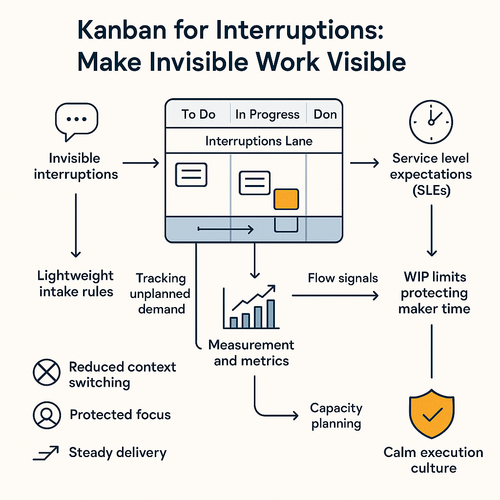
The simple shift was to treat ad‑hoc requests like first‑class work: one visible queue, a few lightweight intake rules, clear Service Level Expectations (SLEs), and tight Work in Progress (WIP) limits. The result was immediate—interruptions dropped, quality rose, and trade‑offs became honest and transparent.
- Route every ad‑hoc ask into a single, shared Kanban lane to expose real demand and make the “invisible” measurable.
- Agree lightweight intake rules and Service Level Expectations (SLEs) so stakeholders know when work lands and how fast it moves.
- Cap Work in Progress (WIP) to protect maker time; interruptions drop and quality rises when focus is guarded.
- Measure unplanned demand to justify capacity, hiring, and clear trade‑offs.
How Kanban Illuminates Hidden Interruptions and Unplanned Work
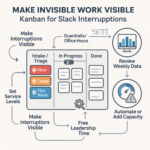
Kanban makes ad‑hoc work visible, protecting capacity and planning confidence. When pings become cards, they’re measurable—and patterns emerge.
- Use a single intake lane that turns DMs (direct messages) into tagged “unplanned” items; comparing arrival rate to throughput often reveals 20–40% hidden demand.
- Create explicit policies for an interrupt lane with a 24‑hour SLE—a fast path, not a free‑for‑all.
- Apply WIP (Work in Progress) limits and mark blockers to cut context switching and return maker hours.
- Watch flow signals to see when interrupts crowd planned projects, guiding on‑call rotas or added capacity.
Crafting Lightweight Intake Policies and Service Level Expectations
Interrupt‑driven work hides in DMs (direct messages). Lightweight intake rules and SLEs (Service Level Expectations) make it visible and set honest timelines without over‑engineering the process.
- Establish one “front door” so all ad‑hoc requests hit a shared Kanban queue; DMs become links to a card, not side channels.
- Write a minimal intake policy that defines what qualifies, the required fields, and when the fast lane applies.
- Publish SLEs (probabilistic targets from actual cycle time)—expectations, not promises.
- Protect maker time with WIP limits and response windows so urgency is earned, not assumed.
- Track arrival rate versus throughput to defend capacity and make the hiring case with data.
Reducing Context Switching and Waste to Protect Focus and Flow
Context switching is the hidden tax on growth. By making ad‑hoc work visible and bounded, your team regains the long, quiet stretches needed to ship.
- Route Slack pings to a shared board; in a week you’ll see who asks, what type, and how long it takes.
- Cap WIP (Work in Progress) by role; two steady lanes beat a dozen half‑starts and reduce defects.
- Set simple SLEs (for example, 24/72 hours) so true urgency is clear and exceptions are explicit.
- Smooth handoffs and measure unplanned demand to safeguard project capacity and inform resourcing.
Building a Calm Execution Culture: Insights, Impact, and Next Steps
Calm execution starts when ad‑hoc work becomes visible and bounded. Kanban reveals hidden demand and steers flow without bureaucracy.
- Route DMs (direct messages) into one shared queue to see real demand, aging, and where attention goes.
- Set light WIP (Work in Progress) limits and SLEs (Service Level Expectations) so interruptions drop and delivery steadies.
- Protect maker time with office hours and batched replies to raise quality while reducing thrash.
- Use flow metrics to defend capacity, inform hiring, and produce forecasts that actually hold.
Start with one visible queue and measure the calm it creates. For practical playbooks you can try tomorrow, browse Lyaxis’ newsletter: https://lyaxis.com/category/newsletter/. If a deeper, structured path would help your team standardize and sustain this, explore Impruver University here: https://university.impruver.com/?aff=lyaxis.