Introduction: Harnessing Kanban to Tame Interruptions and Invisible Work
I’ve led teams where Slack pings never stopped and “quick asks” quietly consumed half the week. The turning point came when we treated every interruption as real demand and ran it through a simple Kanban system. Once the noise became visible, we could set gentle limits, keep our promises, and get hours back for the work that actually moved the needle.
Slack pings accumulate into a hidden queue that drains capacity; lightweight Kanban makes demand visible and protects focus without bureaucracy.
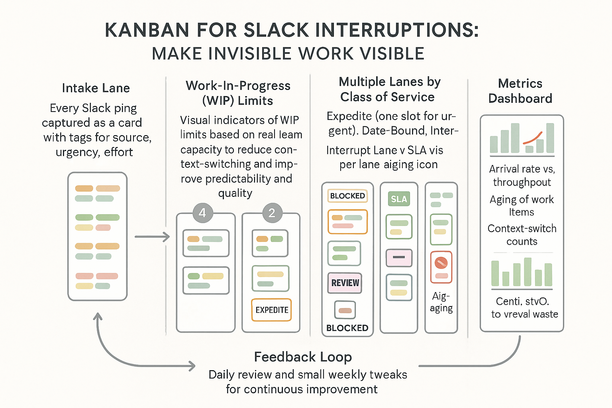
- Capture every ping in a single intake lane with classes of service; bypassing stops, evidence starts.
- Limit work-in-progress (WIP) by real capacity; context-switches drop, quality and predictability rise.
- Make aging and service level agreements (SLAs) visible per lane; hidden demand and stalled work surface fast.
- Track arrival vs throughput and expedite share; planning improves and trade‑offs become explicit.
Lyaxis makes this a calm operating cadence—peek our brief newsletter for patterns; when ready, Impruver University offers guided support. Outcome: fewer fires, steadier delivery.
Capturing the Chaos: Visualizing Ad-Hoc Work and Slack Interruptions
Slack pings are smoke; invisible demand is the fire. Make each interruption visible so urgency stays honest.
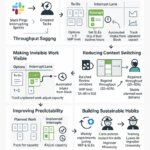
- Create a Kanban “Fast Lane.” Capture pings as cards, with tiny tags for source, urgency, and effort.
- Set visible service level agreements (SLAs) and work‑in‑progress (WIP) caps. Stakeholders see trade-offs; teams protect focus without arguing.
- Track arrival rate and aging. Patterns expose hidden waste, dodge-the-backlog work, and planning gaps.
- Review signals briefly, not ceremonially. Adjust capacity and intake rules based on real demand.
Result: fewer disruptions, clearer promises, higher throughput. Explore the Lyaxis newsletter for the visual kit; Impruver University guides deeper when needed.
Exposing Hidden Waste: Using Kanban to Reveal Demand and Reduce Context Switching
Kanban turns Slack noise into demand signals. Visualize every ping as a card and cap WIP to reveal overload, queues, and handoff churn.
- Add an Interrupt lane; trend its share of capacity to set service levels.
- Limit work‑in‑progress (WIP) by stage; Little’s Law (items in system = arrival rate × average time) makes lead time negotiable.
- Flag blocked/review items to expose approval bottlenecks and cut handoffs.
- Track context switches per person; each costs ~23 minutes.
Want the patterns to watch? The Lyaxis newsletter deconstructs them; when ready, Impruver University offers a lightweight track. Outcome: focus returns, predictability rises.
Pragmatic Planning: Setting Intake Rules and Service Levels Without Bureaucracy
Bureaucracy-free intake rules turn Slack chaos into predictable flow. Small guardrails create fast yes/no decisions and end fire drills.
- Define three lanes: Expedite (one slot), Date‑bound, Standard; route every ping to a single board.
- Triage in 60 seconds on impact, risk, and cost of delay; unclear asks become discovery.
- Publish lightweight service level expectations (SLEs—forecasted response times, not contracts): 85th‑percentile lead times per lane, refreshed weekly from data.
- Cap work-in-progress (WIP) per lane; one Expedite slot makes “urgent” rare and visible.
Expect fewer interruptions, steadier delivery, more focus; our brief unpacks the patterns—when you want pragmatic rollout, Lyaxis maps lanes and SLEs to your stack in this newsletter.
Sustaining Flow and Leadership Relief: Building a Low-Friction Culture with Kanban
Interruptions aren’t the enemy—unmanaged flow is. Kanban turns Slack chaos into steady pull so leaders regain predictability.
- One visible queue for all asks: Slack “/triage” ports into a board; no side doors.
- Gentle work‑in‑progress (WIP) limits by work type protect focus and trim the 20–40% context-switching tax.
- Daily pull, not push; urgent lanes with clear service levels set expectations.
- Honest metrics—arrival vs throughput, aged work, block time—reveal waste and defend capacity.
- Small weekly tweaks make the system teach itself.
Result: fewer fires, shorter cycle times, and hours back for strategy. For a deeper dive, browse the Lyaxis newsletter; when you’re ready for guided support, consider Impruver University.