Introduction: Unlocking Cross-Department Clarity with Swimlane Diagrams
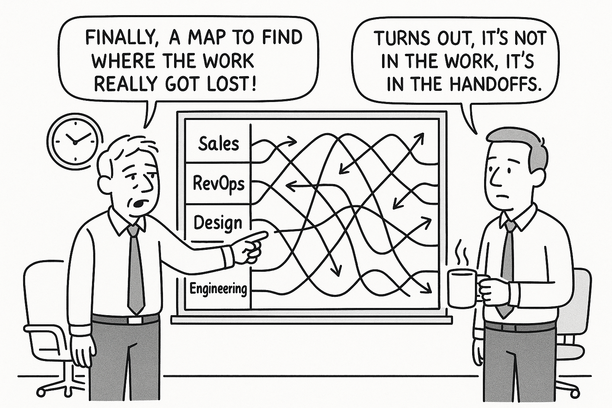
I learned the hard way that most delays don’t live inside a team’s workflow—they hide between teams. On a product launch that touched Sales, Revenue Operations, Design, Engineering, and Finance, everyone was “busy,” yet the work kept stalling at the boundaries. The moment we drew a simple swimlane diagram, the fog lifted: we could finally see every handoff, who owned it, and why cycle time kept slipping.
Swimlane diagrams turn scattered work into a single, cross-functional picture—revealing who owns each handoff, where queues form, and why cycle time slips. Which boundary is stalling throughput today? See the Sales→RevOps (Revenue Operations) quote loop or the Design→Engineering intake that idles for days. Lock accountability with explicit owners and SLAs (service-level agreements) at lane boundaries—no micromanagement. Make waits and rework visible to cut escalations and free leadership time. Use swimlanes for role clarity; reach for VSM (value stream mapping) when you need flow math and end-to-end waste insight.
For ongoing patterns and a concise CEO (Chief Executive Officer) brief on handoff metrics, the Lyaxis newsletter shares pure, practitioner-grade insight. When you’re ready to build capability through practice, Impruver University provides targeted drills (optional code “15off”). Result: faster throughput, fewer meetings, clearer ownership.
Seeing the Work Clearly: How Swimlane Diagrams Expose Handoff Bottlenecks
Swimlane diagrams turn fuzzy boundaries into visible commitments, revealing where work stalls between teams. They cut delays by making ownership and decision rights explicit—so the work can move without more meetings.
- Map each lane with clear entry/exit criteria and a handoff SLA — define what “ready to start” and “done” mean, plus expected response times (SLA = service-level agreement).
- Surface queues between Sales→Ops→Finance — name the decision owner at each boundary to shrink wait time; Ops = Operations.
- Highlight rework loops caused by missing inputs — then standardize what “ready” means to reduce ping‑pong.
- Use swimlanes for cross‑functional orchestration — switch to value stream mapping (VSM) to probe end‑to‑end waste and lead time.
- Instrument the boundaries — track handoff age, first‑time‑right (also called first‑pass yield, FPY), and decision latency.
Ownership Without Overload: Defining Accountability Across Teams
Accountability scales when ownership is visible and handoffs are explicit. Swimlanes reveal where work stalls—without adding bureaucracy.
- Name one Directly Responsible Individual (DRI) per lane — collaborators contribute via simple SLAs, but one person owns outcomes.
- Define handoffs with entry/exit criteria — track time‑to‑accept and first‑pass yield (FPY) to eliminate hidden queues.
- Mark decision points with pre‑set thresholds — fewer escalations, faster cycles, and clearer decision rights.
- Use the right tool at the right level — swimlanes for cross‑team clarity; value stream mapping for waste and lead‑time depth.
Result: faster throughput, fewer pings, and more strategy time for leaders.
Beyond Mapping: Reducing Cycle Time and Elevating Operational Efficiency
Maps only matter when they reduce cycle time—without adding bureaucracy. Use swimlanes when ownership and handoffs (not step detail) are the constraint.
- Target the few constraints first — fix queues at handoffs and ping‑pong loops before anything else.
- Standardize handoffs and SLAs — clear entry/exit criteria and response times end status‑chasing.
- Instrument flow — track handoff wait time, rework rate, and percent complete‑and‑accurate (PCA); review weekly.
- Clarify accountability — each lane owns exit quality; one owner per baton pass.
- Celebrate throughput, not activity — reward completed value, not motion or meeting count.
As these practices take hold, teams spend less time escalating and more time delivering.
Sustaining Momentum: Practical Steps to Embed Swimlane Insights and Leadership Focus
Swimlanes make handoffs visible, owned, and fast. Sustain momentum with light rituals, visible metrics, and leadership that removes friction—not oversight.
- Run a 10‑minute weekly lane scan — clear queues and reset SLAs before work escalates.
- Track two numbers per lane — handoff lead time and first‑pass acceptance (the percent accepted without rework on first submission), posted where work starts.
- Name one Decision Owner at each boundary — Doers execute; leaders unblock and make timely calls.
- Match method to problem — use swimlanes for cross‑team flow; switch to value stream mapping for step‑level waste.
- Adopt “no hop without acceptance criteria” — define what “good” looks like before passing work to cut rework and Slack churn.
Result: clearer ownership, faster cycle time, and less management drag. For steady, low‑noise plays, subscribe to the Lyaxis newsletter, and when you’re ready to practice with structure, build skills through Impruver University (optional “15off”).