Introduction: Closing the Gap Between Sales and Delivery
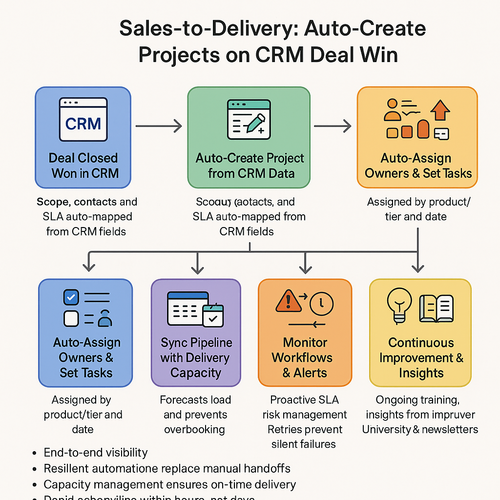
I’ve lost count of the times I watched revenue slip into limbo between “Closed Won” and kickoff. The bell rings for the sale, but a week later delivery is still digging through inboxes for scope, contacts, and files. What finally stopped the leaks was closing that seam the instant a deal flips to Won: auto-creating a standardized project from the customer relationship management (CRM) system, with clear service level agreements (SLAs), owners, and dates assigned up front. When scope is locked, tasks are visible, and timelines are real on day one, onboarding starts in hours—not days—and margins hold.
Why Automation Matters: Ending Revenue Leakage and Onboarding Delays
Revenue slips when a Won deal waits for humans. Automation locks scope, owners, and timelines the moment CRM flips, so onboarding starts the same day and margins hold. Bottom line: fewer handoffs, faster value, steadier margins.
- Stop leakage by mapping scope, contacts, and files into tasks. Work lands in the project—not in inboxes—so nothing hides or gets lost.
- Speed time-to-value (TTV) by standardizing assignments and timelines. Tasks, owners, and dates adapt to product and tier, so kickoff is measured in hours.
- See capacity before you over-commit. A live pipeline-to-delivery view prevents overbooking and missed SLAs.
- Make it durable with monitored workflows and permissions. Resilient automations replace fragile “zaps,” and leaders escape status-chasing.
Building a Seamless Sales-to-Delivery Handoff with CRM and Project Tools
When a deal closes, the clock starts on value and margin. A seamless CRM-to-project handoff prevents leaks and firefights by turning commitments into clear, trackable work.
- Auto-create the right project on “Won.” Use permission-aware templates and map scope, contacts, and SLAs directly from CRM fields.
- Auto-assign owners and dates by product/tier. Spin up kickoff tasks immediately, set client update cadence, and add timeboxes that protect delivery.
- Build resilient integrations, not brittle glue. Favor idempotent application programming interfaces (APIs), retries, alerting, and least-privilege access so automations don’t fail silently.
- Sync pipeline to capacity. Forecast load, throttle intake, and protect promises with a shared view of upcoming work and available teams.
Real-World Patterns: Automating Project Creation and SLA Management
Top teams turn “Won” into a live, standardized project in seconds. Ownership is instant; onboarding accelerates; and leaders get predictability without micromanagement.
- Standardize from the CRM as your source of truth. Projects spin up with task, role, date, and SLA templates driven by clean CRM data.
- Track SLAs with proactive risk alerts and escalations. Prevent late surprises by surfacing risks before deadlines slip.
- Capture scope, approvals, and client configs once. Mapped fields and least‑privilege access keep data clean and secure across systems.
- Monitor integrations end to end. Pipeline becomes capacity forecasts; start dates auto-adjust; and no more silent failures.
Next Steps: Gaining Confidence with Impruver University and Ongoing Insights
If you want the patterns without the pressure, skim practical ideas in the Lyaxis operator newsletter here: https://lyaxis.com/category/newsletter/. When you’re ready to go deeper, explore bite-sized, actionable lessons in Impruver University (15% off with code 15off): https://university.impruver.com/?aff=lyaxis.
Takeaway: faster time-to-value (TTV), fewer escalations, predictable margins—and more sleep.